Journal: Acta Crystallogr D Struct Biol / Year: 2026 Title: A cryo-EM processing pipeline for microtubules using CryoSPARC. Authors: Daniel Zhang / Hugo Muñoz-Hernández / Pavel Filipcik / Kushal Sejwal / Yixin Xu / Sung Ryul Choi / Michel O Steinmetz / Michal Wieczorek / Abstract: Microtubules are cytoskeletal filaments that are typically characterized by a discontinuous helical lattice of α/β-tubulin heterodimers. Microtubules can also adopt variable lattice architectures ...Microtubules are cytoskeletal filaments that are typically characterized by a discontinuous helical lattice of α/β-tubulin heterodimers. Microtubules can also adopt variable lattice architectures both in vitro and in cellular contexts. Pseudo-helical averaging processing strategies have been developed to generate cryo-EM reconstructions of microtubules with and without decorating protein-binding partners, but these pipelines can be difficult to implement for the average user, especially for undecorated filaments. Here, we describe MiCSPARC, a cryo-EM processing pipeline developed around CryoSPARC [Punjani et al. (2017), Nat. Methods, 14, 290-296], which leverages automated particle picking and fast 3D refinement times in CryoSPARC to determine the structures of both decorated and undecorated microtubules. We generate reconstructions of undecorated GDP microtubules, as well as kinesin-1 motor domain-decorated GMPCPP filaments, at resolutions of up to 2.8 Å, demonstrating the robustness of the pipeline. Based on its convenient implementation and its ability to routinely generate high-resolution, seam-corrected microtubule reconstructions, MiCSPARC should provide a valuable tool for understanding microtubule dynamics, microtubule-associated proteins and microtubule-targeting agents.
Details: MiCSPARC - our new pipeline presented with this deposition
CTF correction
Type: NONE
Startup model
Type of model: INSILICO MODEL In silico model: MiCSPARC - our new pipeline presented with this deposition Details: MiCSPARC - our new pipeline presented with this deposition
Final reconstruction
Applied symmetry - Point group: C1 (asymmetric) / Resolution.type: BY AUTHOR / Resolution: 2.77 Å / Resolution method: FSC 0.143 CUT-OFF / Software - Name: cryoSPARC / Number images used: 117345
Initial angle assignment
Type: MAXIMUM LIKELIHOOD
Final angle assignment
Type: MAXIMUM LIKELIHOOD / Software - Name: cryoSPARC
Final 3D classification
Number classes: 2
FSC plot (resolution estimation)
-
Atomic model buiding 1
Initial model
Chain - Source name: AlphaFold / Chain - Initial model type: in silico model
Refinement
Space: REAL / Protocol: AB INITIO MODEL
Output model
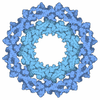
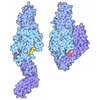
PDB-9t17: Cryo-EM reconstruction of the Kinesin KIF5A motor domain decorated GMPCPP microtubule
+
About Yorodumi
-
News
-
Feb 9, 2022. New format data for meta-information of EMDB entries
New format data for meta-information of EMDB entries
Version 3 of the EMDB header file is now the official format.
The previous official version 1.9 will be removed from the archive.
In the structure databanks used in Yorodumi, some data are registered as the other names, "COVID-19 virus" and "2019-nCoV". Here are the details of the virus and the list of structure data.
Jan 31, 2019. EMDB accession codes are about to change! (news from PDBe EMDB page)
EMDB accession codes are about to change! (news from PDBe EMDB page)
The allocation of 4 digits for EMDB accession codes will soon come to an end. Whilst these codes will remain in use, new EMDB accession codes will include an additional digit and will expand incrementally as the available range of codes is exhausted. The current 4-digit format prefixed with “EMD-” (i.e. EMD-XXXX) will advance to a 5-digit format (i.e. EMD-XXXXX), and so on. It is currently estimated that the 4-digit codes will be depleted around Spring 2019, at which point the 5-digit format will come into force.
The EM Navigator/Yorodumi systems omit the EMD- prefix.
Related info.:Q: What is EMD? / ID/Accession-code notation in Yorodumi/EM Navigator
Yorodumi is a browser for structure data from EMDB, PDB, SASBDB, etc.
This page is also the successor to EM Navigator detail page, and also detail information page/front-end page for Omokage search.
The word "yorodu" (or yorozu) is an old Japanese word meaning "ten thousand". "mi" (miru) is to see.
Related info.:EMDB / PDB / SASBDB / Comparison of 3 databanks / Yorodumi Search / Aug 31, 2016. New EM Navigator & Yorodumi / Yorodumi Papers / Jmol/JSmol / Function and homology information / Changes in new EM Navigator and Yorodumi
 Movie
Movie Controller

 Yorodumi
 Open data
 Basic information
 Map data
 Sample
 Keywords
 Function and homology information
 Bos taurus (domestic cattle) /
  Homo sapiens (human)
 Authors
 Switzerland, 3 items
  Citation
 Structure visualization
 Downloads & links
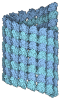
 emd_55425.png
 https://data.pdbj.org/pub/emdb/structures/EMD-55425




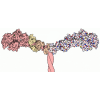
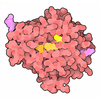
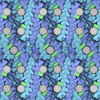
 Z (Sec.)
 Y (Row.)
 X (Col.)


 Sample components
 Escherichia coli (E. coli)
 Processing
 Electron microscopy
 FIELD EMISSION GUN

