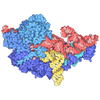
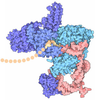
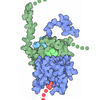
Journal: Science / Year: 2026 Title: Cryo-electron microscopy structure of the budding yeast telomerase holoenzyme. Authors: Hongmiao Hu / Hannah Neumann / Gabriela M Teplitz / Elsa Franco-Echevarría / Pascal Chartrand / Raymund J Wellinger / Thi Hoang Duong Nguyen / Abstract: Telomerase is a reverse transcriptase that synthesizes telomeric repeats at chromosome ends, safeguarding genome integrity. We present the cryo-electron microscopy structure of the budding yeast ...Telomerase is a reverse transcriptase that synthesizes telomeric repeats at chromosome ends, safeguarding genome integrity. We present the cryo-electron microscopy structure of the budding yeast telomerase, which exhibits substantial divergence from its ciliate and vertebrate counterparts. The structure reveals a stable core formed by telomerase RNA TLC1; the three ever shorter telomere (Est) proteins, Est1, Est2 and Est3; and the Pop1/Pop6/Pop7 complex (Pop1/6/7). TLC1, Est3, and Pop1/6/7 serve critical roles in complex assembly. We identified a zinc finger (ZnF) motif in the telomerase reverse transcriptase (TERT) subunit Est2 that is crucial for telomerase function. Structure prediction suggests the presence of ZnFs in TERT from diverse species. These findings offer insights into the functional organization of yeast telomerase and underscore the evolutionary diversity of telomerase holoenzymes.
Details: 150 mM NaCl, 20 mM HEPES NaOH pH 8.0, 2 mM MgCl2, 1% glycerol, 0.05% IGEPAL CA-630, 1 mM DTT, 0.2 mM PMSF
Grid
Model: UltrAuFoil R1.2/1.3 / Support film - Material: CARBON / Support film - topology: HOLEY
Vitrification
Cryogen name: ETHANE / Chamber humidity: 100 % / Chamber temperature: 277.15 K / Instrument: FEI VITROBOT MARK IV / Details: Blot Force: 10 Blot Time: 7.0 s Wait Time: 5 min.
-
Electron microscopy
Microscope
TFS KRIOS
Temperature
Min: 78.0 K
Specialist optics
Energy filter - Name: TFS Selectris X / Energy filter - Slit width: 20 eV
Image recording
Film or detector model: FEI FALCON IV (4k x 4k) / Number grids imaged: 1 / Number real images: 24936 / Average exposure time: 4.4 sec. / Average electron dose: 50.0 e/Å2
Electron beam
Acceleration voltage: 300 kV / Electron source: FIELD EMISSION GUN
In the structure databanks used in Yorodumi, some data are registered as the other names, "COVID-19 virus" and "2019-nCoV". Here are the details of the virus and the list of structure data.
Jan 31, 2019. EMDB accession codes are about to change! (news from PDBe EMDB page)
EMDB accession codes are about to change! (news from PDBe EMDB page)
The allocation of 4 digits for EMDB accession codes will soon come to an end. Whilst these codes will remain in use, new EMDB accession codes will include an additional digit and will expand incrementally as the available range of codes is exhausted. The current 4-digit format prefixed with “EMD-” (i.e. EMD-XXXX) will advance to a 5-digit format (i.e. EMD-XXXXX), and so on. It is currently estimated that the 4-digit codes will be depleted around Spring 2019, at which point the 5-digit format will come into force.
The EM Navigator/Yorodumi systems omit the EMD- prefix.
Related info.:Q: What is EMD? / ID/Accession-code notation in Yorodumi/EM Navigator
Yorodumi is a browser for structure data from EMDB, PDB, SASBDB, etc.
This page is also the successor to EM Navigator detail page, and also detail information page/front-end page for Omokage search.
The word "yorodu" (or yorozu) is an old Japanese word meaning "ten thousand". "mi" (miru) is to see.
Related info.:EMDB / PDB / SASBDB / Comparison of 3 databanks / Yorodumi Search / Aug 31, 2016. New EM Navigator & Yorodumi / Yorodumi Papers / Jmol/JSmol / Function and homology information / Changes in new EM Navigator and Yorodumi
 Movie
Movie Controller


 Open data
 Basic information
 Map data
 Sample
 Keywords
 Function and homology information
 Homo sapiens (human) /
 Saccharomyces cerevisiae (brewer's yeast)
 Authors
 United Kingdom, European Union, 2 items
  Citation
 Structure visualization
 Downloads & links
 emd_55321.png
 https://data.pdbj.org/pub/emdb/structures/EMD-55321



 Z (Sec.)
 Y (Row.)
 X (Col.)


 Sample components
 Processing
 Electron microscopy
 FIELD EMISSION GUN

