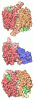
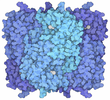
- EMDB-54909: Head to Head tau filament with the Alzheimer's fold -
+
Open data
ID or keywords:
Loading...
-
Basic information
Entry
Database: EMDB / ID: EMD-54909
Title
Head to Head tau filament with the Alzheimer's fold
Map data
Sharpened map
Sample
Complex: Tau filament
Protein or peptide: Isoform Tau-D of Microtubule-associated protein tau
Keywords
TAU / HELICAL / FILAMENT / FIBRIL / AMYLOID / ALZHEIMER'S DISEASE / PAIRED HELICAL FILAMENT / PROTEIN FIBRIL
Function / homology
Function and homology information
plus-end-directed organelle transport along microtubule / histone-dependent DNA binding / negative regulation of protein localization to mitochondrion / neurofibrillary tangle / microtubule lateral binding / axonal transport / tubulin complex / positive regulation of protein localization to synapse / phosphatidylinositol bisphosphate binding / generation of neurons ...plus-end-directed organelle transport along microtubule / histone-dependent DNA binding / negative regulation of protein localization to mitochondrion / neurofibrillary tangle / microtubule lateral binding / axonal transport / tubulin complex / positive regulation of protein localization to synapse / phosphatidylinositol bisphosphate binding / generation of neurons / axon development / axonal transport of mitochondrion / rRNA metabolic process / central nervous system neuron development / regulation of microtubule-based movement / regulation of mitochondrial fission / regulation of chromosome organization / intracellular distribution of mitochondria / minor groove of adenine-thymine-rich DNA binding / lipoprotein particle binding / microtubule polymerization / negative regulation of mitochondrial membrane potential / regulation of microtubule polymerization / dynactin binding / apolipoprotein binding / regulation of calcium-mediated signaling / main axon / Caspase-mediated cleavage of cytoskeletal proteins / glial cell projection / regulation of microtubule polymerization or depolymerization / negative regulation of mitochondrial fission / axolemma / positive regulation of axon extension / neurofibrillary tangle assembly / protein polymerization / positive regulation of microtubule polymerization / regulation of cellular response to heat / positive regulation of protein localization / Activation of AMPK downstream of NMDARs / positive regulation of superoxide anion generation / cytoplasmic microtubule organization / cellular response to brain-derived neurotrophic factor stimulus / regulation of long-term synaptic depression / axon cytoplasm / supramolecular fiber organization / synapse assembly / somatodendritic compartment / astrocyte activation / nuclear periphery / phosphatidylinositol binding / protein phosphatase 2A binding / stress granule assembly / enzyme inhibitor activity / cellular response to reactive oxygen species / regulation of microtubule cytoskeleton organization / memory / microglial cell activation / cellular response to nerve growth factor stimulus / regulation of synaptic plasticity / Hsp90 protein binding / SH3 domain binding / synapse organization / regulation of autophagy / protein homooligomerization / microtubule cytoskeleton organization / PKR-mediated signaling / response to lead ion / neuron projection development / cytoplasmic ribonucleoprotein granule / microtubule cytoskeleton / cell-cell signaling / cellular response to heat / single-stranded DNA binding / growth cone / protein-folding chaperone binding / actin binding / cell body / double-stranded DNA binding / sequence-specific DNA binding / microtubule binding / amyloid fibril formation / dendritic spine / microtubule / learning or memory / protein-macromolecule adaptor activity / neuron projection / membrane raft / negative regulation of gene expression / axon / neuronal cell body / DNA damage response / dendrite / protein kinase binding / enzyme binding / mitochondrion / DNA binding / RNA binding / extracellular region / identical protein binding / nucleus Similarity search - Function
Microtubule-associated protein Tau / Microtubule associated protein, tubulin-binding repeat / Tau and MAP protein, tubulin-binding repeat / Tau and MAP proteins tubulin-binding repeat signature. / Tau and MAP proteins tubulin-binding repeat profile. / : Similarity search - Domain/homology
Journal: J Biol Chem / Year: 2025 Title: Seeding biosensor cell line that reproduces the Alzheimer tau fold. Authors: Taxiarchis Katsinelos / Sofia Lövestam / Chao Qi / Benjamin Ryskeldi-Falcon / Jennifer A Macdonald / Gabriel Stephenson / Bernardino Ghetti / Ann McKee / Sjors H W Scheres / Michel Goedert / Abstract: The assembly of tau protein into amyloid filaments through templated seeding is believed to underlie the propagation of pathology in neurodegenerative diseases, such as Alzheimer's disease (AD) and ...The assembly of tau protein into amyloid filaments through templated seeding is believed to underlie the propagation of pathology in neurodegenerative diseases, such as Alzheimer's disease (AD) and other tauopathies. A commonly used model system for studying this process is through the induction of tau filament formation in cultured cells following the addition of tau seeds isolated from the human brain. However, little is known about the structures of seeded filaments; some biosensor cell lines are unable to reproduce the tau filament structures from AD, because they overexpress tau fragments that do not cover the whole of the ordered filament core. Here, we describe a novel tau seeding biosensor model in human embryonic kidney 293T cells that overexpress residues K297-E391 of human 4R tau. The construct contains an N-terminal hemagglutinin tag, which allows the specific detection of the amplified template. The biosensor cells detected filaments seeded by material from sporadic three-repeat (3R) + four-repeat (4R) tauopathies, with little activity by seeds from 3R-only or 4R-only tauopathies. The sensitivity of seed detection from 3R + 4R tauopathies in our system was similar to or higher than for previously reported biosensors. We also structurally characterized the AD-seeded tau filaments by cryo-EM. Most of the cell-derived filaments consisted of two protofilaments with the Alzheimer's fold but with a "head-to-head" interprotofilament packing. Our results establish a sensitive biosensor cell line with specificity toward seeds from 3R + 4R tauopathies.
FOURIER-SPACE REFINEMENT OF THE COMPLETE ATOMIC MODEL AGAINST THE NARROW PICK FILAMENT MAP WAS PERFORMED IN REFMAC. A STACK OF THREE CONSECUTIVE MONOMERS WAS REFINED TO PRESERVE NEAREST-NEIGHBOUR INTERACTIONS FOR THE MIDDLE CHAIN.
Refinement
Space: RECIPROCAL / Protocol: AB INITIO MODEL / Overall B value: 72.8 / Target criteria: FOURIER SHELL CORRELATION
Output model
PDB-9shs: Head to Head tau filament with the Alzheimer's fold
+
About Yorodumi
-
News
-
Feb 9, 2022. New format data for meta-information of EMDB entries
New format data for meta-information of EMDB entries
Version 3 of the EMDB header file is now the official format.
The previous official version 1.9 will be removed from the archive.
In the structure databanks used in Yorodumi, some data are registered as the other names, "COVID-19 virus" and "2019-nCoV". Here are the details of the virus and the list of structure data.
Jan 31, 2019. EMDB accession codes are about to change! (news from PDBe EMDB page)
EMDB accession codes are about to change! (news from PDBe EMDB page)
The allocation of 4 digits for EMDB accession codes will soon come to an end. Whilst these codes will remain in use, new EMDB accession codes will include an additional digit and will expand incrementally as the available range of codes is exhausted. The current 4-digit format prefixed with “EMD-” (i.e. EMD-XXXX) will advance to a 5-digit format (i.e. EMD-XXXXX), and so on. It is currently estimated that the 4-digit codes will be depleted around Spring 2019, at which point the 5-digit format will come into force.
The EM Navigator/Yorodumi systems omit the EMD- prefix.
Related info.:Q: What is EMD? / ID/Accession-code notation in Yorodumi/EM Navigator
Yorodumi is a browser for structure data from EMDB, PDB, SASBDB, etc.
This page is also the successor to EM Navigator detail page, and also detail information page/front-end page for Omokage search.
The word "yorodu" (or yorozu) is an old Japanese word meaning "ten thousand". "mi" (miru) is to see.
Related info.:EMDB / PDB / SASBDB / Comparison of 3 databanks / Yorodumi Search / Aug 31, 2016. New EM Navigator & Yorodumi / Yorodumi Papers / Jmol/JSmol / Function and homology information / Changes in new EM Navigator and Yorodumi
 Movie
Movie Controller


 Open data
 Basic information
 Map data
 Sample
 Keywords
 Function and homology information
 Homo sapiens (human)
 Authors
 United Kingdom, 1 items
  Citation
 Structure visualization
 Downloads & links
 emd_54909.png
 http://ftp.pdbj.org/pub/emdb/structures/EMD-54909

 Z (Sec.)
 Y (Row.)
 X (Col.)


 Sample components
 Processing
 Electron microscopy
 FIELD EMISSION GUN

