Swiss State Secretariat for Education, Research and Innovation
M822.00045
Switzerland
Citation
Journal: Nat Methods / Year: 2026 Title: MemBrain v2: an end-to-end tool for the analysis of membranes in cryo-electron tomography. Authors: Lorenz Lamm / Simon Zufferey / Hanyi Zhang / Ricardo D Righetto / Florent Waltz / Wojciech Wietrzynski / Kevin A Yamauchi / Alister Burt / Ye Liu / Antonio Martinez-Sanchez / Sebastian ...Authors: Lorenz Lamm / Simon Zufferey / Hanyi Zhang / Ricardo D Righetto / Florent Waltz / Wojciech Wietrzynski / Kevin A Yamauchi / Alister Burt / Ye Liu / Antonio Martinez-Sanchez / Sebastian Ziegler / Fabian Isensee / Julia A Schnabel / Benjamin D Engel / Tingying Peng / Abstract: Cryo-electron tomography provides unique insights into macromolecular complexes in their native environments, yet membrane analysis remains a major bottleneck due to low signal-to-noise ratios, ...Cryo-electron tomography provides unique insights into macromolecular complexes in their native environments, yet membrane analysis remains a major bottleneck due to low signal-to-noise ratios, missing wedge artifacts and the complexity of membrane-associated particles. Existing tools often require extensive manual annotation, struggle with generalization across datasets and lack integrated solutions for segmentation, particle localization and quantitative analysis. We introduce MemBrain v2, a deep-learning-enabled framework that unifies these tasks into a streamlined pipeline. MemBrain-seg leverages a diverse, collaboratively generated training dataset and specialized model training strategies to achieve generalizable membrane segmentation across variable tomographic conditions. MemBrain-pick enables data-efficient localization of membrane-bound particles by integrating geometric constraints with deep learning, reducing the need for extensive manual annotation. MemBrain-stats provides quantitative insights into particle distributions, computing spatial metrics to analyze intramembrane particle organization. MemBrain v2 integrates seamlessly into cryo-electron tomography workflows, providing an accessible and structured approach to membrane analysis.
Applied symmetry - Point group: C1 (asymmetric) / Algorithm: BACK PROJECTION / Resolution.type: BY AUTHOR / Resolution: 22.7 Å / Resolution method: FSC 0.143 CUT-OFF / Software - Name: STOPGAP (ver. 0.7.1) / Number subtomograms used: 4515
Extraction
Number tomograms: 92 / Number images used: 4515 / Software - Name: STOPGAP (ver. 0.7.4) Software - details: As detailed above, the particles were first selected using the MemBrain-pick package, and subsequently extracted using STOPGAP. Details: Particles were picked using MemBrain-pick and extracted using STOPGAP.
CTF correction
Software:
Name
details
TOMOMAN
CTF estimation using TILTCTF module
IMOD
Details: Tilt series CTF estimation was done using the TILTCTF program from TOMOMAN v0.9. CTF-corrected tomograms were calculated using IMOD. Type: PHASE FLIPPING ONLY
Final angle assignment
Type: OTHER / Software - Name: STOPGAP (ver. 0.7.1)
FSC plot (resolution estimation)
+
About Yorodumi
-
News
-
Feb 9, 2022. New format data for meta-information of EMDB entries
New format data for meta-information of EMDB entries
Version 3 of the EMDB header file is now the official format.
The previous official version 1.9 will be removed from the archive.
In the structure databanks used in Yorodumi, some data are registered as the other names, "COVID-19 virus" and "2019-nCoV". Here are the details of the virus and the list of structure data.
Jan 31, 2019. EMDB accession codes are about to change! (news from PDBe EMDB page)
EMDB accession codes are about to change! (news from PDBe EMDB page)
The allocation of 4 digits for EMDB accession codes will soon come to an end. Whilst these codes will remain in use, new EMDB accession codes will include an additional digit and will expand incrementally as the available range of codes is exhausted. The current 4-digit format prefixed with “EMD-” (i.e. EMD-XXXX) will advance to a 5-digit format (i.e. EMD-XXXXX), and so on. It is currently estimated that the 4-digit codes will be depleted around Spring 2019, at which point the 5-digit format will come into force.
The EM Navigator/Yorodumi systems omit the EMD- prefix.
Related info.:Q: What is EMD? / ID/Accession-code notation in Yorodumi/EM Navigator
Yorodumi is a browser for structure data from EMDB, PDB, SASBDB, etc.
This page is also the successor to EM Navigator detail page, and also detail information page/front-end page for Omokage search.
The word "yorodu" (or yorozu) is an old Japanese word meaning "ten thousand". "mi" (miru) is to see.
Related info.:EMDB / PDB / SASBDB / Comparison of 3 databanks / Yorodumi Search / Aug 31, 2016. New EM Navigator & Yorodumi / Yorodumi Papers / Jmol/JSmol / Function and homology information / Changes in new EM Navigator and Yorodumi
 Movie
Movie Controller


 Open data
 Basic information
 Map data
 Sample
 Keywords
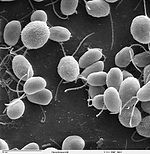 Chlamydomonas reinhardtii (plant)
 Authors
 Switzerland, 1 items
  Citation


 Structure visualization
 Downloads & links
 EMDB map data format
 emd_54837.png
 https://data.pdbj.org/pub/emdb/structures/EMD-54837
 Z (Sec.)
 Y (Row.)
 X (Col.)


 Sample components
 Processing
 Electron microscopy
 FIELD EMISSION GUN

