Journal: EMBO J / Year: 2026 Title: SPACA9 and MNMIP1 bridge the seam of spermatid manchette microtubules. Authors: Jo H Judernatz / Svetlana Doroshev / Robin A Hoogebeen / Sven Jonkers / Donna Schweizer / Molly S C Gravett / Elizabeth G Bromfield / Stuart C Howes / Anna Akhmanova / Rui Zhang / Tzviya Zeev-Ben-Mordehai / Abstract: The manchette is a transient microtubule (MT)-based structure that is vital for the correct shaping of sperm during spermiogenesis. Throughout spermiogenesis, the manchette retains structural ...The manchette is a transient microtubule (MT)-based structure that is vital for the correct shaping of sperm during spermiogenesis. Throughout spermiogenesis, the manchette retains structural integrity for several days, raising the question of how its MTs are regulated. Here, using cryo-electron tomography of manchettes isolated from rat testes, we find that manchette MT ends are structurally diverse. We show that the MT-binding protein CLASP2 is present throughout the manchette and likely regulates both MT ends. Using cryo-electron microscopy single particle analysis and super-resolution microscopy, we reveal that SPACA9 and MNMIP1 (SH3D21) bind to the seam of manchette MTs from the luminal side. SPACA9 binds to both α- and β-tubulin of protofilament 1 but does not interact directly with protofilament 13, while MNMIP1 binds directly to protofilament 13. MNMIP1 further extends and threads through the MT lattice at the seam. Our study reveals a novel seam MT inner protein complex with a unique binding mode, providing a plausible explanation for MT regulation that maintains manchette integrity over an extended period.
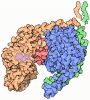
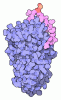
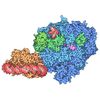
Entire : Complex of SPACA9 and MNMIP1 bound to the seam of microtubules
Entire
Name: Complex of SPACA9 and MNMIP1 bound to the seam of microtubules
Components
Organelle or cellular component: Complex of SPACA9 and MNMIP1 bound to the seam of microtubules
Protein or peptide: Tubulin beta-4B chain
Protein or peptide: Tubulin alpha-1A chain
Protein or peptide: Sperm acrosome-associated protein 9
Protein or peptide: SH3 domain containing 21
Ligand: GUANOSINE-5'-DIPHOSPHATE
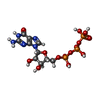
Ligand: GUANOSINE-5'-TRIPHOSPHATE
Ligand: MAGNESIUM ION
-
Supramolecule #1: Complex of SPACA9 and MNMIP1 bound to the seam of microtubules
Supramolecule
Name: Complex of SPACA9 and MNMIP1 bound to the seam of microtubules type: organelle_or_cellular_component / ID: 1 / Parent: 0 / Macromolecule list: #1-#4
Source (natural)
Organism: Rattus norvegicus (Norway rat)
-
Macromolecule #1: Tubulin beta-4B chain
Macromolecule
Name: Tubulin beta-4B chain / type: protein_or_peptide / ID: 1 / Number of copies: 2 / Enantiomer: LEVO
Name: Tubulin alpha-1A chain / type: protein_or_peptide / ID: 2 / Number of copies: 2 / Enantiomer: LEVO EC number: Hydrolases; Acting on acid anhydrides; Acting on GTP to facilitate cellular and subcellular movement
In the structure databanks used in Yorodumi, some data are registered as the other names, "COVID-19 virus" and "2019-nCoV". Here are the details of the virus and the list of structure data.
Jan 31, 2019. EMDB accession codes are about to change! (news from PDBe EMDB page)
EMDB accession codes are about to change! (news from PDBe EMDB page)
The allocation of 4 digits for EMDB accession codes will soon come to an end. Whilst these codes will remain in use, new EMDB accession codes will include an additional digit and will expand incrementally as the available range of codes is exhausted. The current 4-digit format prefixed with “EMD-” (i.e. EMD-XXXX) will advance to a 5-digit format (i.e. EMD-XXXXX), and so on. It is currently estimated that the 4-digit codes will be depleted around Spring 2019, at which point the 5-digit format will come into force.
The EM Navigator/Yorodumi systems omit the EMD- prefix.
Related info.:Q: What is EMD? / ID/Accession-code notation in Yorodumi/EM Navigator
Yorodumi is a browser for structure data from EMDB, PDB, SASBDB, etc.
This page is also the successor to EM Navigator detail page, and also detail information page/front-end page for Omokage search.
The word "yorodu" (or yorozu) is an old Japanese word meaning "ten thousand". "mi" (miru) is to see.
Related info.:EMDB / PDB / SASBDB / Comparison of 3 databanks / Yorodumi Search / Aug 31, 2016. New EM Navigator & Yorodumi / Yorodumi Papers / Jmol/JSmol / Function and homology information / Changes in new EM Navigator and Yorodumi
 Movie
Movie Controller


 Open data
 Basic information
 Map data
 Sample
 Keywords
 Function and homology information
 Rattus norvegicus (Norway rat)
 Authors
 Citation


 Structure visualization
 Downloads & links
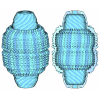
 emd_54641.png
 https://data.pdbj.org/pub/emdb/structures/EMD-54641

 Z (Sec.)
 Y (Row.)
 X (Col.)


 Sample components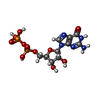
 Processing
 Electron microscopy
 FIELD EMISSION GUN
