 Movie
Movie Controller

[English] 日本語
 Yorodumi
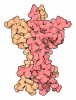
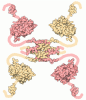
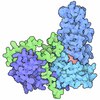
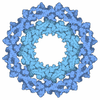
- EMDB-53558: pro-TGF-beta1 in complex with the third TB Domain from Latent Tra... -
+ Open data

- Basic information
| Entry |  | |||||||||
|---|---|---|---|---|---|---|---|---|---|---|
| Title | pro-TGF-beta1 in complex with the third TB Domain from Latent Transforming Growth Factor-beta Binding Protein-1 | |||||||||
 Map data Map data | ||||||||||
 Sample Sample |
| |||||||||
 Keywords Keywords | Latent transforming growth factor TGF-beta1 / LTBP1 / mechanobiology / extracellular matrix protein / disulphide / CYTOKINE / SIGNALING PROTEIN | |||||||||
| Function / homology |  Function and homology information Function and homology informationestablishment of protein localization to extracellular region / protein localization to extracellular region / elastic fiber / frontal suture morphogenesis / Influenza Virus Induced Apoptosis / adaptive immune response based on somatic recombination of immune receptors built from immunoglobulin superfamily domains / positive regulation of microglia differentiation / regulation of interleukin-23 production / positive regulation of primary miRNA processing / morphogenesis of a branching structure ...establishment of protein localization to extracellular region / protein localization to extracellular region / elastic fiber / frontal suture morphogenesis / Influenza Virus Induced Apoptosis / adaptive immune response based on somatic recombination of immune receptors built from immunoglobulin superfamily domains / positive regulation of microglia differentiation / regulation of interleukin-23 production / positive regulation of primary miRNA processing / morphogenesis of a branching structure / negative regulation of skeletal muscle tissue development / embryonic liver development / negative regulation of MyD88-dependent toll-like receptor signaling pathway / regulation of striated muscle tissue development / response to laminar fluid shear stress / heart valve morphogenesis / macrophage derived foam cell differentiation / TGFBR2 MSI Frameshift Mutants in Cancer / regulation of protein import into nucleus / regulation of blood vessel remodeling / transforming growth factor beta complex / negative regulation of macrophage cytokine production / cellular response to acetaldehyde / connective tissue replacement involved in inflammatory response wound healing / negative regulation of natural killer cell mediated cytotoxicity directed against tumor cell target / negative regulation of hyaluronan biosynthetic process / extracellular matrix assembly / non-collagenous component of basement membrane / microfibril binding / type III transforming growth factor beta receptor binding / microfibril / myofibroblast differentiation / transforming growth factor beta receptor activity / TGFBR2 Kinase Domain Mutants in Cancer / odontoblast differentiation / positive regulation of exit from mitosis / salivary gland morphogenesis / positive regulation of isotype switching to IgA isotypes / negative regulation of neuroblast proliferation / transforming growth factor beta production / SMAD2/3 Phosphorylation Motif Mutants in Cancer / TGFBR1 KD Mutants in Cancer / positive regulation of mesenchymal stem cell proliferation / positive regulation of receptor signaling pathway via STAT / membrane protein intracellular domain proteolysis / positive regulation of extracellular matrix assembly / negative regulation of myoblast differentiation / TGFBR3 regulates TGF-beta signaling / neural tube development / positive regulation of vasculature development / hyaluronan catabolic process / ATP biosynthetic process / cell-cell junction organization / type II transforming growth factor beta receptor binding / negative regulation of extracellular matrix disassembly / positive regulation of branching involved in ureteric bud morphogenesis / receptor catabolic process / response to salt / positive regulation of cardiac muscle cell differentiation / TGFBR1 LBD Mutants in Cancer / regulatory T cell differentiation / positive regulation of chemotaxis / negative regulation of cell-cell adhesion mediated by cadherin / type I transforming growth factor beta receptor binding / negative regulation of biomineral tissue development / ureteric bud development / positive regulation of vascular permeability / receptor ligand inhibitor activity / oligodendrocyte development / positive regulation of mononuclear cell migration / response to vitamin D / odontogenesis of dentin-containing tooth / negative regulation of interleukin-17 production / face morphogenesis / digestive tract development / response to cholesterol / sprouting angiogenesis / transforming growth factor beta binding / phosphate-containing compound metabolic process / chondrocyte differentiation / positive regulation of chemokine (C-X-C motif) ligand 2 production / lymph node development / positive regulation of fibroblast migration / aortic valve morphogenesis / RUNX3 regulates CDKN1A transcription / positive regulation of interleukin-17 production / positive regulation of regulatory T cell differentiation / negative regulation of fat cell differentiation / negative regulation of release of sequestered calcium ion into cytosol / Molecules associated with elastic fibres / cellular response to dexamethasone stimulus / neural tube closure / cellular response to insulin-like growth factor stimulus / Syndecan interactions / negative regulation of cell cycle / inner ear development / ventricular cardiac muscle tissue morphogenesis / negative regulation of phagocytosis / response to immobilization stress / positive regulation of epidermal growth factor receptor signaling pathway Similarity search - Function | |||||||||
| Biological species |  Homo sapiens (human) Homo sapiens (human) | |||||||||
| Method | single particle reconstruction / cryo EM / Resolution: 3.06 Å | |||||||||
 Authors Authors | Biggin G / Snee M / Godwin A / Roseman A / Baldock C | |||||||||
| Funding support |  United Kingdom, 1 items United Kingdom, 1 items
| |||||||||
 Citation Citation | Journal: Nat Commun / Year: 2026 Title: Structural basis for the contribution of latent TGFβ binding protein to TGFβ latency and activation. Authors: George R Biggin / Matthew Snee / Yu-Bai Xiao / Catherine Smedley / Alan R F Godwin / Rana Dajani / Holly L Birchenough / Thomas A Jowitt / Mark A Travis / Alan M Roseman / Anna Tarakanova / Clair Baldock /  Abstract: Transforming growth factor-β (TGFβ) is a potent cytokine that controls all aspects of cellular behavior. TGFβ is secreted in complex with its prodomain and latent TGFβ-binding protein-1 (LTBP1), ...Transforming growth factor-β (TGFβ) is a potent cytokine that controls all aspects of cellular behavior. TGFβ is secreted in complex with its prodomain and latent TGFβ-binding protein-1 (LTBP1), forming the large latent complex (LLC), which through interaction with the extracellular matrix enables integrin-mediated activation. Although TGFβ structures are known, the influence of LTBP1 on the structure and activity of TGFβ is unknown. Here, we report the LLC cryo-EM structure comprising the LTBP1 eight-cysteine domain covalently bound to TGFβ, revealing a hydrophobic interface between TGFβ and LTBP1. Structure-guided mutagenesis shows that the interface is important for complex formation and TGFβ activity. Our structure supports a contralateral domain swapped architecture in the LLC, and simulations show that this architecture requires increased force to overcome barriers for integrin-mediated activation, while the covalent attachment of TGFβ to LTBP1 redistributes force to reduce unfolding barriers. These insights will be important for therapeutic strategies targeting TGFβ. | |||||||||
| History |
|
- Structure visualization
| Supplemental images |
|---|

- Downloads & links
-EMDB archive
| Map data | emd_53558.map.gz | 59.5 MB | EMDB map data format | |
|---|---|---|---|---|
| Header (meta data) | emd-53558-v30.xmlemd-53558.xml | 24.5 KB 24.5 KB | Display Display | EMDB header |
| FSC (resolution estimation) | emd_53558_fsc.xml | 8.4 KB | Display | FSC data file |
| Images |  emd_53558.png emd_53558.png | 83.7 KB | ||
| Filedesc metadata | emd-53558.cif.gz | 7.5 KB | ||
| Others | emd_53558_half_map_1.map.gzemd_53558_half_map_2.map.gz | 59.5 MB 59.5 MB | ||
| Archive directory |  https://data.pdbj.org/pub/emdb/structures/EMD-53558ftp://data.pdbj.org/pub/emdb/structures/EMD-53558 https://data.pdbj.org/pub/emdb/structures/EMD-53558ftp://data.pdbj.org/pub/emdb/structures/EMD-53558 | HTTPS FTP |
-Related structure data
| Related structure data |  9r3sMC M: atomic model generated by this map C: citing same article ( |
|---|---|
| Similar structure data |
-Links
| EMDB pages | EMDB (EBI/PDBe) / EMDataResource |
|---|---|
| Related items in Molecule of the Month |



-Map
| File | Download / File: emd_53558.map.gz / Format: CCP4 / Size: 64 MB / Type: IMAGE STORED AS FLOATING POINT NUMBER (4 BYTES) | ||||||||||||||||||||||||||||||||||||
|---|---|---|---|---|---|---|---|---|---|---|---|---|---|---|---|---|---|---|---|---|---|---|---|---|---|---|---|---|---|---|---|---|---|---|---|---|---|
| Projections & slices | Image control
Images are generated by Spider. | ||||||||||||||||||||||||||||||||||||
| Voxel size | X=Y=Z: 1.08 Å | ||||||||||||||||||||||||||||||||||||
| Density |
| ||||||||||||||||||||||||||||||||||||
| Symmetry | Space group: 1 | ||||||||||||||||||||||||||||||||||||
| Details | EMDB XML:
|
 Z (Sec.)
 Y (Row.)
 X (Col.)


-Supplemental data
-Half map: #2
| File | emd_53558_half_map_1.map | ||||||||||||
|---|---|---|---|---|---|---|---|---|---|---|---|---|---|
| Projections & Slices |
| ||||||||||||
| Density Histograms |


-Half map: #1
| File | emd_53558_half_map_2.map | ||||||||||||
|---|---|---|---|---|---|---|---|---|---|---|---|---|---|
| Projections & Slices |
| ||||||||||||
| Density Histograms |


- Sample components
-Entire : Complex of pro-Transforming growth factor beta 1 and the third TB...
| Entire | Name: Complex of pro-Transforming growth factor beta 1 and the third TB Domain from Latent Transforming Growth Factor-beta Binding Protein-1 |
|---|---|
| Components |
|
-Supramolecule #1: Complex of pro-Transforming growth factor beta 1 and the third TB...
| Supramolecule | Name: Complex of pro-Transforming growth factor beta 1 and the third TB Domain from Latent Transforming Growth Factor-beta Binding Protein-1 type: complex / ID: 1 / Parent: 0 / Macromolecule list: #1-#2 Details: This structure represents the resolvable portion of a sample containing pro-TGF-beta 1 disulphide bonded to a region of LTBP1. A fragment of fibrillin-1 was in the sample but fibrillin-1 was not resolved. |
|---|---|
| Source (natural) | Organism: Homo sapiens (human) |
-Macromolecule #1: Transforming growth factor beta-1 proprotein
| Macromolecule | Name: Transforming growth factor beta-1 proprotein / type: protein_or_peptide / ID: 1 / Number of copies: 2 / Enantiomer: LEVO |
|---|---|
| Source (natural) | Organism: Homo sapiens (human) |
| Molecular weight | Theoretical: 42.320191 KDa |
| Recombinant expression | Organism: Homo sapiens (human) |
| Sequence | String: DYKDDDDKLS TCKTIDMELV KRKRIEAIRG QILSKLRLAS PPSQGEVPPG PLPEAVLALY NSTRDRVAGE SAEPEPEPEA DYYAKEVTR VLMVETHNEI YDKFKQSTHS IYMFFNTSEL REAVPEPVLL SRAELRLLRL KLKVEQHVEL YQKYSNNSWR Y LSNRLLAP ...String: DYKDDDDKLS TCKTIDMELV KRKRIEAIRG QILSKLRLAS PPSQGEVPPG PLPEAVLALY NSTRDRVAGE SAEPEPEPEA DYYAKEVTR VLMVETHNEI YDKFKQSTHS IYMFFNTSEL REAVPEPVLL SRAELRLLRL KLKVEQHVEL YQKYSNNSWR Y LSNRLLAP SDSPEWLSFD VTGVVRQWLS RGGEIEGFRL SAHCSCDSRD NTLQVDINGF TTGRRGDLAT IHGMNRPFLL LM ATPLERA QHLQSSRHRR ALDTNYCFSS TEKNCCVRQL YIDFRKDLGW KWIHEPKGYH ANFCLGPCPY IWSLDTQYSK VLA LYNQHN PGASAAPCCV PQALEPLPIV YYVGRKPKVE QLSNMIVRSC KCS UniProtKB: Transforming growth factor beta-1 proprotein |
-Macromolecule #2: Latent-transforming growth factor beta-binding protein 1
| Macromolecule | Name: Latent-transforming growth factor beta-binding protein 1 type: protein_or_peptide / ID: 2 / Number of copies: 1 / Enantiomer: LEVO |
|---|---|
| Source (natural) | Organism: Homo sapiens (human) |
| Molecular weight | Theoretical: 47.603562 KDa |
| Recombinant expression | Organism: Homo sapiens (human) |
| Sequence | String: APLALDVDVD QPKEEKKECY YNLNDASLCD NVLAPNVTKQ ECCCTSGVGW GDNCEIFPCP VLGTAEFTEM CPKGKGFVPA GESSSEAGG ENYKDADECL LFGQEICKNG FCLNTRPGYE CYCKQGTYYD PVKLQCFDMD ECQDPSSCID GQCVNTEGSY N CFCTHPMV ...String: APLALDVDVD QPKEEKKECY YNLNDASLCD NVLAPNVTKQ ECCCTSGVGW GDNCEIFPCP VLGTAEFTEM CPKGKGFVPA GESSSEAGG ENYKDADECL LFGQEICKNG FCLNTRPGYE CYCKQGTYYD PVKLQCFDMD ECQDPSSCID GQCVNTEGSY N CFCTHPMV LDASEKRCIR PAESNEQIEE TDVYQDLCWE HLSDEYVCSR PLVGKQTTYT ECCCLYGEAW GMQCALCPLK DS DDYAQLC NIPVTGRRQP YGRDALVDFS EQYTPEADPY FIQDRFLNSF EELQAEECGI LNGCENGRCV RVQEGYTCDC FDG YHLDTA KMTCVDVNEC DELNNRMSLC KNAKCINTDG SYKCLCLPGY VPSDKPNYCT PLNTALNLEK DSDLTGGGGS GGGG SGGGG SAWSHPQFEK GGGSGGGSGG SAWSHPQFEK UniProtKB: Latent-transforming growth factor beta-binding protein 1 |
-Macromolecule #5: 2-acetamido-2-deoxy-beta-D-glucopyranose
| Macromolecule | Name: 2-acetamido-2-deoxy-beta-D-glucopyranose / type: ligand / ID: 5 / Number of copies: 1 / Formula: NAG |
|---|---|
| Molecular weight | Theoretical: 221.208 Da |
| Chemical component information | 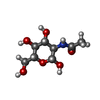 ChemComp-NAG: |
-Macromolecule #6: water
| Macromolecule | Name: water / type: ligand / ID: 6 / Number of copies: 41 / Formula: HOH |
|---|---|
| Molecular weight | Theoretical: 18.015 Da |
| Chemical component information |  ChemComp-HOH: |
-Experimental details
-Structure determination
| Method | cryo EM |
|---|---|
 Processing Processing | single particle reconstruction |
| Aggregation state | particle |
-Sample preparation
| Concentration | 1 mg/mL | |||||||||
|---|---|---|---|---|---|---|---|---|---|---|
| Buffer | pH: 7.4 Component:
Details: 20mM HEPES, 150mM NaCl, pH 7.4 | |||||||||
| Grid | Model: Quantifoil R2/2 / Material: COPPER / Pretreatment - Type: GLOW DISCHARGE / Pretreatment - Time: 30 sec. / Pretreatment - Atmosphere: AIR | |||||||||
| Vitrification | Cryogen name: ETHANE / Chamber humidity: 100 % / Chamber temperature: 277.15 K / Instrument: FEI VITROBOT MARK II / Details: Vitrification carried out in liquid ethane. | |||||||||
| Details | This sample was monodisperse |
- Electron microscopy
| Microscope | TFS KRIOS |
|---|---|
| Specialist optics | Energy filter - Name: TFS Selectris X / Energy filter - Slit width: 20 eV |
| Image recording | Film or detector model: FEI FALCON IV (4k x 4k) / Number grids imaged: 1 / Number real images: 30000 / Average exposure time: 3.22 sec. / Average electron dose: 50.0 e/Å2 |
| Electron beam | Acceleration voltage: 300 kV / Electron source:  FIELD EMISSION GUN FIELD EMISSION GUN |
| Electron optics | C2 aperture diameter: 50.0 µm / Illumination mode: FLOOD BEAM / Imaging mode: BRIGHT FIELD / Cs: 2.7 mm / Nominal defocus max: 2.0 µm / Nominal defocus min: 0.75 µm / Nominal magnification: 165000 |
| Sample stage | Specimen holder model: FEI TITAN KRIOS AUTOGRID HOLDER / Cooling holder cryogen: NITROGEN |
| Experimental equipment |  Model: Titan Krios / Image courtesy: FEI Company |

