 Movie
Movie Controller


+ Open data

- Basic information
| Entry |  | |||||||||
|---|---|---|---|---|---|---|---|---|---|---|
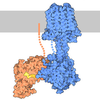
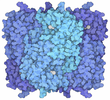
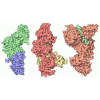
| Title | The structure of ADGRL4 in the active-state | |||||||||
 Map data Map data | ||||||||||
 Sample Sample |
| |||||||||
 Keywords Keywords | Adhesion GPCR / ADGRL4 / ELTD1 / MEMBRANE PROTEIN | |||||||||
| Function / homology |  Function and homology information Function and homology informationadenylate cyclase-activating G protein-coupled bile acid receptor signaling pathway / adenylate cyclase-activating serotonin receptor signaling pathway / intracellular transport / regulation of skeletal muscle contraction / hair follicle placode formation / developmental growth / PKA activation in glucagon signalling / renal water homeostasis / D1 dopamine receptor binding / vascular endothelial cell response to laminar fluid shear stress ...adenylate cyclase-activating G protein-coupled bile acid receptor signaling pathway / adenylate cyclase-activating serotonin receptor signaling pathway / intracellular transport / regulation of skeletal muscle contraction / hair follicle placode formation / developmental growth / PKA activation in glucagon signalling / renal water homeostasis / D1 dopamine receptor binding / vascular endothelial cell response to laminar fluid shear stress / Hedgehog 'off' state / activation of adenylate cyclase activity / adenylate cyclase-activating adrenergic receptor signaling pathway / cellular response to acidic pH / ovarian follicle development / cellular response to glucagon stimulus / intracellular glucose homeostasis / bioluminescence / adenylate cyclase activator activity / positive regulation of insulin secretion involved in cellular response to glucose stimulus / positive regulation of insulin secretion / trans-Golgi network membrane / generation of precursor metabolites and energy / negative regulation of inflammatory response to antigenic stimulus / response to prostaglandin E / bone development / platelet aggregation / cognition / G protein-coupled receptor activity / G-protein beta/gamma-subunit complex binding / Olfactory Signaling Pathway / Activation of the phototransduction cascade / sensory perception of smell / G protein-coupled acetylcholine receptor signaling pathway / G beta:gamma signalling through PLC beta / Presynaptic function of Kainate receptors / Thromboxane signalling through TP receptor / Activation of G protein gated Potassium channels / Inhibition of voltage gated Ca2+ channels via Gbeta/gamma subunits / G-protein activation / Glucagon signaling in metabolic regulation / G beta:gamma signalling through CDC42 / Prostacyclin signalling through prostacyclin receptor / Synthesis, secretion, and inactivation of Glucagon-like Peptide-1 (GLP-1) / photoreceptor disc membrane / G beta:gamma signalling through BTK / ADP signalling through P2Y purinoceptor 12 / Sensory perception of sweet, bitter, and umami (glutamate) taste / Glucagon-type ligand receptors / Adrenaline,noradrenaline inhibits insulin secretion / Vasopressin regulates renal water homeostasis via Aquaporins / G alpha (z) signalling events / Glucagon-like Peptide-1 (GLP1) regulates insulin secretion / ADP signalling through P2Y purinoceptor 1 / cellular response to catecholamine stimulus / G beta:gamma signalling through PI3Kgamma / ADORA2B mediated anti-inflammatory cytokines production / adenylate cyclase-activating dopamine receptor signaling pathway / positive regulation of cold-induced thermogenesis / cellular response to prostaglandin E stimulus / Cooperation of PDCL (PhLP1) and TRiC/CCT in G-protein beta folding / GPER1 signaling / heterotrimeric G-protein complex / G alpha (12/13) signalling events / Inactivation, recovery and regulation of the phototransduction cascade / G-protein beta-subunit binding / extracellular vesicle / Thrombin signalling through proteinase activated receptors (PARs) / adenylate cyclase-activating G protein-coupled receptor signaling pathway / signaling receptor complex adaptor activity / GTPase binding / cytoplasmic vesicle / G protein activity / Ca2+ pathway / High laminar flow shear stress activates signaling by PIEZO1 and PECAM1:CDH5:KDR in endothelial cells / G alpha (i) signalling events / G alpha (s) signalling events / G alpha (q) signalling events / Hydrolases; Acting on acid anhydrides; Acting on GTP to facilitate cellular and subcellular movement / cytoplasmic side of plasma membrane / Ras protein signal transduction / cell surface receptor signaling pathway / Extra-nuclear estrogen signaling / G protein-coupled receptor signaling pathway / lysosomal membrane / GTPase activity / calcium ion binding / GTP binding / synapse / protein-containing complex binding / signal transduction / metal ion binding / extracellular exosome / membrane / plasma membrane / cytosol / cytoplasm Similarity search - Function | |||||||||
| Biological species |  Homo sapiens (human) Homo sapiens (human) | |||||||||
| Method | single particle reconstruction / cryo EM / Resolution: 3.14 Å | |||||||||
 Authors Authors | Chen Q / Favara DM | |||||||||
| Funding support |  United Kingdom, 1 items United Kingdom, 1 items
| |||||||||
 Citation Citation | Journal: Nat Commun / Year: 2025 Title: Structure of the G-coupled adhesion receptor ADGRL4. Authors: Qingchao Chen / Anastasiia Gusach / Aurora Diamante / Jayesh C Patel / Patricia C Edwards / Christopher G Tate / David M Favara / Abstract: Adhesion G protein-coupled receptors (aGPCRs) are a 32-member family of Class B GPCRs that have diverse cellular roles including mechanosensation, cell-fate determination, neurodevelopment, immune ...Adhesion G protein-coupled receptors (aGPCRs) are a 32-member family of Class B GPCRs that have diverse cellular roles including mechanosensation, cell-fate determination, neurodevelopment, immune function and tumour biology. ADGRL4 is upregulated in the tumour microenvironment and is implicated in tumour pathogenesis across a broad range of malignancies. Inhibiting ADGRL4 is a potential therapeutic treatment for currently intractable cancers such as glioblastoma. Previous work suggested that ADGRL4 does not signal through G protein coupled pathways. However, using a sensitive bioluminescent assay, we demonstrate here that ADGRL4 couples weakly to the heterotrimeric G protein G, whilst there is no robust coupling to other G proteins (G, G, G) or β-arrestin 1 or 2. We determine the cryo-EM structure of ADGRL4 coupled to a heterotrimeric G complex to a resolution of 3.1 Å. The overall fold of ADGRL4 is similar to that of other aGPCRs, but the coupling to G is distinct with fewer interactions between the receptor and G protein. The structure is consistent with ADGRL4 being activated by its tethered agonist and represents an important step towards the development of potential inhibitors for the treatment of multiple tumour types. | |||||||||
| History |
|
- Structure visualization
| Supplemental images |
|---|

- Downloads & links
-EMDB archive
| Map data | emd_53437.map.gz | 124.7 MB | EMDB map data format | |
|---|---|---|---|---|
| Header (meta data) | emd-53437-v30.xmlemd-53437.xml | 26.2 KB 26.2 KB | Display Display | EMDB header |
| FSC (resolution estimation) | emd_53437_fsc.xml | 13.3 KB | Display | FSC data file |
| Images |  emd_53437.png emd_53437.png | 52.2 KB | ||
| Filedesc metadata | emd-53437.cif.gz | 7.2 KB | ||
| Others | emd_53437_half_map_1.map.gzemd_53437_half_map_2.map.gz | 226.8 MB 226.8 MB | ||
| Archive directory |  https://data.pdbj.org/pub/emdb/structures/EMD-53437ftp://data.pdbj.org/pub/emdb/structures/EMD-53437 https://data.pdbj.org/pub/emdb/structures/EMD-53437ftp://data.pdbj.org/pub/emdb/structures/EMD-53437 | HTTPS FTP |
-Related structure data
| Related structure data |  9qxlMC M: atomic model generated by this map C: citing same article ( |
|---|---|
| Similar structure data |
-Links
| EMDB pages | EMDB (EBI/PDBe) / EMDataResource |
|---|---|
| Related items in Molecule of the Month |

-Map
| File | Download / File: emd_53437.map.gz / Format: CCP4 / Size: 244.1 MB / Type: IMAGE STORED AS FLOATING POINT NUMBER (4 BYTES) | ||||||||||||||||||||
|---|---|---|---|---|---|---|---|---|---|---|---|---|---|---|---|---|---|---|---|---|---|
| Voxel size | X=Y=Z: 0.67 Å | ||||||||||||||||||||
| Density |
| ||||||||||||||||||||
| Symmetry | Space group: 1 | ||||||||||||||||||||
| Details | EMDB XML:
|
-Supplemental data
-Half map: #2
| File | emd_53437_half_map_1.map | ||||||||||||
|---|---|---|---|---|---|---|---|---|---|---|---|---|---|
| Projections & Slices |
| ||||||||||||
| Density Histograms |
 Z
Z Y
Y X
X


-Half map: #1
| File | emd_53437_half_map_2.map | ||||||||||||
|---|---|---|---|---|---|---|---|---|---|---|---|---|---|
| Projections & Slices |
| ||||||||||||
| Density Histograms |


- Sample components
-Entire : ADGRL4 complex
| Entire | Name: ADGRL4 complex |
|---|---|
| Components |
|
-Supramolecule #1: ADGRL4 complex
| Supramolecule | Name: ADGRL4 complex / type: complex / ID: 1 / Parent: 0 / Macromolecule list: all |
|---|---|
| Source (natural) | Organism: Homo sapiens (human) |
| Molecular weight | Theoretical: 7.9 KDa |
-Supramolecule #2: Adhesion G protein-coupled receptor L4
| Supramolecule | Name: Adhesion G protein-coupled receptor L4 / type: complex / ID: 2 / Parent: 1 / Macromolecule list: #1 |
|---|---|
| Source (natural) | Organism: Homo sapiens (human) |
-Supramolecule #3: mini-Gq
| Supramolecule | Name: mini-Gq / type: complex / ID: 3 / Parent: 1 / Macromolecule list: #2 |
|---|---|
| Source (natural) | Organism: Homo sapiens (human) |
-Supramolecule #4: Guanine nucleotide-binding protein G(I)/G(S)/G(T) subunit beta-1
| Supramolecule | Name: Guanine nucleotide-binding protein G(I)/G(S)/G(T) subunit beta-1 type: complex / ID: 4 / Parent: 1 / Macromolecule list: #3 |
|---|---|
| Source (natural) | Organism: Homo sapiens (human) |
-Supramolecule #5: G-subunit gamma-2
| Supramolecule | Name: G-subunit gamma-2 / type: complex / ID: 5 / Parent: 1 / Macromolecule list: #4 |
|---|---|
| Source (natural) | Organism: Homo sapiens (human) |
-Macromolecule #1: Green fluorescent protein,Adhesion G protein-coupled receptor L4
| Macromolecule | Name: Green fluorescent protein,Adhesion G protein-coupled receptor L4 type: protein_or_peptide / ID: 1 / Number of copies: 1 / Enantiomer: LEVO |
|---|---|
| Source (natural) | Organism: Homo sapiens (human) |
| Molecular weight | Theoretical: 70.00825 KDa |
| Recombinant expression | Organism: Homo sapiens (human) |
| Sequence | String: MKRLPLLVVF STLLNCSYTQ YPYDVPDYAG SGGSAWSHPQ FEKGGGSGGG SGGSAWSHPQ FEKGSGHHHH HHHHHHGSGL EVLFQGPGS GVSKGEELFT GVVPILVELD GDVNGHKFSV SGEGEGDATY GKLTLKFICT TGKLPVPWPT LVTTLTYGVQ C FSRYPDHM ...String: MKRLPLLVVF STLLNCSYTQ YPYDVPDYAG SGGSAWSHPQ FEKGGGSGGG SGGSAWSHPQ FEKGSGHHHH HHHHHHGSGL EVLFQGPGS GVSKGEELFT GVVPILVELD GDVNGHKFSV SGEGEGDATY GKLTLKFICT TGKLPVPWPT LVTTLTYGVQ C FSRYPDHM KQHDFFKSAM PEGYVQERTI FFKDDGNYKT RAEVKFEGDT LVNRIELKGI DFKEDGNILG HKLEYNYNSH NV YIMADKQ KNGIKVNFKI RHNIEDGSVQ LADHYQQNTP IGDGPVLLPD NHYLSTQSKL SKDPNEKRDH MVLLEFVTAA GIT LGMDEL YKGSGENLYF QSGSGGSGTH FAILMSSGPS IGIKDYNILT RITQLGIIIS LICLAICIFT FWFFSEIQST RTTI HKNLC CSLFLAELVF LVGINTNTNK LFCSIIAGLL HYFFLAAFAW MCIEGIHLYL IVVGVIYNKG FLHKNFYIFG YLSPA VVVG FSAALGYRYY GTTKVCWLST ENNFIWSFIG PACLIILVNL LAFGVIIYKV FRHTAGLKPE VSCFENIRSC ARGALA LLF LLGTTWIFGV LHVVHASVVT AYLFTVSNAF QGMFIFLFLC VLSRKIQEEY YRLFKNVPCC FGCLR UniProtKB: Green fluorescent protein, Adhesion G protein-coupled receptor L4 |
-Macromolecule #2: GNAS complex locus,Guanine nucleotide-binding protein G(s) subuni...
| Macromolecule | Name: GNAS complex locus,Guanine nucleotide-binding protein G(s) subunit alpha isoforms short type: protein_or_peptide / ID: 2 / Number of copies: 1 / Enantiomer: LEVO EC number: Hydrolases; Acting on acid anhydrides; Acting on GTP to facilitate cellular and subcellular movement |
|---|---|
| Source (natural) | Organism: Homo sapiens (human) |
| Molecular weight | Theoretical: 30.585227 KDa |
| Recombinant expression | Organism: Homo sapiens (human) |
| Sequence | String: GGSGSGDYKD DDDKGGSGSG NSKTEDQRNE EKAQREANKK IEKQLQKDKQ VYRATHRLLL LGADNSGKST IVKQMRILHG GSGGSGGTS GIFETKFQVD KVNFHMFDVG GQRDERRKWI QCFNDVTAII FVVDSSDYNR LQEALNLFKS IWNNRWLRTI S VILFLNKQ ...String: GGSGSGDYKD DDDKGGSGSG NSKTEDQRNE EKAQREANKK IEKQLQKDKQ VYRATHRLLL LGADNSGKST IVKQMRILHG GSGGSGGTS GIFETKFQVD KVNFHMFDVG GQRDERRKWI QCFNDVTAII FVVDSSDYNR LQEALNLFKS IWNNRWLRTI S VILFLNKQ DLLAEKVLAG KSKIEDYFPE FARYTTPEDA TPEPGEDPRV TRAKYFIRDE FLRISTASGD GRHYCYPHFT CA VDTENAR RIFNDCKDII LQMNLREYNL V UniProtKB: GNAS complex locus, Guanine nucleotide-binding protein G(s) subunit alpha isoforms short |
-Macromolecule #3: Guanine nucleotide-binding protein G(I)/G(S)/G(T) subunit beta-1
| Macromolecule | Name: Guanine nucleotide-binding protein G(I)/G(S)/G(T) subunit beta-1 type: protein_or_peptide / ID: 3 / Number of copies: 1 / Enantiomer: LEVO |
|---|---|
| Source (natural) | Organism: Homo sapiens (human) |
| Molecular weight | Theoretical: 38.522098 KDa |
| Recombinant expression | Organism:  Trichoplusia ni (cabbage looper) Trichoplusia ni (cabbage looper) |
| Sequence | String: MHHHHHHHHS ELDQLRQEAE QLKNQIRDAR KACADATLSQ ITNNIDPVGR IQMRTRRTLR GHLAKIYAMH WGTDSRLLVS ASQDGKLII WDSYTTNKVH AIPLRSSWVM TCAYAPSGNY VACGGLDNIC SIYNLKTREG NVRVSRELAG HTGYLSCCRF L DDNQIVTS ...String: MHHHHHHHHS ELDQLRQEAE QLKNQIRDAR KACADATLSQ ITNNIDPVGR IQMRTRRTLR GHLAKIYAMH WGTDSRLLVS ASQDGKLII WDSYTTNKVH AIPLRSSWVM TCAYAPSGNY VACGGLDNIC SIYNLKTREG NVRVSRELAG HTGYLSCCRF L DDNQIVTS SGDTTCALWD IETGQQTTTF TGHTGDVMSL SLAPDTRLFV SGACDASAKL WDVREGMCRQ TFTGHESDIN AI CFFPNGN AFATGSDDAT CRLFDLRADQ ELMTYSHDNI ICGITSVSFS KSGRLLLAGY DDFNCNVWDA LKADRAGVLA GHD NRVSCL GVTDDGMAVA TGSWDSFLKI WN UniProtKB: Guanine nucleotide-binding protein G(I)/G(S)/G(T) subunit beta-1 |
-Macromolecule #4: Guanine nucleotide-binding protein G(I)/G(S)/G(O) subunit gamma-2
| Macromolecule | Name: Guanine nucleotide-binding protein G(I)/G(S)/G(O) subunit gamma-2 type: protein_or_peptide / ID: 4 / Number of copies: 1 / Enantiomer: LEVO |
|---|---|
| Source (natural) | Organism: Homo sapiens (human) |
| Molecular weight | Theoretical: 7.861143 KDa |
| Recombinant expression | Organism: Trichoplusia ni (cabbage looper) |
| Sequence | String: MASNNTASIA QARKLVEQLK MEANIDRIKV SKAAADLMAY CEAHAKEDPL LTPVPASENP FREKKFFCAI L UniProtKB: Guanine nucleotide-binding protein G(I)/G(S)/G(O) subunit gamma-2 |
-Experimental details
-Structure determination
| Method | cryo EM |
|---|---|
 Processing Processing | single particle reconstruction |
| Aggregation state | particle |
-Sample preparation
| Concentration | 1.1 mg/mL |
|---|---|
| Buffer | pH: 7.4 |
| Grid | Model: UltrAuFoil R1.2/1.3 / Material: GOLD / Support film - Material: GOLD / Support film - topology: HOLEY / Pretreatment - Type: PLASMA CLEANING |
| Vitrification | Cryogen name: ETHANE / Chamber humidity: 100 % / Chamber temperature: 277.15 K / Instrument: FEI VITROBOT MARK IV |
- Electron microscopy
| Microscope | TFS KRIOS |
|---|---|
| Image recording | Film or detector model: FEI FALCON IV (4k x 4k) / Average electron dose: 60.0 e/Å2 |
| Electron beam | Acceleration voltage: 300 kV / Electron source:  FIELD EMISSION GUN FIELD EMISSION GUN |
| Electron optics | C2 aperture diameter: 100.0 µm / Illumination mode: SPOT SCAN / Imaging mode: BRIGHT FIELD / Cs: 2.7 mm / Nominal defocus max: 1.8 µm / Nominal defocus min: 0.8 µm |
| Sample stage | Specimen holder model: FEI TITAN KRIOS AUTOGRID HOLDER / Cooling holder cryogen: NITROGEN |
| Experimental equipment |  Model: Titan Krios / Image courtesy: FEI Company |
