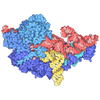
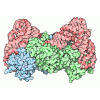
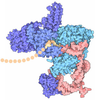
- EMDB-53320: DNA polymerase without DNA or inhibitor -
+
データを開く
IDまたはキーワード:
読み込み中...
-
基本情報
登録情報
データベース: EMDB / ID: EMD-53320
タイトル
DNA polymerase without DNA or inhibitor
マップデータ
Experimental map
試料
複合体: DNA polymerase with DNA and inhibitor
タンパク質・ペプチド: DNA polymerase III PolC-type
DNA: DNA (5'-D(P*TP*AP*A)-3')
リガンド: ZINC ION
リガンド: MAGNESIUM ION
リガンド: water
キーワード
DNA polymerase / DNA BINDING PROTEIN
機能・相同性
機能・相同性情報
3'-5' exonuclease activity / DNA-templated DNA replication / DNA-directed DNA polymerase / DNA-directed DNA polymerase activity / DNA binding / cytoplasm 類似検索 - 分子機能
DNA polymerase III PolC-like, N-terminal domain II / DNA polymerase III PolC-type, N-terminal domain I / DNA polymerase III polC-type N-terminus II / DNA polymerase III polC-type N-terminus I / DNA polymerase III, alpha subunit, Gram-positive type / PolC, middle finger subdomain superfamily / DNA polymerase III epsilon subunit, exonuclease domain / DNA polymerase III, alpha subunit / Bacterial DNA polymerase III, alpha subunit, NTPase domain / DNA polymerase, helix-hairpin-helix motif ...DNA polymerase III PolC-like, N-terminal domain II / DNA polymerase III PolC-type, N-terminal domain I / DNA polymerase III polC-type N-terminus II / DNA polymerase III polC-type N-terminus I / DNA polymerase III, alpha subunit, Gram-positive type / PolC, middle finger subdomain superfamily / DNA polymerase III epsilon subunit, exonuclease domain / DNA polymerase III, alpha subunit / Bacterial DNA polymerase III, alpha subunit, NTPase domain / DNA polymerase, helix-hairpin-helix motif / DNA polymerase III alpha subunit finger domain / Bacterial DNA polymerase III alpha NTPase domain / Helix-hairpin-helix motif / Bacterial DNA polymerase III alpha subunit finger domain / PHP domain / PHP domain / Polymerase/histidinol phosphatase, N-terminal / DNA polymerase alpha chain like domain / Polymerase/histidinol phosphatase-like / Exonuclease / Exonuclease, RNase T/DNA polymerase III / EXOIII / OB-fold nucleic acid binding domain, AA-tRNA synthetase-type / OB-fold nucleic acid binding domain / Ribonuclease H superfamily / Ribonuclease H-like superfamily / Nucleic acid-binding, OB-fold 類似検索 - ドメイン・相同性
ジャーナル: Nat Commun / 年: 2025 タイトル: A unique inhibitor conformation selectively targets the DNA polymerase PolC of Gram-positive priority pathogens. 著者: Mia Urem / Annemieke H Friggen / Nina Musch / Michael H Silverman / Christopher J Swain / Michael R Barbachyn / Lawrence I Mortin / Xiang Yu / Robert J DeLuccia / Meindert H Lamers / Wiep Klaas Smits / 要旨: Infections with antimicrobial resistant pathogens are a major threat to human health. Inhibitors of the replicative polymerase PolC are a promising novel class of antimicrobials against Gram-positive ...Infections with antimicrobial resistant pathogens are a major threat to human health. Inhibitors of the replicative polymerase PolC are a promising novel class of antimicrobials against Gram-positive pathogens, but the structural basis for their activity remains unknown. The first-in-class PolC-targeting antimicrobial, ibezapolstat, is a guanine analogue in late-stage clinical development for the treatment of Clostridioides difficile infections, and related inhibitors are being developed for systemic treatment of infections with methicillin-resistant Staphylococcus aureus (MRSA) and vancomycin-resistant enterococci (VRE). Here, we present the cryo-electron microscopy structures of Enterococcus faecium PolC bound to DNA and in complex with ibezapolstat or the previously-undescribed inhibitor ACX-801. Both inhibitors form base-pairing interactions with the DNA in the active site, thereby competing with incoming dGTP nucleotides. We identify a crucial susceptibility determinant in PolC that is conserved in other organisms, such as C. difficile. This is explained by an unusual non-planar conformation of the inhibitors that induce a binding pocket in PolC. By combining structural, biochemical, bioinformatic and genetic analyses, this work lays the foundation for the rational development of an innovative class of antimicrobials against Gram-positive priority pathogens.
 ムービー
ムービー コントローラー


 データを開く
 基本情報
基本情報
 マップデータ
 試料
試料 キーワード
キーワード 機能・相同性情報
 Enterococcus faecium (バクテリア) /
  Escherichia coli (大腸菌)
 データ登録者
 オランダ, 1件
  引用
引用
 構造の表示
構造の表示
 ダウンロードとリンク
 emd_53320.png
 http://ftp.pdbj.org/pub/emdb/structures/EMD-53320


 Z (Sec.)
 Y (Row.)
 X (Col.)


 試料の構成要素
 解析
解析 電子顕微鏡法
 FIELD EMISSION GUN

