 Movie
Movie Controller


+ Open data

- Basic information
| Entry |  | |||||||||||||||
|---|---|---|---|---|---|---|---|---|---|---|---|---|---|---|---|---|
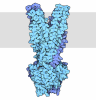
| Title | 3D cryoEM map of the BSAP-1 and B1RS complex | |||||||||||||||
 Map data Map data | Electron density map of the BSAP-1 B1RS complex. | |||||||||||||||
 Sample Sample |
| |||||||||||||||
 Keywords Keywords | Complex / Pore forming toxin / Bacteroidales / MACPF / MEMBRANE PROTEIN | |||||||||||||||
| Function / homology | : / : / MACPF protein, D2 domain / MACPF protein, D3 domain / Membrane attack complex/perforin (MACPF) domain profile. / Membrane attack complex component/perforin (MACPF) domain / Prokaryotic membrane lipoprotein lipid attachment site profile. / Conserved hypothetical exported protein / MACPF domain-containing protein Function and homology information Function and homology information | |||||||||||||||
| Biological species |  Bacteroides fragilis (bacteria) / Bacteroides thetaiotaomicron VPI-5482 (bacteria) Bacteroides fragilis (bacteria) / Bacteroides thetaiotaomicron VPI-5482 (bacteria) | |||||||||||||||
| Method | single particle reconstruction / cryo EM / Resolution: 4.3 Å | |||||||||||||||
 Authors Authors | Pasveer EL / Remaut HK | |||||||||||||||
| Funding support |  Belgium, 4 items Belgium, 4 items
| |||||||||||||||
 Citation Citation | Journal: J Biol Chem / Year: 2026 Title: Identification of receptor-binding domains of Bacteroidales antibacterial pore-forming toxins. Authors: Sofia Borgini / Edwin Pasveer / Chloé Petre / Bogdan I Iorga / Didier Vertommen / Han Remaut / Jean-François Collet / Frédéric Lauber /  Abstract: Bacteroidales are abundant Gram-negative bacteria present in the gut microbiota of most animals, including humans, where they carry out vital functions for host health. To thrive in this competitive ...Bacteroidales are abundant Gram-negative bacteria present in the gut microbiota of most animals, including humans, where they carry out vital functions for host health. To thrive in this competitive environment, Bacteroidales use sophisticated weapons to outmatch competitors. Among these, Bacteroidales secreted antimicrobial proteins (BSAPs) represent a novel class of bactericidal pore-forming toxins that are highly specific to their receptor, typically targeting only a single membrane protein or lipopolysaccharide. The molecular determinants conferring this high selectivity remain unknown. In this study, we therefore investigated the model protein BSAP-1 and determined which of its domains is involved in providing receptor specificity. We demonstrate that receptor recognition is entirely driven by the C-terminal domain (CTD) of BSAP-1 using a combination of in vivo competition assays, in vitro protein binding studies, and mutational analysis. Specifically, we show that deletion of the CTD abrogates BSAP-1 bactericidal activity by preventing receptor binding, whereas grafting the CTD to unrelated carrier proteins enables CTD-driven interaction with the BSAP-1 receptor. Combining structural investigation of a BSAP-1-receptor complex with mutational analysis, we unveil that this interaction is driven by electrostatic interactions. Building upon this discovery, we show that BSAPs can be categorized according to the structure of their CTD, suggesting a strong CTD structure-receptor type correlation. In summary, our research demonstrates that BSAP receptor recognition is driven by their CTD and paves the way for future applications. | |||||||||||||||
| History |
|
- Structure visualization
| Supplemental images |
|---|

- Downloads & links
-EMDB archive
| Map data | emd_53314.map.gz | 20.7 MB | EMDB map data format | |
|---|---|---|---|---|
| Header (meta data) | emd-53314-v30.xmlemd-53314.xml | 20.6 KB 20.6 KB | Display Display | EMDB header |
| FSC (resolution estimation) | emd_53314_fsc.xml | 10.2 KB | Display | FSC data file |
| Images |  emd_53314.png emd_53314.png | 34.1 KB | ||
| Filedesc metadata | emd-53314.cif.gz | 6.4 KB | ||
| Others | emd_53314_half_map_1.map.gzemd_53314_half_map_2.map.gz | 31.3 MB 31.4 MB | ||
| Archive directory |  https://data.pdbj.org/pub/emdb/structures/EMD-53314ftp://data.pdbj.org/pub/emdb/structures/EMD-53314 https://data.pdbj.org/pub/emdb/structures/EMD-53314ftp://data.pdbj.org/pub/emdb/structures/EMD-53314 | HTTPS FTP |
-Related structure data
| Similar structure data |
|---|
-Links
| EMDB pages | EMDB (EBI/PDBe) / EMDataResource |
|---|---|
| Related items in Molecule of the Month |
-Map
| File | Download / File: emd_53314.map.gz / Format: CCP4 / Size: 40.6 MB / Type: IMAGE STORED AS FLOATING POINT NUMBER (4 BYTES) | ||||||||||||||||||||
|---|---|---|---|---|---|---|---|---|---|---|---|---|---|---|---|---|---|---|---|---|---|
| Annotation | Electron density map of the BSAP-1 B1RS complex. | ||||||||||||||||||||
| Voxel size | X=Y=Z: 0.753 Å | ||||||||||||||||||||
| Density |
| ||||||||||||||||||||
| Symmetry | Space group: 1 | ||||||||||||||||||||
| Details | EMDB XML:
|
-Supplemental data
-Half map: half map 1
| File | emd_53314_half_map_1.map | ||||||||||||
|---|---|---|---|---|---|---|---|---|---|---|---|---|---|
| Annotation | half map 1 | ||||||||||||
| Projections & Slices |
| ||||||||||||
| Density Histograms |
 Z
Z Y
Y X
X


-Half map: half map 2
| File | emd_53314_half_map_2.map | ||||||||||||
|---|---|---|---|---|---|---|---|---|---|---|---|---|---|
| Annotation | half map 2 | ||||||||||||
| Projections & Slices |
| ||||||||||||
| Density Histograms |


- Sample components
-Entire : Complex of the pore forming toxin BSAP-1 bound the the receptor B1RS
| Entire | Name: Complex of the pore forming toxin BSAP-1 bound the the receptor B1RS |
|---|---|
| Components |
|
-Supramolecule #1: Complex of the pore forming toxin BSAP-1 bound the the receptor B1RS
| Supramolecule | Name: Complex of the pore forming toxin BSAP-1 bound the the receptor B1RS type: complex / ID: 1 / Parent: 0 / Macromolecule list: all / Details: Purified BSAP-1 |
|---|---|
| Source (natural) | Organism: Bacteroides fragilis (bacteria) |
| Molecular weight | Theoretical: 125 KDa |
-Macromolecule #1: BSAP-1
| Macromolecule | Name: BSAP-1 / type: protein_or_peptide / ID: 1 / Enantiomer: LEVO |
|---|---|
| Source (natural) | Organism: Bacteroides thetaiotaomicron VPI-5482 (bacteria) |
| Recombinant expression | Organism:  Escherichia coli (E. coli) Escherichia coli (E. coli) |
| Sequence | String: MKKLFISLCI ILFTISCTNE EETNNYTPVD NQSNSTSEII LQERNSSLPR VWSKKTAQRV TTRASFTDAT DFLGCSYAVE NGTSIIGDFA NAKYPVVNMK KLLERYPSYI NPKELRTTET KALSYSDFDR LEKNKTFTKT VKSGFSLNLG PFKFGRQKTI KETFVHNTDD ...String: MKKLFISLCI ILFTISCTNE EETNNYTPVD NQSNSTSEII LQERNSSLPR VWSKKTAQRV TTRASFTDAT DFLGCSYAVE NGTSIIGDFA NAKYPVVNMK KLLERYPSYI NPKELRTTET KALSYSDFDR LEKNKTFTKT VKSGFSLNLG PFKFGRQKTI KETFVHNTDD SEKVVHGELS IEVVNGMLNL QTAPSALRKI AADYLDELFV DALYNSSMVE LMQSYGEFVL TGYYTGGRAS ALFYGVDTNS IQFDSKEKDM DVAINASYEW KNKKPTAPSD TIHSASGNLS IGTKRENSET ITNKFSALSY SIKTLGGAYG YSISTPPYDI TNYSIDLTPW LQSLNDPKTH TMIDLQDGGL YPISDFILEE NFKQRYNDTH MDFQYQESLE EPYIEIIKMY IRKSNSGEKL YDIVPVLNTR QGDKLIFSNP DAASQSDEEL KANSIPATFL TKSNAIKDEK SKYYQLKIKA DPNKTINPII QTTLSFQINN VDEKGMYKFK NANTNIWYIY NPTSMYCFAY YDDDYIPDAY GILDWVNGIP IKAVTMTTLY QRYKIYGL UniProtKB: MACPF domain-containing protein |
-Macromolecule #2: B1RS
| Macromolecule | Name: B1RS / type: protein_or_peptide / ID: 2 / Enantiomer: LEVO |
|---|---|
| Source (natural) | Organism: Bacteroides fragilis (bacteria) |
| Sequence | String: MKKIITLATL GLLVAAAPIS AQTVYDAAKI TGKDLNGTAR FVGMGGAMGA LGGDISTIGT NPAGIGIYRS NDFMTSFGFS SYGTESKYLG DKFKSDKIQG SFDNLGFVFA SKIGNETSLR YVNFGFNYHK AKSFYKNMNM KGGLGNSSQT YQMAQQASGI TKWGDYPYDD ...String: MKKIITLATL GLLVAAAPIS AQTVYDAAKI TGKDLNGTAR FVGMGGAMGA LGGDISTIGT NPAGIGIYRS NDFMTSFGFS SYGTESKYLG DKFKSDKIQG SFDNLGFVFA SKIGNETSLR YVNFGFNYHK AKSFYKNMNM KGGLGNSSQT YQMAQQASGI TKWGDYPYDD PEIGWLSILG YDGWLISDIT TDKMNAAGKP NSPYVDKDGN QRYDANGKPL YTTPGNYYGM YDDGVANFHS QERGGIDQYD FNVAFNFNDR FYLGLTLGAY AVDYSKYTYY SEAYTGANAP QNYNLRSWNK VRGSGFDLKL GTIIRPFENS PFRIGLAIHT PTFYNLDYKT SARVESDVLN VETGKIDQWS VDTRDKLPGN GDMVREFRLQ TPWTYNVSLG YTIGTSLALG AEYEYQDYST MKFRGPTGSS SEFTFENSTR PMMKGVNTLR LGLEYKVIPQ FALRAGYNYT SAIFHGDAFK DLPYYSIQTD TDWANTKALS NYTLGIGYRG SVFYADLAYK FSTYNEDFYP FVNKYEENNA TTVLTPETTK VTNTRSQVLF TLGLRF UniProtKB: Conserved hypothetical exported protein |
-Experimental details
-Structure determination
| Method | cryo EM |
|---|---|
 Processing Processing | single particle reconstruction |
| Aggregation state | particle |
-Sample preparation
| Concentration | 1 mg/mL |
|---|---|
| Buffer | pH: 7.5 / Details: 50mM HEPES, 150mM NaCl, 1mM DTT, 0.03% DDM |
| Grid | Model: Quantifoil R2/1 / Material: COPPER / Mesh: 300 / Support film - Material: GRAPHENE OXIDE / Support film - topology: CONTINUOUS / Pretreatment - Type: GLOW DISCHARGE / Pretreatment - Time: 40 sec. / Pretreatment - Atmosphere: OTHER / Pretreatment - Pressure: 0.004 kPa |
| Vitrification | Cryogen name: ETHANE / Chamber humidity: 90 % / Chamber temperature: 298 K / Instrument: GATAN CRYOPLUNGE 3 |
- Electron microscopy
| Microscope | JEOL CRYO ARM 300 |
|---|---|
| Image recording | Film or detector model: GATAN K3 (6k x 4k) / Digitization - Dimensions - Width: 5760 pixel / Digitization - Dimensions - Height: 4092 pixel / Number grids imaged: 1 / Number real images: 31383 / Average exposure time: 3.036 sec. / Average electron dose: 60.0 e/Å2 |
| Electron beam | Acceleration voltage: 300 kV / Electron source:  FIELD EMISSION GUN FIELD EMISSION GUN |
| Electron optics | C2 aperture diameter: 100.0 µm / Illumination mode: OTHER / Imaging mode: BRIGHT FIELD / Nominal defocus max: 2.4 µm / Nominal defocus min: 0.8 µm |
| Sample stage | Specimen holder model: JEOL 3200FSC CRYOHOLDER / Cooling holder cryogen: NITROGEN |
+Image processing
-Atomic model buiding 1
| Initial model | Chain - Source name: AlphaFold / Chain - Initial model type: in silico model |
|---|---|
| Details | PredictAndBuild |
| Refinement | Protocol: OTHER |
