Journal: Nat Commun / Year: 2025 Title: Multi-domain O-GlcNAcase structures reveal allosteric regulatory mechanisms. Authors: Sara Basse Hansen / Sergio G Bartual / Huijie Yuan / Olawale G Raimi / Andrii Gorelik / Andrew T Ferenbach / Kristian Lytje / Jan Skov Pedersen / Taner Drace / Thomas Boesen / Daan M F van Aalten / Abstract: Nucleocytoplasmic protein O-GlcNAcylation is a dynamic modification catalysed by O-GlcNAc transferase (OGT) and reversed by O-GlcNAc hydrolase (OGA), whose activities are regulated through largely ...Nucleocytoplasmic protein O-GlcNAcylation is a dynamic modification catalysed by O-GlcNAc transferase (OGT) and reversed by O-GlcNAc hydrolase (OGA), whose activities are regulated through largely unknown O-GlcNAc-dependent feedback mechanisms. OGA is a homodimeric, multi-domain enzyme containing a catalytic core and a pseudo-histone acetyltransferase (pHAT) domain. While a catalytic structure has been reported, the structure and function of the pHAT domain remain elusive. Here, we report a crystal structure of the Trichoplax adhaerens pHAT domain and cryo-EM data of the multi-domain T. adhaerens and human OGAs, complemented by biophysical analyses. Here, we show that the eukaryotic OGA pHAT domain forms catalytically incompetent, symmetric homodimers, projecting a partially conserved putative peptide-binding site. In solution, OGA exist as flexible multi-domain dimers, but catalytic core-pHAT linker interactions restrict pHAT positional range. In human OGA, pHAT movements remodel the active site environment through conformational changes in a flexible arm region. These findings reveal allosteric mechanisms through which the pHAT domain contributes to O-GlcNAc homeostasis.
In the structure databanks used in Yorodumi, some data are registered as the other names, "COVID-19 virus" and "2019-nCoV". Here are the details of the virus and the list of structure data.
Jan 31, 2019. EMDB accession codes are about to change! (news from PDBe EMDB page)
EMDB accession codes are about to change! (news from PDBe EMDB page)
The allocation of 4 digits for EMDB accession codes will soon come to an end. Whilst these codes will remain in use, new EMDB accession codes will include an additional digit and will expand incrementally as the available range of codes is exhausted. The current 4-digit format prefixed with “EMD-” (i.e. EMD-XXXX) will advance to a 5-digit format (i.e. EMD-XXXXX), and so on. It is currently estimated that the 4-digit codes will be depleted around Spring 2019, at which point the 5-digit format will come into force.
The EM Navigator/Yorodumi systems omit the EMD- prefix.
Related info.:Q: What is EMD? / ID/Accession-code notation in Yorodumi/EM Navigator
Yorodumi is a browser for structure data from EMDB, PDB, SASBDB, etc.
This page is also the successor to EM Navigator detail page, and also detail information page/front-end page for Omokage search.
The word "yorodu" (or yorozu) is an old Japanese word meaning "ten thousand". "mi" (miru) is to see.
Related info.:EMDB / PDB / SASBDB / Comparison of 3 databanks / Yorodumi Search / Aug 31, 2016. New EM Navigator & Yorodumi / Yorodumi Papers / Jmol/JSmol / Function and homology information / Changes in new EM Navigator and Yorodumi
 Movie
Movie Controller


 Open data
 Basic information
 Map data
 Sample
 Keywords
 Function and homology information
 Trichoplax adhaerens (invertebrata) /
  Homo sapiens (human)
 Authors
 United Kingdom,
  Denmark, 2 items
  Citation
 Structure visualization
 Downloads & links
 emd_53081.png
 http://ftp.pdbj.org/pub/emdb/structures/EMD-53081


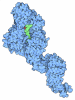
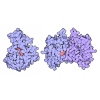
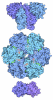
 Z (Sec.)
 Y (Row.)
 X (Col.)


 Sample components
 Escherichia coli (E. coli)
 Processing
 Electron microscopy
 FIELD EMISSION GUN

