 Movie
Movie Controller
 About Yorodumi

[English] 日本語
 Yorodumi
- EMDB-52360: Microtubule plus end architecture in presence of the ciliary tip ... -
+ Open data

- Basic information
| Entry |  | |||||||||
|---|---|---|---|---|---|---|---|---|---|---|
| Title | Microtubule plus end architecture in presence of the ciliary tip module. | |||||||||
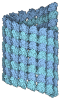
 Map data Map data | Extracted subtomogram of microtubule plus end containing a ciliary tip module cork (bin 2, cryoCARE denoised) | |||||||||
 Sample Sample |
| |||||||||
 Keywords Keywords | microtubule / plus end / protofilaments / ciliary tip module / CYTOSOLIC PROTEIN | |||||||||
| Biological species |   Sus scrofa domesticus (domestic pig) / Sus scrofa domesticus (domestic pig) /  Homo sapiens (human) / Homo sapiens (human) /  Mus musculus (house mouse) Mus musculus (house mouse) | |||||||||
| Method | electron tomography / cryo EM | |||||||||
 Authors Authors | Hoogebeen RA / Saunders HAJ / Howes SC / Akhmanova A | |||||||||
| Funding support |  Netherlands, 1 items Netherlands, 1 items
| |||||||||
 Citation Citation | Journal: Nat Struct Mol Biol / Year: 2025 Title: A network of interacting ciliary tip proteins with opposing activities imparts slow and processive microtubule growth. Authors: Harriet A J Saunders / Cyntha M van den Berg / Robin A Hoogebeen / Donna Schweizer / Kelly E Stecker / Ronald Roepman / Stuart C Howes / Anna Akhmanova / Abstract: Cilia are motile or sensory organelles present on many eukaryotic cells. Their formation and function rely on axonemal microtubules, which exhibit very slow dynamics, but the underlying mechanisms ...Cilia are motile or sensory organelles present on many eukaryotic cells. Their formation and function rely on axonemal microtubules, which exhibit very slow dynamics, but the underlying mechanisms are largely unexplored. Here we reconstituted in vitro the individual and collective activities of the ciliary tip module proteins CEP104, CSPP1, TOGARAM1, ARMC9 and CCDC66, which interact with each other and with microtubules and, when mutated in humans, cause ciliopathies such as Joubert syndrome. We show that CEP104, a protein with a tubulin-binding TOG domain, and its luminal partner CSPP1 inhibit microtubule growth and shortening. Another TOG-domain protein, TOGARAM1, overcomes growth inhibition imposed by CEP104 and CSPP1. CCDC66 and ARMC9 do not affect microtubule dynamics but act as scaffolds for their partners. Cryo-electron tomography demonstrated that, together, ciliary tip module members form plus-end-specific cork-like structures that reduce protofilament flaring. The combined effect of these proteins is very slow processive microtubule elongation, which recapitulates axonemal dynamics in cells. | |||||||||
| History |
|
- Structure visualization
| Supplemental images |
|---|

- Downloads & links
-EMDB archive
 emd_52360.png
-Related structure data

- Links
Links
| EMDB pages | EMDB (EBI/PDBe) / EMDataResource |
|---|---|
| Related items in Molecule of the Month |
-Map
| File | Download / File: emd_52360.map.gz / Format: CCP4 / Size: 206 MB / Type: IMAGE STORED AS FLOATING POINT NUMBER (4 BYTES) | ||||||||||||||||||||||||||||||||
|---|---|---|---|---|---|---|---|---|---|---|---|---|---|---|---|---|---|---|---|---|---|---|---|---|---|---|---|---|---|---|---|---|---|
| Annotation | Extracted subtomogram of microtubule plus end containing a ciliary tip module cork (bin 2, cryoCARE denoised) | ||||||||||||||||||||||||||||||||
| Projections & slices | Image control
Images are generated by Spider. generated in cubic-lattice coordinate | ||||||||||||||||||||||||||||||||
| Voxel size | X=Y=Z: 4.34 Å | ||||||||||||||||||||||||||||||||
| Density |
| ||||||||||||||||||||||||||||||||
| Symmetry | Space group: 1 | ||||||||||||||||||||||||||||||||
| Details | EMDB XML:
|
 Z (Sec.)
 Y (Row.)
 X (Col.)


-Supplemental data
+Additional map: Full tomogram belonging to primary map (bin2, cryoCARE denoised).


+Additional map: #9


+Additional map: #10


+Additional map: #11


+Additional map: #12


+Additional map: #13


+Additional map: #14


+Additional map: #15


+Additional map: #16


+Additional map: #17


+Additional map: #18


+Additional map: #1


+Additional map: #19


+Additional map: #20


+Additional map: #21


+Additional map: #22


+Additional map: #23


+Additional map: #24


+Additional map: #25


+Additional map: #26


+Additional map: #27


+Additional map: #28


+Additional map: #2


+Additional map: #29


+Additional map: #30


+Additional map: #31


+Additional map: #3


+Additional map: #4


+Additional map: #5


+Additional map: #6


+Additional map: #7


+Additional map: #8


- Sample components
-Entire : Microtubules with sub-stoichiometric EB3 and the ciliary tip module
| Entire | Name: Microtubules with sub-stoichiometric EB3 and the ciliary tip module |
|---|---|
| Components |
|
-Supramolecule #1: Microtubules with sub-stoichiometric EB3 and the ciliary tip module
| Supramolecule | Name: Microtubules with sub-stoichiometric EB3 and the ciliary tip module type: complex / ID: 1 / Parent: 0 |
|---|
-Supramolecule #2: tubulin
| Supramolecule | Name: tubulin / type: organelle_or_cellular_component / ID: 2 / Parent: 1 |
|---|---|
| Source (natural) | Organism: Sus scrofa domesticus (domestic pig) / Organ: brain |
-Supramolecule #3: EB3
| Supramolecule | Name: EB3 / type: organelle_or_cellular_component / ID: 3 / Parent: 1 |
|---|---|
| Source (natural) | Organism: Homo sapiens (human) |
-Supramolecule #4: CEP104
| Supramolecule | Name: CEP104 / type: organelle_or_cellular_component / ID: 4 / Parent: 1 |
|---|---|
| Source (natural) | Organism: Homo sapiens (human) |
-Supramolecule #5: CSPP1
| Supramolecule | Name: CSPP1 / type: organelle_or_cellular_component / ID: 5 / Parent: 1 |
|---|---|
| Source (natural) | Organism: Homo sapiens (human) |
-Supramolecule #6: TOGARAM1
| Supramolecule | Name: TOGARAM1 / type: organelle_or_cellular_component / ID: 6 / Parent: 1 |
|---|---|
| Source (natural) | Organism: Mus musculus (house mouse) |
-Supramolecule #7: ARMC9
| Supramolecule | Name: ARMC9 / type: organelle_or_cellular_component / ID: 7 / Parent: 1 |
|---|---|
| Source (natural) | Organism: Homo sapiens (human) |
-Supramolecule #8: CCDC66
| Supramolecule | Name: CCDC66 / type: organelle_or_cellular_component / ID: 8 / Parent: 1 |
|---|---|
| Source (natural) | Organism: Homo sapiens (human) |
-Experimental details
-Structure determination
| Method | cryo EM |
|---|---|
 Processing Processing | electron tomography |
| Aggregation state | filament |
-Sample preparation
| Buffer | pH: 6.8 Details: MRB80 buffer = 80 mM piperazine-N, N[prime]-bis (2-ethane sulfonic acid), pH 6.8, supplemented with 4 mM MgCl2, and 1 mM EGTA. |
|---|---|
| Grid | Model: Quantifoil R2/1 / Material: COPPER / Mesh: 200 / Support film - Material: CARBON / Support film - topology: HOLEY / Pretreatment - Type: GLOW DISCHARGE / Pretreatment - Time: 30 sec. / Pretreatment - Pressure: 0.039 kPa |
| Vitrification | Cryogen name: ETHANE / Chamber humidity: 90 % / Chamber temperature: 303.15 K / Instrument: FEI VITROBOT MARK IV Details: Prior to vitrification, the sample was manually back-blotted inside the Vitrobot chamber.. |
| Sectioning | Other: NO SECTIONING |
| Fiducial marker | Manufacturer: Cell Microscopy Core, Utrecht University Medical Center (UMC) Diameter: 5 nm |
- Electron microscopy
| Microscope | FEI TALOS ARCTICA |
|---|---|
| Specialist optics | Energy filter - Name: GIF Bioquantum / Energy filter - Slit width: 20 eV |
| Image recording | Film or detector model: GATAN K2 SUMMIT (4k x 4k) / Detector mode: COUNTING / Digitization - Dimensions - Width: 3710 pixel / Digitization - Dimensions - Height: 3838 pixel / Average electron dose: 1.6 e/Å2 |
| Electron beam | Acceleration voltage: 200 kV / Electron source:  FIELD EMISSION GUN FIELD EMISSION GUN |
| Electron optics | C2 aperture diameter: 70.0 µm / Illumination mode: FLOOD BEAM / Imaging mode: BRIGHT FIELD / Nominal defocus max: 4.0 µm / Nominal defocus min: 2.0 µm / Nominal magnification: 63000 |
| Sample stage | Cooling holder cryogen: NITROGEN |
| Experimental equipment | 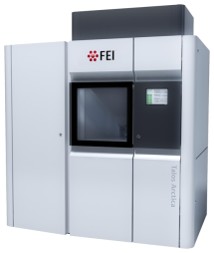 Model: Talos Arctica / Image courtesy: FEI Company |
-Image processing
| Final reconstruction | Algorithm: BACK PROJECTION / Number images used: 61 |
|---|---|
| CTF correction | Type: NONE |
