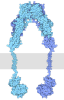
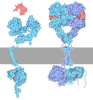
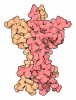
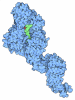
Drosophila melanogaster insulin receptor ectodomain in complex with two DILP2 molecules
Map data
Primary map after PostProcess in Relion
Sample
Complex: Drosophila insulin receptor ectodomain with DILP-2
Protein or peptide: Probable insulin-like peptide 2
Protein or peptide: Probable insulin-like peptide 2
Protein or peptide: Insulin-like receptor
Ligand: 2-acetamido-2-deoxy-beta-D-glucopyranose
Keywords
Receptor / Dilp2 / Drosophila / complex / SIGNALING PROTEIN
Function / homology
Function and homology information
primary spermatocyte growth / positive regulation of fat cell proliferation / negative regulation of peptide hormone secretion / Extra-nuclear estrogen signaling / response to anoxia / negative regulation of entry into reproductive diapause / Insulin signaling pathway / Insulin receptor recycling / female mating behavior / male germ-line stem cell asymmetric division ...primary spermatocyte growth / positive regulation of fat cell proliferation / negative regulation of peptide hormone secretion / Extra-nuclear estrogen signaling / response to anoxia / negative regulation of entry into reproductive diapause / Insulin signaling pathway / Insulin receptor recycling / female mating behavior / male germ-line stem cell asymmetric division / embryonic development via the syncytial blastoderm / larval feeding behavior / female germ-line stem cell population maintenance / germ-band shortening / germ-line stem-cell niche homeostasis / imaginal disc growth / open tracheal system development / carbohydrate homeostasis / germ-line stem cell division / negative regulation of circadian sleep/wake cycle, sleep / positive regulation of neuron remodeling / lymph gland development / follicle cell of egg chamber development / regulation of growth rate / positive regulation of border follicle cell migration / female germ-line stem cell asymmetric division / intestinal stem cell homeostasis / positive regulation of multicellular organism growth / growth cone membrane / positive regulation of organ growth / regulation of organ growth / female gonad development / positive regulation of lipid storage / response to amino acid starvation / insulin receptor complex / embryo development ending in birth or egg hatching / sleep / insulin receptor activity / positive regulation of neuroblast proliferation / insulin binding / triglyceride homeostasis / negative regulation of glycogen catabolic process / response to food / regulation of cell size / multicellular organism growth / negative regulation of feeding behavior / negative regulation of macroautophagy / positive regulation of wound healing / locomotor rhythm / positive regulation of cell size / regulation of multicellular organism growth / lipid homeostasis / insulin receptor substrate binding / developmental growth / determination of adult lifespan / phosphatidylinositol 3-kinase binding / cholesterol homeostasis / positive regulation of TORC1 signaling / axon guidance / locomotory behavior / cellular response to starvation / response to cocaine / growth factor activity / insulin receptor binding / cellular response to glucose stimulus / SH3 domain binding / circadian rhythm / hormone activity / receptor protein-tyrosine kinase / insulin receptor signaling pathway / nervous system development / glucose homeostasis / regulation of cell population proliferation / protein autophosphorylation / positive regulation of cell growth / response to oxidative stress / protein tyrosine kinase activity / positive regulation of phosphatidylinositol 3-kinase/protein kinase B signal transduction / positive regulation of MAPK cascade / protein phosphorylation / receptor ligand activity / axon / positive regulation of cell population proliferation / : / metal ion binding / extracellular region / ATP binding / identical protein binding / plasma membrane Similarity search - Function
Long hematopoietin receptor, single chain family signature. / Tyrosine-protein kinase, receptor class II, conserved site / Receptor tyrosine kinase class II signature. / Insulin family / Insulin-like / Insulin/IGF/Relaxin family / Insulin / insulin-like growth factor / relaxin family. / Insulin, conserved site / Insulin family signature. / Insulin-like superfamily ...Long hematopoietin receptor, single chain family signature. / Tyrosine-protein kinase, receptor class II, conserved site / Receptor tyrosine kinase class II signature. / Insulin family / Insulin-like / Insulin/IGF/Relaxin family / Insulin / insulin-like growth factor / relaxin family. / Insulin, conserved site / Insulin family signature. / Insulin-like superfamily / Receptor L-domain / Furin-like cysteine-rich domain / Receptor L-domain superfamily / Furin-like cysteine rich region / Receptor L domain / Furin-like repeat / Furin-like repeats / Fibronectin type III domain / Growth factor receptor cysteine-rich domain superfamily / Fibronectin type 3 domain / : / Fibronectin type-III domain profile. / Fibronectin type III / Fibronectin type III superfamily / Tyrosine-protein kinase, catalytic domain / Tyrosine kinase, catalytic domain / Tyrosine protein kinases specific active-site signature. / Tyrosine-protein kinase, active site / Protein tyrosine and serine/threonine kinase / Serine-threonine/tyrosine-protein kinase, catalytic domain / Protein kinase, ATP binding site / Protein kinases ATP-binding region signature. / Immunoglobulin-like fold / Protein kinase domain profile. / Protein kinase domain / Protein kinase-like domain superfamily Similarity search - Domain/homology
In the structure databanks used in Yorodumi, some data are registered as the other names, "COVID-19 virus" and "2019-nCoV". Here are the details of the virus and the list of structure data.
Jan 31, 2019. EMDB accession codes are about to change! (news from PDBe EMDB page)
EMDB accession codes are about to change! (news from PDBe EMDB page)
The allocation of 4 digits for EMDB accession codes will soon come to an end. Whilst these codes will remain in use, new EMDB accession codes will include an additional digit and will expand incrementally as the available range of codes is exhausted. The current 4-digit format prefixed with “EMD-” (i.e. EMD-XXXX) will advance to a 5-digit format (i.e. EMD-XXXXX), and so on. It is currently estimated that the 4-digit codes will be depleted around Spring 2019, at which point the 5-digit format will come into force.
The EM Navigator/Yorodumi systems omit the EMD- prefix.
Related info.:Q: What is EMD? / ID/Accession-code notation in Yorodumi/EM Navigator
Yorodumi is a browser for structure data from EMDB, PDB, SASBDB, etc.
This page is also the successor to EM Navigator detail page, and also detail information page/front-end page for Omokage search.
The word "yorodu" (or yorozu) is an old Japanese word meaning "ten thousand". "mi" (miru) is to see.
Related info.:EMDB / PDB / SASBDB / Comparison of 3 databanks / Yorodumi Search / Aug 31, 2016. New EM Navigator & Yorodumi / Yorodumi Papers / Jmol/JSmol / Function and homology information / Changes in new EM Navigator and Yorodumi
 Movie
Movie Controller

 Yorodumi
 Open data
 Basic information
 Map data
 Sample
 Keywords
 Function and homology information
 Drosophila melanogaster (fruit fly)
 Authors
 United Kingdom, 1 items
  Citation
 Structure visualization
 Downloads & links
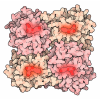
 emd_52310.png
 https://data.pdbj.org/pub/emdb/structures/EMD-52310



 Z (Sec.)
 Y (Row.)
 X (Col.)


 Sample components
 Spodoptera frugiperda (fall armyworm)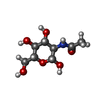
 Processing
 Electron microscopy
 FIELD EMISSION GUN

