 Movie
Movie Controller


+ Open data

- Basic information
| Entry |  | |||||||||
|---|---|---|---|---|---|---|---|---|---|---|
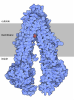
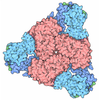
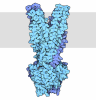
| Title | C. thermocellum UvrA (basal conformation) | |||||||||
 Map data Map data | Map sharpened locally with LocScale2 | |||||||||
 Sample Sample |
| |||||||||
 Keywords Keywords | DNA binding protein / DNA Repair pathway / Nucleotide excision repair pathway / NER | |||||||||
| Function / homology |  Function and homology information Function and homology informationexcinuclease ABC activity / excinuclease repair complex / SOS response / nucleotide-excision repair / ATP hydrolysis activity / DNA binding / zinc ion binding / ATP binding / cytoplasm Similarity search - Function | |||||||||
| Biological species |  Acetivibrio thermocellus (bacteria) Acetivibrio thermocellus (bacteria) | |||||||||
| Method | single particle reconstruction / cryo EM / Resolution: 2.97 Å | |||||||||
 Authors Authors | Nirwal S / Czarnocki-Cieciura M / Nowotny M | |||||||||
| Funding support |  Poland, 1 items Poland, 1 items
| |||||||||
 Citation Citation | Journal: Nat Commun / Year: 2025 Title: Structural snapshots of the mechanism of ATP-dependent DNA damage recognition by UvrA. Authors: Shivlee Nirwal / Mariusz Czarnocki-Cieciura / Weronika Zajko / Krzysztof Skowronek / Roman H Szczepanowski / Marcin Nowotny / Abstract: Nucleotide excision repair is a DNA repair pathway which detects and fixes various DNA lesions that distort the structure of DNA. In bacteria, the pathway starts with the UvrA protein which has two ...Nucleotide excision repair is a DNA repair pathway which detects and fixes various DNA lesions that distort the structure of DNA. In bacteria, the pathway starts with the UvrA protein which has two adenosine triphosphatase modules and forms dimers. The DNA is handed over from UvrA to UvrB, which is a weak helicase that verifies the presence of damage. Despite intense studies, the role of the ATPase activity of UvrA in damage recognition is unclear. Here, we present a series of cryo-electron microscopy structures of UvrA in complex with three different DNAs and in the presence and absence of nucleotides. We also present a structure of UvrA:UvrB:DNA complex. These structures reveal a major rearrangement of the UvrA dimer upon ATP binding. We propose that these conformational changes are used to mechanically probe the integrity of DNA for damage localization. Collectively, our results present snapshots of UvrA's ATP-dependent DNA damage detection. | |||||||||
| History |
|
- Structure visualization
| Supplemental images |
|---|

- Downloads & links
-EMDB archive
| Map data | emd_51665.map.gz | 4.4 MB | EMDB map data format | |
|---|---|---|---|---|
| Header (meta data) | emd-51665-v30.xmlemd-51665.xml | 23.6 KB 23.6 KB | Display Display | EMDB header |
| FSC (resolution estimation) | emd_51665_fsc.xml | 10.6 KB | Display | FSC data file |
| Images |  emd_51665.png emd_51665.png | 84.2 KB | ||
| Masks | emd_51665_msk_1.mapemd_51665_msk_2.map | 125 MB 125 MB | Mask map | |
| Filedesc metadata | emd-51665.cif.gz | 7 KB | ||
| Others | emd_51665_additional_1.map.gzemd_51665_half_map_1.map.gzemd_51665_half_map_2.map.gz | 62.1 MB 115.7 MB 115.7 MB | ||
| Archive directory |  https://data.pdbj.org/pub/emdb/structures/EMD-51665ftp://data.pdbj.org/pub/emdb/structures/EMD-51665 https://data.pdbj.org/pub/emdb/structures/EMD-51665ftp://data.pdbj.org/pub/emdb/structures/EMD-51665 | HTTPS FTP |
-Related structure data
| Related structure data |  9gxkMC  9gxlC  9gxmC  9gxnC  9gxoC  9gxpC  9gxqC  9gxrC  9gxsC  9gxtC  9gxuC  9gxvC  9gxwC  9gy7C M: atomic model generated by this map C: citing same article ( |
|---|---|
| Similar structure data |


-Links
| EMDB pages | EMDB (EBI/PDBe) / EMDataResource |
|---|---|
| Related items in Molecule of the Month |
-Map
| File | Download / File: emd_51665.map.gz / Format: CCP4 / Size: 125 MB / Type: IMAGE STORED AS FLOATING POINT NUMBER (4 BYTES) | ||||||||||||||||||||||||||||||||||||
|---|---|---|---|---|---|---|---|---|---|---|---|---|---|---|---|---|---|---|---|---|---|---|---|---|---|---|---|---|---|---|---|---|---|---|---|---|---|
| Annotation | Map sharpened locally with LocScale2 | ||||||||||||||||||||||||||||||||||||
| Projections & slices | Image control
Images are generated by Spider. | ||||||||||||||||||||||||||||||||||||
| Voxel size | X=Y=Z: 0.84 Å | ||||||||||||||||||||||||||||||||||||
| Density |
| ||||||||||||||||||||||||||||||||||||
| Symmetry | Space group: 1 | ||||||||||||||||||||||||||||||||||||
| Details | EMDB XML:
|
 Z (Sec.)
 Y (Row.)
 X (Col.)


-Supplemental data
-Mask #1
| File | emd_51665_msk_1.map | ||||||||||||
|---|---|---|---|---|---|---|---|---|---|---|---|---|---|
| Projections & Slices |
| ||||||||||||
| Density Histograms |


-Mask #2
| File | emd_51665_msk_2.map | ||||||||||||
|---|---|---|---|---|---|---|---|---|---|---|---|---|---|
| Projections & Slices |
| ||||||||||||
| Density Histograms |


-Additional map: Unsharpened map
| File | emd_51665_additional_1.map | ||||||||||||
|---|---|---|---|---|---|---|---|---|---|---|---|---|---|
| Annotation | Unsharpened map | ||||||||||||
| Projections & Slices |
| ||||||||||||
| Density Histograms |


-Half map: #2
| File | emd_51665_half_map_1.map | ||||||||||||
|---|---|---|---|---|---|---|---|---|---|---|---|---|---|
| Projections & Slices |
| ||||||||||||
| Density Histograms |


-Half map: #1
| File | emd_51665_half_map_2.map | ||||||||||||
|---|---|---|---|---|---|---|---|---|---|---|---|---|---|
| Projections & Slices |
| ||||||||||||
| Density Histograms |


- Sample components
-Entire : C. thermocellum UvrA
| Entire | Name: C. thermocellum UvrA |
|---|---|
| Components |
|
-Supramolecule #1: C. thermocellum UvrA
| Supramolecule | Name: C. thermocellum UvrA / type: complex / ID: 1 / Parent: 0 / Macromolecule list: #1 |
|---|---|
| Source (natural) | Organism: Acetivibrio thermocellus (bacteria) |
| Molecular weight | Theoretical: 214 KDa |
-Macromolecule #1: UvrABC system protein A
| Macromolecule | Name: UvrABC system protein A / type: protein_or_peptide / ID: 1 / Number of copies: 2 / Enantiomer: LEVO |
|---|---|
| Source (natural) | Organism: Acetivibrio thermocellus (bacteria) |
| Molecular weight | Theoretical: 107.144773 KDa |
| Recombinant expression | Organism:  Escherichia coli (E. coli) Escherichia coli (E. coli) |
| Sequence | String: MGSSHHHHHH SSGLVPRGSH MKKDYIVVKG AREHNLKNID VKIPRDKFVV ITGLSGSGKS SLAFDTIYAE GQRRYVESLS SYARQFLGQ MEKPDVDYID GLSPAIAIDQ KTTSRNPRST VGTVTEIYDY LRLLFARIGT PHCYLCGREI SQQTVDQMVD R IMEFEEGT ...String: MGSSHHHHHH SSGLVPRGSH MKKDYIVVKG AREHNLKNID VKIPRDKFVV ITGLSGSGKS SLAFDTIYAE GQRRYVESLS SYARQFLGQ MEKPDVDYID GLSPAIAIDQ KTTSRNPRST VGTVTEIYDY LRLLFARIGT PHCYLCGREI SQQTVDQMVD R IMEFEEGT RIQLLAPVVR GRKGEYHKLI EDIKKEGYVR IRVDGEVVDV NDPVNLDKNK KHNIEIVVDR LIVRPGIQKR LT DSIETVL RLSNGILVVD VIGGKEMLLS QNFACTECNV SMEEITPRMF SFNNPYGACP ECTGLGSLMR IDPDLVIPDK KLS LAQGAV RASGWNIAND ESYARMYIDA LAKHYNFSVD TPVEELPPHI LDIILYGTNG EKIKIEYERE NEKGTFMASF PGII NSMER RYKETTSEVM KQYYENFMSN IPCPVCKGAR LKKESLAVTI GGKNIYEVCC LSIGEAKEFF ANLNLTERQQ LIARQ ILKE INARLGFLVD VGLDYLTLAR AAGTLSGGEA QRIRLATQIG SGLMGVIYIL DEPSIGLHQR DNDRLLRSLK KLRDLG NTL LVVEHDEDTM YASDYIIDLG PGAGSHGGQI VAEGTVEEIK QNPNSVTGEY LSGRKKIEVP KERRKPNGKW LEIIGAR EN NLKNINVRIP LGVFTCITGV SGSGKSSLIN EILYKRLAAE LNRASVKPGE HDLIKGIEYL DKVIDIDQSP IGRTPRSN P ATYTGVFDFI REIFANTTEA KTRGYKAGRF SFNVKGGRCE ACAGDGINKI EMHFLPDIYV PCEVCKGKRY NRETLEVRY KGKNIAEVLD MTVEEALEFF KNIPRIHKKI ETLYDVGLGY IKLGQSSTTL SGGEAQRVKL ATELSRKSTG KTMYILDEPT TGLHMADVH RLVGILHRLV EAGNSVVVIE HNLDVIKTAD YIIDLGPEGG SGGGLVVAEG TPEEVAKVEN SYTGQFLKKV L ST UniProtKB: UvrABC system protein A |
-Macromolecule #2: ZINC ION
| Macromolecule | Name: ZINC ION / type: ligand / ID: 2 / Number of copies: 6 / Formula: ZN |
|---|---|
| Molecular weight | Theoretical: 65.409 Da |
-Experimental details
-Structure determination
| Method | cryo EM |
|---|---|
 Processing Processing | single particle reconstruction |
| Aggregation state | particle |
-Sample preparation
| Buffer | pH: 7.5 |
|---|---|
| Grid | Model: Quantifoil R2/1 / Material: GOLD / Mesh: 200 / Support film - Material: CARBON / Support film - topology: HOLEY |
| Vitrification | Cryogen name: ETHANE / Chamber humidity: 95 % / Chamber temperature: 277 K / Instrument: FEI VITROBOT MARK IV |
| Details | Sample fixed with 0.01% glutaraldehyde and concentrated prior to vitrification; exact concentration cannot be estimated accurately. |
- Electron microscopy
| Microscope | TFS KRIOS |
|---|---|
| Specialist optics | Energy filter - Name: GIF Bioquantum / Energy filter - Slit width: 20 eV |
| Software | Name: EPU (ver. 2.10.0.1941REL) |
| Image recording | Film or detector model: GATAN K3 BIOQUANTUM (6k x 4k) / Number grids imaged: 1 / Number real images: 1511 / Average electron dose: 41.93 e/Å2 / Details: Images were collected with 20 deg stage tilt |
| Electron beam | Acceleration voltage: 300 kV / Electron source:  FIELD EMISSION GUN FIELD EMISSION GUN |
| Electron optics | C2 aperture diameter: 50.0 µm / Illumination mode: FLOOD BEAM / Imaging mode: BRIGHT FIELD / Cs: 2.7 mm / Nominal defocus max: 2.0 µm / Nominal defocus min: 1.0 µm / Nominal magnification: 105000 |
| Experimental equipment |  Model: Titan Krios / Image courtesy: FEI Company |
+Image processing

-Atomic model buiding 1
| Refinement | Protocol: AB INITIO MODEL |
|---|---|
| Output model | PDB-9gxk: |
