National Institutes of Health/National Institute of Mental Health (NIH/NIMH)
R01-GM144542
United States
National Institutes of Health/National Institute of General Medical Sciences (NIH/NIGMS)
R35-GM141517
United States
National Science Foundation (NSF, United States)
2046778
United States
Citation
Journal: Protein Sci / Year: 2025 Title: Structural insights into the Pseudomonas aeruginosa ClpP1•ClpP2 heterocomplex and its interactions with the AAA+ ClpX unfoldase. Authors: Alireza Ghanbarpour / Jia Jia Zhang / Joseph H Davis / Tania A Baker / Robert T Sauer / Abstract: ClpXP and other AAA+ proteases play central roles in bacterial proteostasis by degrading misfolded and regulatory proteins. In Pseudomonas aeruginosa, ClpXP consists of the ClpX unfoldase and ClpP ...ClpXP and other AAA+ proteases play central roles in bacterial proteostasis by degrading misfolded and regulatory proteins. In Pseudomonas aeruginosa, ClpXP consists of the ClpX unfoldase and ClpP peptidase, which influence critical adaptive processes contributing to stress resistance. P. aeruginosa ClpP1 and ClpP2 paralogs assemble into homomeric (ClpP1•ClpP1) and heteromeric (ClpP1•ClpP2) complexes. ClpP2 is only active in the ClpP1•ClpP2 heterocomplex. Here, we present a cryo-EM structure of ClpX•ClpP1•ClpP2, revealing how ClpX binds ClpP1, which in turn interacts with ClpP2. Comparison of the active heterocomplex with an inactive ClpP2 crystal structure shows that ClpP1 binding induces conformational changes in ClpP2, stabilizing an active catalytic triad. Differences in ClpP1 and ClpP2 substrate-binding residues and an unstructured ClpP2 N-terminal segment that protrudes into the peptidase chamber likely contribute to distinct peptide-cleavage specificities of ClpX•ClpP1•ClpP2 and ClpX•ClpP1•ClpP1. Given the role of ClpP1•ClpP2 in biofilm formation and virulence, these structural insights may provide a foundation for developing selective inhibitors to combat P. aeruginosa infections.
In the structure databanks used in Yorodumi, some data are registered as the other names, "COVID-19 virus" and "2019-nCoV". Here are the details of the virus and the list of structure data.
Jan 31, 2019. EMDB accession codes are about to change! (news from PDBe EMDB page)
EMDB accession codes are about to change! (news from PDBe EMDB page)
The allocation of 4 digits for EMDB accession codes will soon come to an end. Whilst these codes will remain in use, new EMDB accession codes will include an additional digit and will expand incrementally as the available range of codes is exhausted. The current 4-digit format prefixed with “EMD-” (i.e. EMD-XXXX) will advance to a 5-digit format (i.e. EMD-XXXXX), and so on. It is currently estimated that the 4-digit codes will be depleted around Spring 2019, at which point the 5-digit format will come into force.
The EM Navigator/Yorodumi systems omit the EMD- prefix.
Related info.:Q: What is EMD? / ID/Accession-code notation in Yorodumi/EM Navigator
Yorodumi is a browser for structure data from EMDB, PDB, SASBDB, etc.
This page is also the successor to EM Navigator detail page, and also detail information page/front-end page for Omokage search.
The word "yorodu" (or yorozu) is an old Japanese word meaning "ten thousand". "mi" (miru) is to see.
Related info.:EMDB / PDB / SASBDB / Comparison of 3 databanks / Yorodumi Search / Aug 31, 2016. New EM Navigator & Yorodumi / Yorodumi Papers / Jmol/JSmol / Function and homology information / Changes in new EM Navigator and Yorodumi
 Movie
Movie Controller


 Open data
 Basic information
 Map data
 Sample
 Keywords
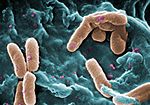 Pseudomonas aeruginosa (bacteria)
 Authors
 United States, 3 items
  Citation
 Structure visualization
 Downloads & links
 EMDB map data format
 emd_49273.png
 https://data.pdbj.org/pub/emdb/structures/EMD-49273

 Z (Sec.)
 Y (Row.)
 X (Col.)


 Sample components
 Processing
 Electron microscopy
 FIELD EMISSION GUN

