- EMDB-48887: Amino-terminal domain for GluK2-1xNeto2 in the apo state -
+
Open data
ID or keywords:
Loading...
-
Basic information
Entry
Database: EMDB / ID: EMD-48887
Title
Amino-terminal domain for GluK2-1xNeto2 in the apo state
Map data
Amino-terminal domain for GluK2-1xNeto2 in the apo state
Sample
Complex: Amino-terminal domain for GluK2-1xNeto2 in the apo state
Protein or peptide: Glutamate ionotropic receptor kainate type subunit 2 (GluK2)
Protein or peptide: Neuropilin and tolloid-like protein 2 (Neto2)
Keywords
Kainate receptor / GluK2 / Ion Channel / Neto2 / MEMBRANE PROTEIN
Function / homology
Function and homology information
mossy fiber rosette / detection of cold stimulus involved in thermoception / Activation of Na-permeable kainate receptors / regulation of short-term neuronal synaptic plasticity / Activation of Ca-permeable Kainate Receptor / kainate selective glutamate receptor complex / negative regulation of synaptic transmission, glutamatergic / ubiquitin conjugating enzyme binding / regulation of JNK cascade / glutamate receptor activity ...mossy fiber rosette / detection of cold stimulus involved in thermoception / Activation of Na-permeable kainate receptors / regulation of short-term neuronal synaptic plasticity / Activation of Ca-permeable Kainate Receptor / kainate selective glutamate receptor complex / negative regulation of synaptic transmission, glutamatergic / ubiquitin conjugating enzyme binding / regulation of JNK cascade / glutamate receptor activity / inhibitory postsynaptic potential / behavioral fear response / neurotransmitter receptor localization to postsynaptic specialization membrane / receptor clustering / glutamate receptor signaling pathway / regulation of neurotransmitter receptor localization to postsynaptic specialization membrane / kainate selective glutamate receptor activity / neuronal action potential / extracellularly glutamate-gated ion channel activity / ionotropic glutamate receptor complex / modulation of excitatory postsynaptic potential / neuron apoptotic process / positive regulation of synaptic transmission / regulation of long-term neuronal synaptic plasticity / glutamate-gated receptor activity / glutamate-gated calcium ion channel activity / ionotropic glutamate receptor binding / dendrite cytoplasm / ligand-gated monoatomic ion channel activity involved in regulation of presynaptic membrane potential / excitatory postsynaptic potential / hippocampal mossy fiber to CA3 synapse / SNARE binding / PDZ domain binding / synaptic transmission, glutamatergic / transmitter-gated monoatomic ion channel activity involved in regulation of postsynaptic membrane potential / regulation of membrane potential / intracellular protein transport / postsynaptic density membrane / intracellular calcium ion homeostasis / modulation of chemical synaptic transmission / positive regulation of neuron apoptotic process / terminal bouton / negative regulation of neuron apoptotic process / scaffold protein binding / presynaptic membrane / chemical synaptic transmission / perikaryon / postsynaptic membrane / postsynaptic density / axon / ubiquitin protein ligase binding / neuronal cell body / synapse / dendrite / glutamatergic synapse / membrane / identical protein binding / plasma membrane Similarity search - Function
CUB domain / Domain first found in C1r, C1s, uEGF, and bone morphogenetic protein. / CUB domain / Spermadhesin, CUB domain superfamily / CUB domain profile. / Low-density lipoprotein receptor domain class A / Low-density lipoprotein (LDL) receptor class A, conserved site / LDL-receptor class A (LDLRA) domain signature. / LDL-receptor class A (LDLRA) domain profile. / Low-density lipoprotein receptor domain class A ...CUB domain / Domain first found in C1r, C1s, uEGF, and bone morphogenetic protein. / CUB domain / Spermadhesin, CUB domain superfamily / CUB domain profile. / Low-density lipoprotein receptor domain class A / Low-density lipoprotein (LDL) receptor class A, conserved site / LDL-receptor class A (LDLRA) domain signature. / LDL-receptor class A (LDLRA) domain profile. / Low-density lipoprotein receptor domain class A / Low-density lipoprotein (LDL) receptor class A repeat / LDL receptor-like superfamily / Ionotropic glutamate receptor, metazoa / Ligated ion channel L-glutamate- and glycine-binding site / Ligand-gated ion channel / Ionotropic glutamate receptor, L-glutamate and glycine-binding domain / Ligated ion channel L-glutamate- and glycine-binding site / : / Ionotropic glutamate receptor / Eukaryotic homologues of bacterial periplasmic substrate binding proteins. / Receptor, ligand binding region / Receptor family ligand binding region / Periplasmic binding protein-like I Similarity search - Domain/homology
In the structure databanks used in Yorodumi, some data are registered as the other names, "COVID-19 virus" and "2019-nCoV". Here are the details of the virus and the list of structure data.
Jan 31, 2019. EMDB accession codes are about to change! (news from PDBe EMDB page)
EMDB accession codes are about to change! (news from PDBe EMDB page)
The allocation of 4 digits for EMDB accession codes will soon come to an end. Whilst these codes will remain in use, new EMDB accession codes will include an additional digit and will expand incrementally as the available range of codes is exhausted. The current 4-digit format prefixed with “EMD-” (i.e. EMD-XXXX) will advance to a 5-digit format (i.e. EMD-XXXXX), and so on. It is currently estimated that the 4-digit codes will be depleted around Spring 2019, at which point the 5-digit format will come into force.
The EM Navigator/Yorodumi systems omit the EMD- prefix.
Related info.:Q: What is EMD? / ID/Accession-code notation in Yorodumi/EM Navigator
Yorodumi is a browser for structure data from EMDB, PDB, SASBDB, etc.
This page is also the successor to EM Navigator detail page, and also detail information page/front-end page for Omokage search.
The word "yorodu" (or yorozu) is an old Japanese word meaning "ten thousand". "mi" (miru) is to see.
Related info.:EMDB / PDB / SASBDB / Comparison of 3 databanks / Yorodumi Search / Aug 31, 2016. New EM Navigator & Yorodumi / Yorodumi Papers / Jmol/JSmol / Function and homology information / Changes in new EM Navigator and Yorodumi
 Movie
Movie Controller


 Open data
 Basic information
 Map data
 Sample
 Keywords
 Function and homology information
 Rattus norvegicus (Norway rat)
 Authors
 United States, 5 items
  Citation
 Structure visualization
 Downloads & links
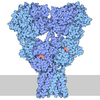
 emd_48887.png
 https://data.pdbj.org/pub/emdb/structures/EMD-48887
 Z (Sec.)
 Y (Row.)
 X (Col.)


 Sample components
 Homo sapiens (human)
 Processing
 Electron microscopy
 FIELD EMISSION GUN

