[English] 日本語
Yorodumi
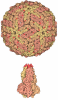
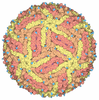
- EMDB-48667: Dengue virus serotype-4 (DENV4) complex with DCSIGN CRD at 4C -

+
Open data


ID or keywords:

Loading...

-
Basic information

Entry
Database: EMDB / ID: EMD-48667
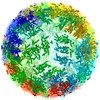
TitleDengue virus serotype-4 (DENV4) complex with DCSIGN CRD at 4C
Map dataDENV4 DCSIGN CRD main map
Sample
  • Virus: Dengue virus 4 Dominica/814669/1981
    • Protein or peptide: envelope protein E
    • Protein or peptide: M protein
    • Protein or peptide: DC-SIGN CRD
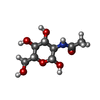
  • Ligand: 2-acetamido-2-deoxy-beta-D-glucopyranose
  • Ligand: CALCIUM ION
KeywordsDENV4 / DCSIGN / VIRUS / Structural Genomics / Center for Structural Biology of Infectious Diseases / CSBID
Function / homology
Function and homology information


B cell adhesion / immature T cell proliferation / cell-cell recognition / dendritic cell migration / intracellular transport of virus / cell adhesion receptor activity / peptide antigen transport / Butyrophilin (BTN) family interactions / positive regulation of viral life cycle / virion binding ...B cell adhesion / immature T cell proliferation / cell-cell recognition / dendritic cell migration / intracellular transport of virus / cell adhesion receptor activity / peptide antigen transport / Butyrophilin (BTN) family interactions / positive regulation of viral life cycle / virion binding / heterophilic cell-cell adhesion / antigen processing and presentation / leukocyte cell-cell adhesion / regulation of T cell proliferation / pattern recognition receptor activity / D-mannose binding / RSV-host interactions / flavivirin / symbiont-mediated suppression of host JAK-STAT cascade via inhibition of host TYK2 activity / Dengue Virus Attachment and Entry / host cell mitochondrion / symbiont-mediated suppression of host JAK-STAT cascade via inhibition of STAT2 activity / positive regulation of T cell proliferation / symbiont-mediated suppression of host cytoplasmic pattern recognition receptor signaling pathway via inhibition of MAVS activity / CD209 (DC-SIGN) signaling / viral genome replication / peptide antigen binding / endocytosis / viral capsid / host cell / nucleoside-triphosphate phosphatase / double-stranded RNA binding / carbohydrate binding / virus receptor activity / channel activity / monoatomic ion transmembrane transport / clathrin-dependent endocytosis of virus by host cell / mRNA (guanine-N7)-methyltransferase / methyltransferase cap1 / molecular adaptor activity / adaptive immune response / methyltransferase cap1 activity / mRNA 5'-cap (guanine-N7-)-methyltransferase activity / RNA helicase activity / protein dimerization activity / intracellular signal transduction / immune response / host cell perinuclear region of cytoplasm / host cell endoplasmic reticulum membrane / RNA helicase / symbiont-mediated suppression of host type I interferon-mediated signaling pathway / membrane raft / serine-type endopeptidase activity / external side of plasma membrane / symbiont-mediated activation of host autophagy / innate immune response / RNA-directed RNA polymerase / viral RNA genome replication / RNA-directed RNA polymerase activity / fusion of virus membrane with host endosome membrane / viral envelope / symbiont entry into host cell / lipid binding / virion attachment to host cell / host cell nucleus / virion membrane / structural molecule activity / cell surface / ATP hydrolysis activity / proteolysis / extracellular region / ATP binding / membrane / metal ion binding / plasma membrane / cytoplasm
Similarity search - Function
CD209-like, C-type lectin-like domain / : / C-type lectin, conserved site / C-type lectin domain signature. / Lectin C-type domain / C-type lectin domain profile. / C-type lectin-like / C-type lectin (CTL) or carbohydrate-recognition domain (CRD) / C-type lectin-like/link domain superfamily / C-type lectin fold ...CD209-like, C-type lectin-like domain / : / C-type lectin, conserved site / C-type lectin domain signature. / Lectin C-type domain / C-type lectin domain profile. / C-type lectin-like / C-type lectin (CTL) or carbohydrate-recognition domain (CRD) / C-type lectin-like/link domain superfamily / C-type lectin fold / Flavivirus capsid protein C superfamily / Flavivirus non-structural protein NS2B / Genome polyprotein, Flavivirus / : / Flavivirus non-structural protein NS4A / Flavivirus non-structural protein NS2B / Flavivirus non-structural protein NS4B / mRNA cap 0/1 methyltransferase / Flavivirus non-structural protein NS4B / Flavivirus non-structural protein NS4A / Flavivirus NS2B domain profile. / mRNA cap 0 and cap 1 methyltransferase (EC 2.1.1.56 and EC 2.1.1.57) domain profile. / Flavivirus non-structural protein NS2A / Flavivirus non-structural protein NS2A / Flavivirus NS3, petidase S7 / Peptidase S7, Flavivirus NS3 serine protease / Flavivirus NS3 protease (NS3pro) domain profile. / RNA-directed RNA polymerase, thumb domain, Flavivirus / Flavivirus RNA-directed RNA polymerase, thumb domain / RNA-directed RNA polymerase, flavivirus / Flavivirus RNA-directed RNA polymerase, fingers and palm domains / Flavivirus capsid protein C / Flavivirus capsid protein C / Flavivirus non-structural Protein NS1 / Flavivirus non-structural protein NS1 / Envelope glycoprotein M superfamily, flavivirus / Envelope glycoprotein M, flavivirus / Flavivirus polyprotein propeptide superfamily / Flavivirus envelope glycoprotein M / Flavivirus polyprotein propeptide / Flavivirus polyprotein propeptide / : / Flavivirus NS3 helicase, C-terminal helical domain / Flavivirus envelope glycoprotein E, Stem/Anchor domain superfamily / Flavivirus envelope glycoprotein E, stem/anchor domain / Flavivirus envelope glycoprotein E, Stem/Anchor domain / Flaviviral glycoprotein E, central domain, subdomain 1 / Flaviviral glycoprotein E, central domain, subdomain 2 / Flavivirus glycoprotein E, immunoglobulin-like domain / Flavivirus glycoprotein, immunoglobulin-like domain / Flavivirus glycoprotein central and dimerisation domain / Flavivirus glycoprotein, central and dimerisation domains / Ribosomal RNA methyltransferase, FtsJ domain / FtsJ-like methyltransferase / Flavivirus/Alphavirus glycoprotein, immunoglobulin-like domain superfamily / Flavivirus glycoprotein, central and dimerisation domain superfamily / Flaviviral glycoprotein E, dimerisation domain / DEAD box, Flavivirus / Flavivirus DEAD domain / Immunoglobulin E-set / helicase superfamily c-terminal domain / Superfamilies 1 and 2 helicase C-terminal domain profile. / Superfamilies 1 and 2 helicase ATP-binding type-1 domain profile. / DEAD-like helicases superfamily / Helicase, C-terminal / Helicase superfamily 1/2, ATP-binding domain / RNA-directed RNA polymerase, catalytic domain / RdRp of positive ssRNA viruses catalytic domain profile. / S-adenosyl-L-methionine-dependent methyltransferase superfamily / Peptidase S1, PA clan, chymotrypsin-like fold / Peptidase S1, PA clan / DNA/RNA polymerase superfamily / P-loop containing nucleoside triphosphate hydrolase
Similarity search - Domain/homology
Genome polyprotein / CD209 antigen
Similarity search - Component
Biological speciesDengue virus 4 Dominica/814669/1981 / Homo sapiens (human)
Methodsingle particle reconstruction / cryo EM / Resolution: 3.73 Å
AuthorsAre VN / Fokine A / Klose T / Kuhn RJ / Center for Structural Biology of Infectious Diseases (CSBID)
Funding support United States, 1 items
OrganizationGrant numberCountry
National Institutes of Health/National Institute Of Allergy and Infectious Diseases (NIH/NIAID)U01 AI11001613 United States
CitationJournal: To Be Published
Title: Cryo-EM structures and biochemical assays demonstrate dengue viruses utilize heparin and glycan binding receptor DC-SIGN for infection
Authors: Are VN / Kuhn RJ
History
DepositionJan 15, 2025-
Header (metadata) releaseJul 22, 2026-
Map releaseJul 22, 2026-
UpdateJul 22, 2026-
Current statusJul 22, 2026Processing site: RCSB / Status: Released

-
Structure visualization

Supplemental images

Downloads & links

-
Map

FileDownload / File: emd_48667.map.gz / Format: CCP4 / Size: 512 MB / Type: IMAGE STORED AS FLOATING POINT NUMBER (4 BYTES)
AnnotationDENV4 DCSIGN CRD main map
Projections & slices

Image control

Size
Brightness
Contrast
Others
AxesZ (Sec.)Y (Row.)X (Col.)
1.69 Å/pix.
x 512 pix.
= 863.181 Å
1.69 Å/pix.
x 512 pix.
= 863.181 Å
1.69 Å/pix.
x 512 pix.
= 863.181 Å

Surface

Projections

Slices (1/3)

Slices (1/2)

Slices (2/3)

Images are generated by Spider.

Voxel sizeX=Y=Z: 1.6859 Å
Density
Contour LevelBy AUTHOR: 0.25
Minimum - Maximum-0.8475578 - 1.6796032
Average (Standard dev.)-0.004266023 (±0.08628969)
SymmetrySpace group: 1
Details

EMDB XML:

Map geometry
Axis orderXYZ
Origin000
Dimensions512512512
Spacing512512512
CellA=B=C: 863.1808 Å
α=β=γ: 90.0 °

-
Supplemental data

-
Half map: half map B

Fileemd_48667_half_map_1.map
Annotationhalf map B
Projections & Slices
AxesZYX

Projections

Slices (1/2)
Density Histograms

-
Half map: half map A

Fileemd_48667_half_map_2.map
Annotationhalf map A
Projections & Slices
AxesZYX

Projections

Slices (1/2)
Density Histograms

-
Sample components

-
Entire : Dengue virus 4 Dominica/814669/1981

EntireName: Dengue virus 4 Dominica/814669/1981
Components
  • Virus: Dengue virus 4 Dominica/814669/1981
    • Protein or peptide: envelope protein E
    • Protein or peptide: M protein
    • Protein or peptide: DC-SIGN CRD
  • Ligand: 2-acetamido-2-deoxy-beta-D-glucopyranose
  • Ligand: CALCIUM ION

-
Supramolecule #1: Dengue virus 4 Dominica/814669/1981

SupramoleculeName: Dengue virus 4 Dominica/814669/1981 / type: virus / ID: 1 / Parent: 0 / Macromolecule list: #1-#3 / NCBI-ID: 408871 / Sci species name: Dengue virus 4 Dominica/814669/1981 / Virus type: VIRION / Virus isolate: STRAIN / Virus enveloped: Yes / Virus empty: No
Molecular weightTheoretical: 45 MDa

-
Macromolecule #1: envelope protein E

MacromoleculeName: envelope protein E / type: protein_or_peptide / ID: 1 / Number of copies: 3 / Enantiomer: LEVO
Source (natural)Organism: Dengue virus 4 Dominica/814669/1981
Molecular weightTheoretical: 54.051969 KDa
Recombinant expressionOrganism: Aedes albopictus (Asian tiger mosquito)
SequenceString: MRCVGVGNRD FVEGVSGGAW VDLVLEHGGC VTTMAQGKPT LDFELTKTTA KEVALLRTYC IEASISNITT ATRCPTQGEP YLKEEQDQQ YICRRDVVDR GWGNGCGLFG KGGVVTCAKF SCSGKITGNL VQIENLEYTV VVTVHNGDTH AVGNDTSNHG V TAMITPRS ...String:
MRCVGVGNRD FVEGVSGGAW VDLVLEHGGC VTTMAQGKPT LDFELTKTTA KEVALLRTYC IEASISNITT ATRCPTQGEP YLKEEQDQQ YICRRDVVDR GWGNGCGLFG KGGVVTCAKF SCSGKITGNL VQIENLEYTV VVTVHNGDTH AVGNDTSNHG V TAMITPRS PSVEVKLPDY GELTLDCEPR SGIDFNEMIL MKMKKKTWLV HKQWFLDLPL PWTAGADTSE VHWNYKERMV TF KVPHAKR QDVTVLGSQE GAMHSALAGA TEVDSGDGNH MFAGHLKCKV RMEKLRIKGM SYTMCSGKFS IDKEMAETQH GTT VVKVKY EGAGAPCKVP IEIRDVNKEK VVGRIISSTP LAENTNSVTN IELEPPFGDS YIVIGVGNSA LTLHWFRKGS SIGK MFEST YRGAKRMAIL GETAWDFGSV GGLFTSLGKA VHQVFGSVYT TMFGGVSWMI RILIGFLVLW IGTNSRNTSM AMTCI AVGG ITLFLGFTVQ A

UniProtKB: Genome polyprotein

-
Macromolecule #2: M protein

MacromoleculeName: M protein / type: protein_or_peptide / ID: 2 / Number of copies: 3 / Enantiomer: LEVO
Source (natural)Organism: Dengue virus 4 Dominica/814669/1981
Molecular weightTheoretical: 8.242602 KDa
Recombinant expressionOrganism: Aedes albopictus (Asian tiger mosquito)
SequenceString:
SVALTPHSGM GLETRAETWM SSEGAWKHAQ RVESWILRNP GFALLAGFMA YMIGQTGIQR TVFFVLMMLV APSY

UniProtKB: Genome polyprotein

-
Macromolecule #3: DC-SIGN CRD

MacromoleculeName: DC-SIGN CRD / type: protein_or_peptide / ID: 3 / Number of copies: 3 / Enantiomer: LEVO
Source (natural)Organism: Homo sapiens (human)
Molecular weightTheoretical: 21.680691 KDa
Recombinant expressionOrganism: Escherichia coli 'BL21-Gold(DE3)pLysS AG' (bacteria)
SequenceString: MASWSHPQFE KGSSHHHHHH SSGSGGGGGE NLYFQGSERL CHPCPWEWTF FQGNCYFMSN SQRNWHDSIT ACKEVGAQLV VIKSAEEQN FLQLQSSRSN RFTWMGLSDL NQEGTWQWVD GSPLLPSFKQ YWNRGEPNNV GEEDCAEFSG NGWNDDKCNL A KFWICKKS ...String:
MASWSHPQFE KGSSHHHHHH SSGSGGGGGE NLYFQGSERL CHPCPWEWTF FQGNCYFMSN SQRNWHDSIT ACKEVGAQLV VIKSAEEQN FLQLQSSRSN RFTWMGLSDL NQEGTWQWVD GSPLLPSFKQ YWNRGEPNNV GEEDCAEFSG NGWNDDKCNL A KFWICKKS AASCSRDEEQ FLSPAPATPN PPPA

UniProtKB: CD209 antigen

-
Macromolecule #4: 2-acetamido-2-deoxy-beta-D-glucopyranose

MacromoleculeName: 2-acetamido-2-deoxy-beta-D-glucopyranose / type: ligand / ID: 4 / Number of copies: 6 / Formula: NAG
Molecular weightTheoretical: 221.208 Da
Chemical component information

ChemComp-NAG:
2-acetamido-2-deoxy-beta-D-glucopyranose

-
Macromolecule #5: CALCIUM ION

MacromoleculeName: CALCIUM ION / type: ligand / ID: 5 / Number of copies: 9 / Formula: CA
Molecular weightTheoretical: 40.078 Da

-
Experimental details

-
Structure determination

Methodcryo EM
Processingsingle particle reconstruction
Aggregation stateparticle

-
Sample preparation

BufferpH: 8
Component:
ConcentrationFormulaName
20.0 mMC4H12ClNO3Tris-HCl
120.0 mMNaClSodium chloride
10.0 mMCaCl2Calcium chloride

Details: 1x NT buffer pH 8.0
GridModel: PELCO Ultrathin Carbon with Lacey Carbon / Material: COPPER / Mesh: 400 / Support film - Material: CARBON / Support film - topology: LACEY / Pretreatment - Type: GLOW DISCHARGE / Pretreatment - Time: 60 sec. / Pretreatment - Atmosphere: AIR
VitrificationCryogen name: ETHANE / Chamber humidity: 90 % / Chamber temperature: 298 K / Instrument: LEICA EM GP

-
Electron microscopy

MicroscopeTFS KRIOS
Specialist opticsEnergy filter - Name: GIF Bioquantum / Energy filter - Slit width: 20 eV
SoftwareName: Leginon
Image recordingFilm or detector model: GATAN K3 BIOCONTINUUM (6k x 4k) / Number grids imaged: 1 / Number real images: 1815 / Average exposure time: 3.0 sec. / Average electron dose: 35.4 e/Å2
Electron beamAcceleration voltage: 300 kV / Electron source: FIELD EMISSION GUN
Electron opticsIllumination mode: FLOOD BEAM / Imaging mode: BRIGHT FIELD / Cs: 2.7 mm / Nominal defocus max: 2.0 µm / Nominal defocus min: 0.6 µm / Nominal magnification: 64000
Sample stageSpecimen holder model: FEI TITAN KRIOS AUTOGRID HOLDER / Cooling holder cryogen: NITROGEN
Experimental equipment
Model: Titan Krios / Image courtesy: FEI Company

+
Image processing

CTF correctionSoftware - Name: cryoSPARC / Type: PHASE FLIPPING AND AMPLITUDE CORRECTION
Startup modelType of model: OTHER
Final reconstructionApplied symmetry - Point group: I (icosahedral) / Resolution.type: BY AUTHOR / Resolution: 3.73 Å / Resolution method: FSC 0.143 CUT-OFF / Software - Name: cryoSPARC / Number images used: 17896
Initial angle assignmentType: MAXIMUM LIKELIHOOD / Software - Name: cryoSPARC
Final angle assignmentType: MAXIMUM LIKELIHOOD / Software - Name: cryoSPARC
Final 3D classificationSoftware - Name: cryoSPARC
FSC plot (resolution estimation)

-
Atomic model buiding 1

Initial model
PDB IDChain

chain_id: AB, source_name: PDB, initial_model_type: experimental model

chain_id: A, source_name: PDB, initial_model_type: experimental model
SoftwareName: UCSF Chimera
RefinementSpace: REAL / Protocol: RIGID BODY FIT
Output model

PDB-9mvf:
Dengue virus serotype-4 (DENV4) complex with DCSIGN CRD at 4C

+
About Yorodumi

-
News

-
Feb 9, 2022. New format data for meta-information of EMDB entries

New format data for meta-information of EMDB entries

  • Version 3 of the EMDB header file is now the official format.
  • The previous official version 1.9 will be removed from the archive.

Related info.:EMDB header

External links:wwPDB to switch to version 3 of the EMDB data model

-
Aug 12, 2020. Covid-19 info

Covid-19 info

URL: https://pdbj.org/emnavi/covid19.php

New page: Covid-19 featured information page in EM Navigator.

Related info.:Covid-19 info / Mar 5, 2020. Novel coronavirus structure data

+
Mar 5, 2020. Novel coronavirus structure data

Novel coronavirus structure data

Related info.:Yorodumi Speices / Aug 12, 2020. Covid-19 info

External links:COVID-19 featured content - PDBj / Molecule of the Month (242):Coronavirus Proteases

+
Jan 31, 2019. EMDB accession codes are about to change! (news from PDBe EMDB page)

EMDB accession codes are about to change! (news from PDBe EMDB page)

  • The allocation of 4 digits for EMDB accession codes will soon come to an end. Whilst these codes will remain in use, new EMDB accession codes will include an additional digit and will expand incrementally as the available range of codes is exhausted. The current 4-digit format prefixed with “EMD-” (i.e. EMD-XXXX) will advance to a 5-digit format (i.e. EMD-XXXXX), and so on. It is currently estimated that the 4-digit codes will be depleted around Spring 2019, at which point the 5-digit format will come into force.
  • The EM Navigator/Yorodumi systems omit the EMD- prefix.

Related info.:Q: What is EMD? / ID/Accession-code notation in Yorodumi/EM Navigator

External links:EMDB Accession Codes are Changing Soon! / Contact to PDBj

+
Jul 12, 2017. Major update of PDB

Major update of PDB

  • wwPDB released updated PDB data conforming to the new PDBx/mmCIF dictionary.
  • This is a major update changing the version number from 4 to 5, and with Remediation, in which all the entries are updated.
  • In this update, many items about electron microscopy experimental information are reorganized (e.g. em_software).
  • Now, EM Navigator and Yorodumi are based on the updated data.

External links:wwPDB Remediation / Enriched Model Files Conforming to OneDep Data Standards Now Available in the PDB FTP Archive

-
Yorodumi

Thousand views of thousand structures

  • Yorodumi is a browser for structure data from EMDB, PDB, SASBDB, etc.
  • This page is also the successor to EM Navigator detail page, and also detail information page/front-end page for Omokage search.
  • The word "yorodu" (or yorozu) is an old Japanese word meaning "ten thousand". "mi" (miru) is to see.

Related info.:EMDB / PDB / SASBDB / Comparison of 3 databanks / Yorodumi Search / Aug 31, 2016. New EM Navigator & Yorodumi / Yorodumi Papers / Jmol/JSmol / Function and homology information / Changes in new EM Navigator and Yorodumi

Read more