[English] 日本語
Yorodumi
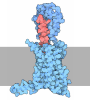
- EMDB-48385: CGRP Receptor in complex with C8 Minibinder -

+
Open data


ID or keywords:

Loading...

-
Basic information

Entry
Database: EMDB / ID: EMD-48385
TitleCGRP Receptor in complex with C8 Minibinder
Map dataRELION 5.0 (BLUSH maximization) refinement
Sample
  • Complex: CGRP Receptor in complex with dC2_049
    • Protein or peptide: De novo designed minibinder - dC2_049
    • Protein or peptide: Receptor activity-modifying protein 1
    • Protein or peptide: Calcitonin gene-related peptide type 1 receptor
KeywordsGPCR / denovo protein design / MEMBRANE PROTEIN
Function / homology
Function and homology information


calcitonin gene-related peptide binding / cellular response to sucrose stimulus / adrenomedullin binding / CGRP receptor complex / adrenomedullin receptor activity / adrenomedullin receptor complex / adrenomedullin receptor signaling pathway / amylin receptor activity / calcitonin receptor activity / calcitonin gene-related peptide receptor signaling pathway ...calcitonin gene-related peptide binding / cellular response to sucrose stimulus / adrenomedullin binding / CGRP receptor complex / adrenomedullin receptor activity / adrenomedullin receptor complex / adrenomedullin receptor signaling pathway / amylin receptor activity / calcitonin receptor activity / calcitonin gene-related peptide receptor signaling pathway / calcitonin gene-related peptide receptor activity / positive regulation of glycoprotein biosynthetic process / amylin receptor 1 signaling pathway / amylin receptor signaling pathway / Calcitonin-like ligand receptors / regulation of G protein-coupled receptor signaling pathway / G protein-coupled receptor signaling pathway, coupled to cyclic nucleotide second messenger / coreceptor activity / cellular response to hormone stimulus / protein localization to plasma membrane / receptor internalization / intracellular protein transport / G protein-coupled receptor activity / calcium ion transport / protein transport / angiogenesis / adenylate cyclase-activating G protein-coupled receptor signaling pathway / High laminar flow shear stress activates signaling by PIEZO1 and PECAM1:CDH5:KDR in endothelial cells / G alpha (s) signalling events / signaling receptor complex / cell surface receptor signaling pathway / lysosome / endosome / G protein-coupled receptor signaling pathway / cell surface / endoplasmic reticulum / plasma membrane / cytoplasm
Similarity search - Function
GPCR, family 2, calcitonin gene-related peptide, type 1 receptor / Receptor activity modifying protein / RAMP domain superfamily / Receptor activity modifying family / GPCR, family 2, calcitonin receptor family / G-protein coupled receptors family 2 signature 1. / : / GPCR, family 2, extracellular hormone receptor domain / G-protein coupled receptors family 2 profile 1. / Domain present in hormone receptors ...GPCR, family 2, calcitonin gene-related peptide, type 1 receptor / Receptor activity modifying protein / RAMP domain superfamily / Receptor activity modifying family / GPCR, family 2, calcitonin receptor family / G-protein coupled receptors family 2 signature 1. / : / GPCR, family 2, extracellular hormone receptor domain / G-protein coupled receptors family 2 profile 1. / Domain present in hormone receptors / Hormone receptor domain / GPCR family 2, extracellular hormone receptor domain superfamily / G-protein coupled receptors family 2 signature 2. / GPCR, family 2, secretin-like, conserved site / GPCR, family 2, secretin-like / 7 transmembrane receptor (Secretin family) / GPCR, family 2-like / G-protein coupled receptors family 2 profile 2.
Similarity search - Domain/homology
Receptor activity-modifying protein 1 / Calcitonin gene-related peptide type 1 receptor
Similarity search - Component
Biological speciesHomo sapiens (human) / synthetic construct (others)
Methodsingle particle reconstruction / cryo EM / Resolution: 3.26 Å
AuthorsCao J / Cary BP / Belousoff MJ / Wootten DL
Funding support Australia, 4 items
OrganizationGrant numberCountry
National Health and Medical Research Council (NHMRC, Australia)1150083 Australia
Australian Research Council (ARC)DP210101504 Australia
National Health and Medical Research Council (NHMRC, Australia)2026300 Australia
Australian Research Council (ARC)IC200100052 Australia
CitationJournal: Nature / Year: 2026
Title: De novo design of miniproteins targeting GPCRs.
Authors: Edin Muratspahić / David Feldman / David E Kim / Xiangli Qu / Ana-Maria Bratovianu / Paula Rivera-Sánchez / Jan Hendrik Voss / Emil P T Hertz / Mads Jeppesen / Federica Dimitri / Kensuke ...Authors: Edin Muratspahić / David Feldman / David E Kim / Xiangli Qu / Ana-Maria Bratovianu / Paula Rivera-Sánchez / Jan Hendrik Voss / Emil P T Hertz / Mads Jeppesen / Federica Dimitri / Kensuke Sakamoto / Amrita Nallathambi / Pia Peceli / Jianjun Cao / Brian P Cary / Matthew J Belousoff / Peter Keov / Phuc N H Trinh / Qingchao Chen / Yue Ren / Justyn Fine / Sudha Mishra / Annu Dalal / Shachie Sinha / Ramanuj Banerjee / Manisankar Ganguly / Karthik Varappalayam Karuppusamy / Isaac Sappington / Thomas Schlichthaerle / Jason Z Zhang / Arvind Pillai / Brian Coventry / Ljubica Mihaljević / Magnus S Bauer / Susana Vázquez Torres / Amir Motmaen / Gyu Rie Lee / Long Tran / Xinru Wang / Inna Goreshnik / Dionne K Vafeados / Justin E Svendsen / Parisa Hosseinzadeh / Nicolai Lindegaard / Matthäus Brandt / Yann Waltenspühl / Kristine Deibler / Lukas Deweid / Anja Bennett / Jendrik Schöppe / Tiantang Dong / Xiaoli Yan / Luke Oostdyk / William Cao / Lakshmi Anantharaman / Johan J Weisser / Jesper Frank Bastlund / Christoffer Bundgaard / Ayodeji A Asuni / Justin G English / Lance J Stewart / Lauren Halloran / Jamie B Spangler / André Lieber / Arun K Shukla / Patrick M Sexton / Bryan L Roth / Brian E Krumm / Denise Wootten / Christopher G Tate / Christoffer Norn / David Baker /
Abstract: G-protein-coupled receptors (GPCRs) have key roles in physiology and are central targets for drug discovery and development, but the design of protein agonists and antagonists has been challenging as ...G-protein-coupled receptors (GPCRs) have key roles in physiology and are central targets for drug discovery and development, but the design of protein agonists and antagonists has been challenging as GPCRs are integral membrane proteins and conformationally dynamic. Here we describe de novo design methods and a high-throughput receptor-diversion microscopy-based screen for generating GPCR-binding miniproteins with high affinity, potency and selectivity. We design miniprotein agonists that activate receptors involved in itch and pain, as well as antagonists that inhibit receptors implicated in cancer, metabolic disorders such as diabetes and obesity, and migraines. The cryo-electron microscopy (cryo-EM) structures of five receptor-bound designs are close to the computational design models. A designed chemokine receptor antagonist mobilizes haematopoietic stem and progenitor cells in vivo at a level comparable to a clinically used drug, with fewer adverse effects.
History
DepositionDec 19, 2024-
Header (metadata) releaseJan 28, 2026-
Map releaseJan 28, 2026-
UpdateAug 12, 2026-
Current statusAug 12, 2026Processing site: RCSB / Status: Released

-
Structure visualization

Supplemental images

Downloads & links

-
Map

FileDownload / File: emd_48385.map.gz / Format: CCP4 / Size: 64 MB / Type: IMAGE STORED AS FLOATING POINT NUMBER (4 BYTES)
AnnotationRELION 5.0 (BLUSH maximization) refinement
Projections & slices

Image control

Size
Brightness
Contrast
Others
AxesZ (Sec.)Y (Row.)X (Col.)
0.75 Å/pix.
x 256 pix.
= 192. Å
0.75 Å/pix.
x 256 pix.
= 192. Å
0.75 Å/pix.
x 256 pix.
= 192. Å

Surface

Projections

Slices (1/3)

Slices (1/2)

Slices (2/3)

Images are generated by Spider.

Voxel sizeX=Y=Z: 0.75 Å
Density
Contour LevelBy AUTHOR: 0.00377
Minimum - Maximum-0.006181121 - 0.014504547
Average (Standard dev.)-0.000055999364 (±0.0005681656)
SymmetrySpace group: 1
Details

EMDB XML:

Map geometry
Axis orderXYZ
Origin000
Dimensions256256256
Spacing256256256
CellA=B=C: 192.0 Å
α=β=γ: 90.0 °

-
Supplemental data

-
Mask #1

Fileemd_48385_msk_1.map
Projections & Slices
AxesZYX

Projections

Slices (1/2)
Density Histograms

-
Additional map: cryosparc refinement, unsharpened map

Fileemd_48385_additional_1.map
Annotationcryosparc refinement, unsharpened map
Projections & Slices
AxesZYX

Projections

Slices (1/2)
Density Histograms

-
Additional map: cryosparc refinement, sharpened map

Fileemd_48385_additional_2.map
Annotationcryosparc refinement, sharpened map
Projections & Slices
AxesZYX

Projections

Slices (1/2)
Density Histograms

-
Half map: cryosparc refinement, half-map 1

Fileemd_48385_half_map_1.map
Annotationcryosparc refinement, half-map 1
Projections & Slices
AxesZYX

Projections

Slices (1/2)
Density Histograms

-
Half map: cryosparc refinement, half-map 2

Fileemd_48385_half_map_2.map
Annotationcryosparc refinement, half-map 2
Projections & Slices
AxesZYX

Projections

Slices (1/2)
Density Histograms

-
Sample components

-
Entire : CGRP Receptor in complex with dC2_049

EntireName: CGRP Receptor in complex with dC2_049
Components
  • Complex: CGRP Receptor in complex with dC2_049
    • Protein or peptide: De novo designed minibinder - dC2_049
    • Protein or peptide: Receptor activity-modifying protein 1
    • Protein or peptide: Calcitonin gene-related peptide type 1 receptor

-
Supramolecule #1: CGRP Receptor in complex with dC2_049

SupramoleculeName: CGRP Receptor in complex with dC2_049 / type: complex / ID: 1 / Parent: 0 / Macromolecule list: all
Source (natural)Organism: Homo sapiens (human)

-
Macromolecule #1: De novo designed minibinder - dC2_049

MacromoleculeName: De novo designed minibinder - dC2_049 / type: protein_or_peptide / ID: 1 / Number of copies: 1 / Enantiomer: LEVO
Source (natural)Organism: synthetic construct (others)
Molecular weightTheoretical: 7.970083 KDa
Recombinant expressionOrganism: Escherichia coli (E. coli)
SequenceString:
DTNFELGVEY FMLGLQALVH GDYDNAIKYF NKAIEYFKKS SDKEKAAKYI ALAQKYIDEA KKLKAEKEA

-
Macromolecule #2: Receptor activity-modifying protein 1

MacromoleculeName: Receptor activity-modifying protein 1 / type: protein_or_peptide / ID: 2 / Number of copies: 1 / Enantiomer: LEVO
Source (natural)Organism: Homo sapiens (human)
Molecular weightTheoretical: 17.066701 KDa
Recombinant expressionOrganism: Trichoplusia ni (cabbage looper)
SequenceString:
MKTIIALSYI FCLVFADYKD DDDKHGSCQE ANYGALLREL CLTQFQVDME AVGETLWCDW GRTIRSYREL ADCTWHMAEK LGCFWPNAE VDRFFLAVHG RYFRSCPISG RAVRDPPGSI LYPFIVVPIT VTLLVTALVV WQSKRTEGIV

UniProtKB: Receptor activity-modifying protein 1

-
Macromolecule #3: Calcitonin gene-related peptide type 1 receptor

MacromoleculeName: Calcitonin gene-related peptide type 1 receptor / type: protein_or_peptide / ID: 3 / Number of copies: 1 / Enantiomer: LEVO
Source (natural)Organism: Homo sapiens (human)
Molecular weightTheoretical: 56.27452 KDa
Recombinant expressionOrganism: Trichoplusia ni (cabbage looper)
SequenceString: MKTIIALSYI FCLVFADYKD DDDLEVLFQG PAELEESPED SIQLGVTRNK IMTAQYECYQ KIMQDPIQQA EGVYCNRTWD GWLCWNDVA AGTESMQLCP DYFQDFDPSE KVTKICDQDG NWFRHPASNR TWTNYTQCNV NTHEKVKTAL NLFYLTIIGH G LSIASLLI ...String:
MKTIIALSYI FCLVFADYKD DDDLEVLFQG PAELEESPED SIQLGVTRNK IMTAQYECYQ KIMQDPIQQA EGVYCNRTWD GWLCWNDVA AGTESMQLCP DYFQDFDPSE KVTKICDQDG NWFRHPASNR TWTNYTQCNV NTHEKVKTAL NLFYLTIIGH G LSIASLLI SLGIFFYFKS LSCQRITLHK NLFFSFVCNS VVTIIHLTAV ANNQALVATN PVSCKVSQFI HLYLMGCNYF WM LCEGIYL HTLIVVAVFA EKQHLMWYYF LGWGFPLIPA CIHAIARSLY YNDNCWISSD THLLYIIHGP ICAALLVNLF FLL NIVRVL ITKLKVTHQA ESNLYMKAVR ATLILVPLLG IEFVLIPWRP EGKIAEEVYD YIMHILMHFQ GLLVSTIFCF FNGE VQAIL RRNWNQYKIQ FGNSFSNSEA LRSASYTVST ISDGPGYSHD CPSEHLNGKS IHDIENVLLK PENLYNPAGL EVLFQ GPHH HHHHHH

UniProtKB: Calcitonin gene-related peptide type 1 receptor

-
Experimental details

-
Structure determination

Methodcryo EM
Processingsingle particle reconstruction
Aggregation stateparticle

-
Sample preparation

Concentration11 mg/mL
BufferpH: 7.4
GridModel: Quantifoil R1.2/1.3 / Material: COPPER / Mesh: 200 / Support film - Material: GOLD / Support film - topology: HOLEY ARRAY / Pretreatment - Type: GLOW DISCHARGE / Pretreatment - Time: 120 sec. / Pretreatment - Atmosphere: AIR / Details: 20 mA discharge
VitrificationCryogen name: ETHANE / Chamber humidity: 100 % / Chamber temperature: 277 K / Instrument: FEI VITROBOT MARK IV

-
Electron microscopy

MicroscopeTFS KRIOS
Image recordingFilm or detector model: FEI FALCON IV (4k x 4k) / Digitization - Dimensions - Width: 4096 pixel / Digitization - Dimensions - Height: 4096 pixel / Average electron dose: 50.0 e/Å2
Electron beamAcceleration voltage: 300 kV / Electron source: FIELD EMISSION GUN
Electron opticsC2 aperture diameter: 50.0 µm / Illumination mode: FLOOD BEAM / Imaging mode: BRIGHT FIELD / Cs: 2.7 mm / Nominal defocus max: 1.2 µm / Nominal defocus min: 0.6 µm / Nominal magnification: 165000
Sample stageSpecimen holder model: OTHER
Experimental equipment
Model: Titan Krios / Image courtesy: FEI Company

+
Image processing

CTF correctionType: PHASE FLIPPING AND AMPLITUDE CORRECTION
Startup modelType of model: INSILICO MODEL
Final reconstructionApplied symmetry - Point group: C1 (asymmetric) / Resolution.type: BY AUTHOR / Resolution: 3.26 Å / Resolution method: FSC 0.143 CUT-OFF / Number images used: 175000
Initial angle assignmentType: MAXIMUM LIKELIHOOD
Final angle assignmentType: MAXIMUM LIKELIHOOD
FSC plot (resolution estimation)

-
Atomic model buiding 1

Initial modelChain - Source name: RoseTTAFold / Chain - Initial model type: in silico model
RefinementSpace: REAL / Protocol: FLEXIBLE FIT
Output model

PDB-9mm5:
CGRP Receptor in complex with dC2_049

+
About Yorodumi

-
News

-
Feb 9, 2022. New format data for meta-information of EMDB entries

New format data for meta-information of EMDB entries

  • Version 3 of the EMDB header file is now the official format.
  • The previous official version 1.9 will be removed from the archive.

Related info.:EMDB header

External links:wwPDB to switch to version 3 of the EMDB data model

-
Aug 12, 2020. Covid-19 info

Covid-19 info

URL: https://pdbj.org/emnavi/covid19.php

New page: Covid-19 featured information page in EM Navigator.

Related info.:Covid-19 info / Mar 5, 2020. Novel coronavirus structure data

+
Mar 5, 2020. Novel coronavirus structure data

Novel coronavirus structure data

Related info.:Yorodumi Speices / Aug 12, 2020. Covid-19 info

External links:COVID-19 featured content - PDBj / Molecule of the Month (242):Coronavirus Proteases

+
Jan 31, 2019. EMDB accession codes are about to change! (news from PDBe EMDB page)

EMDB accession codes are about to change! (news from PDBe EMDB page)

  • The allocation of 4 digits for EMDB accession codes will soon come to an end. Whilst these codes will remain in use, new EMDB accession codes will include an additional digit and will expand incrementally as the available range of codes is exhausted. The current 4-digit format prefixed with “EMD-” (i.e. EMD-XXXX) will advance to a 5-digit format (i.e. EMD-XXXXX), and so on. It is currently estimated that the 4-digit codes will be depleted around Spring 2019, at which point the 5-digit format will come into force.
  • The EM Navigator/Yorodumi systems omit the EMD- prefix.

Related info.:Q: What is EMD? / ID/Accession-code notation in Yorodumi/EM Navigator

External links:EMDB Accession Codes are Changing Soon! / Contact to PDBj

+
Jul 12, 2017. Major update of PDB

Major update of PDB

  • wwPDB released updated PDB data conforming to the new PDBx/mmCIF dictionary.
  • This is a major update changing the version number from 4 to 5, and with Remediation, in which all the entries are updated.
  • In this update, many items about electron microscopy experimental information are reorganized (e.g. em_software).
  • Now, EM Navigator and Yorodumi are based on the updated data.

External links:wwPDB Remediation / Enriched Model Files Conforming to OneDep Data Standards Now Available in the PDB FTP Archive

-
Yorodumi

Thousand views of thousand structures

  • Yorodumi is a browser for structure data from EMDB, PDB, SASBDB, etc.
  • This page is also the successor to EM Navigator detail page, and also detail information page/front-end page for Omokage search.
  • The word "yorodu" (or yorozu) is an old Japanese word meaning "ten thousand". "mi" (miru) is to see.

Related info.:EMDB / PDB / SASBDB / Comparison of 3 databanks / Yorodumi Search / Aug 31, 2016. New EM Navigator & Yorodumi / Yorodumi Papers / Jmol/JSmol / Function and homology information / Changes in new EM Navigator and Yorodumi

Read more