 Movie
Movie Controller

[English] 日本語
 Yorodumi
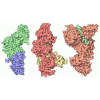
- EMDB-44419: Structure of Clostridioides difficile Component A (50-463) in Com... -
+ Open data

- Basic information
| Entry |  | |||||||||
|---|---|---|---|---|---|---|---|---|---|---|
| Title | Structure of Clostridioides difficile Component A (50-463) in Complex with a CDTb Oligomer | |||||||||
 Map data Map data | ||||||||||
 Sample Sample |
| |||||||||
 Keywords Keywords | Clostridioides / difficile / toxin / CDT / TRANSFERASE | |||||||||
| Function / homology |  Function and homology information Function and homology informationTransferases; Glycosyltransferases; Pentosyltransferases / protein homooligomerization / extracellular region / identical protein binding Similarity search - Function | |||||||||
| Biological species |  Clostridioides difficile (bacteria) Clostridioides difficile (bacteria) | |||||||||
| Method | single particle reconstruction / cryo EM / Resolution: 3.6 Å | |||||||||
 Authors Authors | Sheedlo MJ / Mullard RM | |||||||||
| Funding support |  United States, 1 items United States, 1 items
| |||||||||
 Citation Citation | Journal: mBio / Year: 2025 Title: The N-terminus of the transferase A component directs toxin activity and potency. Authors: Robin M Mullard / Michael J Sheedlo / Abstract: infection is the leading cause of antibiotic-associated, hospital-acquired diarrhea in the USA; the pathology of which is mediated by toxins. The presence of a toxin known as the Transferase (CDT) ... infection is the leading cause of antibiotic-associated, hospital-acquired diarrhea in the USA; the pathology of which is mediated by toxins. The presence of a toxin known as the Transferase (CDT) in some clinical isolates is linked to severe symptoms including increased incidence of reinfection and higher rates of mortality. Despite its apparent importance to pathology, a mechanistic model of how CDT intoxicates cells remains incomplete. Here, we describe a motif composed of acidic and basic residues (the KDKEK motif) that is essential for toxin function. Using Cryogenic Electron Microscopy (Cryo-EM), we highlight an orientation of the KDKEK motif wherein the acidic residues engage structures thought to play an important role during toxin delivery. We thus present a model wherein these interactions prime CDT for entry into host cells. We expect that this model can be extrapolated to other bacterial toxins to understand how they enter cells.IMPORTANCE is the leading cause of hospital-acquired infectious diarrhea in the USA. The pathology that accompanies infection is triggered by toxins produced by the bacterium. One of these, the Transferase (CDT), has been associated with poorer patient outcomes, although a direct connection to CDT activity has remained elusive. Herein, we present new insight into the mechanism of CDT intoxication and define two regions of the toxin as important for its activity. Moreover, we have generated mutants of CDT that retain the ability to assemble but can no longer intoxicate host cells. In the future, we expect these mutants will serve as valuable tools to help elucidate the role of CDT during infection. | |||||||||
| History |
|
- Structure visualization
| Supplemental images |
|---|

- Downloads & links
-EMDB archive
| Map data | emd_44419.map.gz | 141.3 MB | EMDB map data format | |
|---|---|---|---|---|
| Header (meta data) | emd-44419-v30.xmlemd-44419.xml | 22.5 KB 22.5 KB | Display Display | EMDB header |
| Images |  emd_44419.png emd_44419.png | 36.7 KB | ||
| Filedesc metadata | emd-44419.cif.gz | 6.9 KB | ||
| Others | emd_44419_half_map_1.map.gzemd_44419_half_map_2.map.gz | 139 MB 139 MB | ||
| Archive directory |  https://data.pdbj.org/pub/emdb/structures/EMD-44419ftp://data.pdbj.org/pub/emdb/structures/EMD-44419 https://data.pdbj.org/pub/emdb/structures/EMD-44419ftp://data.pdbj.org/pub/emdb/structures/EMD-44419 | HTTPS FTP |
-Related structure data
| Related structure data |  9bbfMC M: atomic model generated by this map C: citing same article ( |
|---|---|
| Similar structure data |
-Links
| EMDB pages | EMDB (EBI/PDBe) / EMDataResource |
|---|---|
| Related items in Molecule of the Month |
-Map
| File | Download / File: emd_44419.map.gz / Format: CCP4 / Size: 149.9 MB / Type: IMAGE STORED AS FLOATING POINT NUMBER (4 BYTES) | ||||||||||||||||||||||||||||||||||||
|---|---|---|---|---|---|---|---|---|---|---|---|---|---|---|---|---|---|---|---|---|---|---|---|---|---|---|---|---|---|---|---|---|---|---|---|---|---|
| Projections & slices | Image control
Images are generated by Spider. | ||||||||||||||||||||||||||||||||||||
| Voxel size | X=Y=Z: 0.65 Å | ||||||||||||||||||||||||||||||||||||
| Density |
| ||||||||||||||||||||||||||||||||||||
| Symmetry | Space group: 1 | ||||||||||||||||||||||||||||||||||||
| Details | EMDB XML:
|
 Z (Sec.)
 Y (Row.)
 X (Col.)


-Supplemental data
-Half map: #2
| File | emd_44419_half_map_1.map | ||||||||||||
|---|---|---|---|---|---|---|---|---|---|---|---|---|---|
| Projections & Slices |
| ||||||||||||
| Density Histograms |


-Half map: #1
| File | emd_44419_half_map_2.map | ||||||||||||
|---|---|---|---|---|---|---|---|---|---|---|---|---|---|
| Projections & Slices |
| ||||||||||||
| Density Histograms |


- Sample components
-Entire : Clostridioides difficile Transferase component A in complex with ...
| Entire | Name: Clostridioides difficile Transferase component A in complex with Clostridioides difficile Transferase component B |
|---|---|
| Components |
|
-Supramolecule #1: Clostridioides difficile Transferase component A in complex with ...
| Supramolecule | Name: Clostridioides difficile Transferase component A in complex with Clostridioides difficile Transferase component B type: complex / ID: 1 / Parent: 0 / Macromolecule list: #1-#2 |
|---|---|
| Source (natural) | Organism: Clostridioides difficile (bacteria) |
-Macromolecule #1: ADP-ribosyltransferase binding component
| Macromolecule | Name: ADP-ribosyltransferase binding component / type: protein_or_peptide / ID: 1 / Number of copies: 7 / Enantiomer: LEVO |
|---|---|
| Source (natural) | Organism: Clostridioides difficile (bacteria) |
| Molecular weight | Theoretical: 94.289367 KDa |
| Recombinant expression | Organism:  Escherichia coli (E. coli) Escherichia coli (E. coli) |
| Sequence | String: MEIVNEDILP NNGLMGYYFT DEHFKDLKLM APIKDGNLKF EEKKVDKLLD KDKSDVKSIR WTGRIIPSKD GEYTLSTDRD DVLMQVNTE STISNTLKVN MKKGKEYKVR IELQDKNLGS IDNLSSPNLY WELDGMKKII PEENLFLRDY SNIEKDDPFI P NNNFFDPK ...String: MEIVNEDILP NNGLMGYYFT DEHFKDLKLM APIKDGNLKF EEKKVDKLLD KDKSDVKSIR WTGRIIPSKD GEYTLSTDRD DVLMQVNTE STISNTLKVN MKKGKEYKVR IELQDKNLGS IDNLSSPNLY WELDGMKKII PEENLFLRDY SNIEKDDPFI P NNNFFDPK LMSDWEDEDL DTDNDNIPDS YERNGYTIKD LIAVKWEDSF AEQGYKKYVS NYLESNTAGD PYTDYEKASG SF DKAIKTE ARDPLVAAYP IVGVGMEKLI ISTNEHASTD QGKTVSRATT NSKTESNTAG VSVNVGYQNG FTANVTTNYS HTT DNSTAV QDSNGESWNT GLSINKGESA YINANVRYYN TGTAPMYKVT PTTNLVLDGD TLSTIKAQEN QIGNNLSPGD TYPK KGLSP LALNTMDQFS SRLIPINYDQ LKKLDAGKQI KLETTQVSGN FGTKNSSGQI VTEGNSWSDY ISQIDSISAS IILDT ENES YERRVTAKNL QDPEDKTPEL TIGEAIEKAF GATKKDGLLY FNDIPIDESC VELIFDDNTA NKIKDSLKTL SDKKIY NVK LERGMNILIK TPTYFTNFDD YNNYPSTWSN VNTTNQDGLQ GSANKLNGET KIKIPMSELK PYKRYVFSGY SKDPLTS NS IIVKIKAKEE KTDYLVPEQG YTKFSYEFET TEKDSSNIEI TLIGSGTTYL DNLSITELNS TPEILDEPEV KIPTDQEI M DAHKIYFADL NFNPSTGNTY INGMYFAPTQ TNKEALDYIQ KYRVEATLQY SGFKDIGTKD KEMRNYLGDP NQPKTNYVN LRSYFTGGEN IMTYKKLRIY AITPDDRELL VLSVD UniProtKB: ADP-ribosyltransferase binding component |
-Macromolecule #2: ADP-ribosyltransferase enzymatic component
| Macromolecule | Name: ADP-ribosyltransferase enzymatic component / type: protein_or_peptide / ID: 2 / Number of copies: 1 / Enantiomer: LEVO |
|---|---|
| Source (natural) | Organism: Clostridioides difficile (bacteria) |
| Molecular weight | Theoretical: 47.626613 KDa |
| Recombinant expression | Organism: Escherichia coli (E. coli) |
| Sequence | String: KAPIERPEDF LKDKEKAKEW ERKEAERIEQ KLERSEKEAL ESYKKDSVEI SKYSQTRNYF YDYQIEANSR EKEYKELRNA ISKNKIDKP MYVYYFESPE KFAFNKVIRT ENQNEISLEK FNEFKETIQN KLFKQDGFKD ISLYEPGKGD EKPTPLLMHL K LPRNTGML ...String: KAPIERPEDF LKDKEKAKEW ERKEAERIEQ KLERSEKEAL ESYKKDSVEI SKYSQTRNYF YDYQIEANSR EKEYKELRNA ISKNKIDKP MYVYYFESPE KFAFNKVIRT ENQNEISLEK FNEFKETIQN KLFKQDGFKD ISLYEPGKGD EKPTPLLMHL K LPRNTGML PYTNTNNVST LIEQGYSIKI DKIVRIVIDG KHYIKAEASV VSSLDFKDDV SKGDSWGKAN YNDWSNKLTP NE LADVNDY MRGGYTAINN YLISNGPVNN PNPELDSKIT NIENALKREP IPTNLTVYRR SGPQEFGLTL TSPEYDFNKL ENI DAFKSK WEGQALSYPN FISTSIGSVN MSAFAKRKIV LRITIPKGSP GAYLSAIPGY AGEYEVLLNH GSKFKINKID SYKD GTITK LIVDATLIP UniProtKB: ADP-ribosyltransferase enzymatic component |
-Macromolecule #3: CALCIUM ION
| Macromolecule | Name: CALCIUM ION / type: ligand / ID: 3 / Number of copies: 14 / Formula: CA |
|---|---|
| Molecular weight | Theoretical: 40.078 Da |
-Experimental details
-Structure determination
| Method | cryo EM |
|---|---|
 Processing Processing | single particle reconstruction |
| Aggregation state | particle |
-Sample preparation
| Buffer | pH: 8 |
|---|---|
| Grid | Model: Quantifoil R2/1 / Material: COPPER / Mesh: 200 / Pretreatment - Type: GLOW DISCHARGE / Pretreatment - Time: 45 sec. |
| Vitrification | Cryogen name: ETHANE / Chamber humidity: 100 % / Chamber temperature: 295 K / Instrument: FEI VITROBOT MARK IV |
- Electron microscopy
| Microscope | FEI TITAN KRIOS |
|---|---|
| Image recording | Film or detector model: GATAN K3 BIOQUANTUM (6k x 4k) / Average electron dose: 52.0 e/Å2 |
| Electron beam | Acceleration voltage: 300 kV / Electron source:  FIELD EMISSION GUN FIELD EMISSION GUN |
| Electron optics | Illumination mode: FLOOD BEAM / Imaging mode: BRIGHT FIELD / Nominal defocus max: 2.5 µm / Nominal defocus min: 0.5 µm |
| Experimental equipment |  Model: Titan Krios / Image courtesy: FEI Company |
