National Institutes of Health/National Institute Of Allergy and Infectious Diseases (NIH/NIAID)
R21-AI167756
United States
National Institutes of Health/National Institute Of Allergy and Infectious Diseases (NIH/NIAID)
U54-AI170856
United States
Citation
Journal: Viruses / Year: 2024 Title: Arg18 Substitutions Reveal the Capacity of the HIV-1 Capsid Protein for Non-Fullerene Assembly. Authors: Randall T Schirra / Nayara F B Dos Santos / Barbie K Ganser-Pornillos / Owen Pornillos / Abstract: In the fullerene cone HIV-1 capsid, the central channels of the hexameric and pentameric capsomers each contain a ring of arginine (Arg18) residues that perform essential roles in capsid assembly and ...In the fullerene cone HIV-1 capsid, the central channels of the hexameric and pentameric capsomers each contain a ring of arginine (Arg18) residues that perform essential roles in capsid assembly and function. In both the hexamer and pentamer, the Arg18 rings coordinate inositol hexakisphosphate, an assembly and stability factor for the capsid. Previously, it was shown that amino-acid substitutions of Arg18 can promote pentamer incorporation into capsid-like particles (CLPs) that spontaneously assemble in vitro under high-salt conditions. Here, we show that these Arg18 mutant CLPs contain a non-canonical pentamer conformation and distinct lattice characteristics that do not follow the fullerene geometry of retroviral capsids. The Arg18 mutant pentamers resemble the hexamer in intra-oligomeric contacts and form a unique tetramer-of-pentamers that allows for incorporation of an octahedral vertex with a cross-shaped opening in the hexagonal capsid lattice. Our findings highlight an unexpected degree of structural plasticity in HIV-1 capsid assembly.
In the structure databanks used in Yorodumi, some data are registered as the other names, "COVID-19 virus" and "2019-nCoV". Here are the details of the virus and the list of structure data.
Jan 31, 2019. EMDB accession codes are about to change! (news from PDBe EMDB page)
EMDB accession codes are about to change! (news from PDBe EMDB page)
The allocation of 4 digits for EMDB accession codes will soon come to an end. Whilst these codes will remain in use, new EMDB accession codes will include an additional digit and will expand incrementally as the available range of codes is exhausted. The current 4-digit format prefixed with “EMD-” (i.e. EMD-XXXX) will advance to a 5-digit format (i.e. EMD-XXXXX), and so on. It is currently estimated that the 4-digit codes will be depleted around Spring 2019, at which point the 5-digit format will come into force.
The EM Navigator/Yorodumi systems omit the EMD- prefix.
Related info.:Q: What is EMD? / ID/Accession-code notation in Yorodumi/EM Navigator
Yorodumi is a browser for structure data from EMDB, PDB, SASBDB, etc.
This page is also the successor to EM Navigator detail page, and also detail information page/front-end page for Omokage search.
The word "yorodu" (or yorozu) is an old Japanese word meaning "ten thousand". "mi" (miru) is to see.
Related info.:EMDB / PDB / SASBDB / Comparison of 3 databanks / Yorodumi Search / Aug 31, 2016. New EM Navigator & Yorodumi / Yorodumi Papers / Jmol/JSmol / Function and homology information / Changes in new EM Navigator and Yorodumi
 Movie
Movie Controller


 Open data
 Basic information
 Map data
 Sample
 Keywords
 Function and homology information
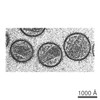 Human immunodeficiency virus 1
 Authors
 United States, 2 items
  Citation
 Structure visualization
 Downloads & links
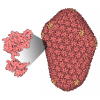
 emd_43641.png
 http://ftp.pdbj.org/pub/emdb/structures/EMD-43641


 Z (Sec.)
 Y (Row.)
 X (Col.)


 Sample components
 Escherichia coli BL21(DE3) (bacteria)
 Processing
 Electron microscopy
 FIELD EMISSION GUN


