National Institutes of Health/National Institute of General Medical Sciences (NIH/NIGMS)
GM128867
United States
National Institutes of Health/National Institute of General Medical Sciences (NIH/NIGMS)
GM1295410
United States
National Institutes of Health/National Institute of General Medical Sciences (NIH/NIGMS)
GM007185
United States
National Science Foundation (NSF, United States)
DMR-1548924
United States
The Pew Charitable Trusts
JAR
United States
David and Lucile Packard Foundation
JAR
United States
Citation
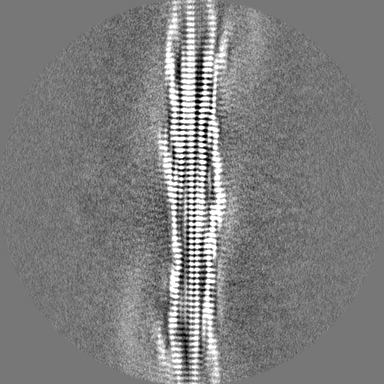
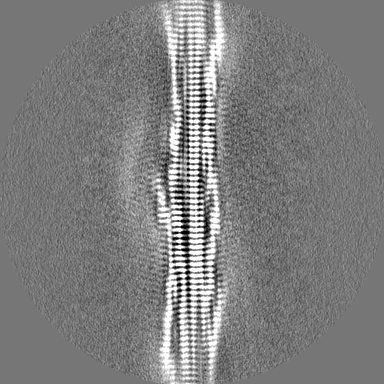
Journal: Structure / Year: 2025 Title: Structural insights into functional regulation of the human CPEB3 prion by an amyloid-forming segment. Authors: Maria D Flores / Michael R Sawaya / David R Boyer / Samantha Zink / Susanna Tovmasyan / Adrian Saucedo / Logan S Richards / Chih-Te Zee / Jorge Cardenas / Luana Fioriti / Jose A Rodriguez / Abstract: The cytoplasmic polyadenylation-element-binding-protein-3 (CPEB3) is a functional prion thought to modulate protein synthesis and enable consolidation of long-term memory in neurons. We report a ...The cytoplasmic polyadenylation-element-binding-protein-3 (CPEB3) is a functional prion thought to modulate protein synthesis and enable consolidation of long-term memory in neurons. We report a cryoelectron microscopy (cryo-EM) structure of amyloid fibrils grown in vitro from the first prion-like domain of human CPEB3 (hCPEB3), revealing their ordered 49-residue core, spanning L103 to F151. CPEB3 lacking that segment coalesces into abnormal puncta in cells compared to wild-type CPEB3, localizes away from dormant p-bodies and toward stress granules, and lacks the ability to influence protein synthesis in neurons. Fluorescence-guided cryo-focused ion beam (cryo-FIB) milling and cryo-electron tomography (cryo-ET) applied to neuronal cells expressing CPEB3 reveal CPEB3-GFP signal from lamellae enriched in multivesicular bodies (MVBs), cavernous multilamellar compartments, and bundled filaments, suggesting a state of induced cellular stress. Accordingly, cells expressing wild-type CPEB3 are less viable than those expressing CPEB3 without its amyloid core, suggesting human CPEB3 regulation may be required to overcome the liability associated with its self-assembly in cells.
UniProtKB: Cytoplasmic polyadenylation element-binding protein 3
-
Experimental details
-
Structure determination
Method
cryo EM
Processing
helical reconstruction
Aggregation state
filament
-
Sample preparation
Buffer
pH: 5 Component:
Concentration
Formula
Name
125.0 mM
NaCl
sodium chloride
50.0 mM
Tris-Base
10.0 mM
HK2PO4
dipotassium phosphate
5.0 mM
glutamic acid
Grid
Model: Quantifoil R1.2/1.3 / Material: GOLD / Mesh: 300 / Support film - Material: CARBON / Support film - topology: CONTINUOUS / Support film - Film thickness: 200
Vitrification
Cryogen name: ETHANE / Chamber humidity: 100 % / Chamber temperature: 4 K / Instrument: FEI VITROBOT MARK I
-
Electron microscopy
Microscope
FEI TITAN KRIOS
Specialist optics
Energy filter - Name: GIF Bioquantum / Energy filter - Slit width: 20 eV
Image recording
Film or detector model: GATAN K3 (6k x 4k) / Number grids imaged: 1 / Average electron dose: 52.0 e/Å2
Electron beam
Acceleration voltage: 300 kV / Electron source: FIELD EMISSION GUN
Electron optics
Illumination mode: OTHER / Imaging mode: BRIGHT FIELD / Cs: 2.7 mm / Nominal defocus max: 3.0 µm / Nominal defocus min: 1.0 µm
In the structure databanks used in Yorodumi, some data are registered as the other names, "COVID-19 virus" and "2019-nCoV". Here are the details of the virus and the list of structure data.
Jan 31, 2019. EMDB accession codes are about to change! (news from PDBe EMDB page)
EMDB accession codes are about to change! (news from PDBe EMDB page)
The allocation of 4 digits for EMDB accession codes will soon come to an end. Whilst these codes will remain in use, new EMDB accession codes will include an additional digit and will expand incrementally as the available range of codes is exhausted. The current 4-digit format prefixed with “EMD-” (i.e. EMD-XXXX) will advance to a 5-digit format (i.e. EMD-XXXXX), and so on. It is currently estimated that the 4-digit codes will be depleted around Spring 2019, at which point the 5-digit format will come into force.
The EM Navigator/Yorodumi systems omit the EMD- prefix.
Related info.:Q: What is EMD? / ID/Accession-code notation in Yorodumi/EM Navigator
Yorodumi is a browser for structure data from EMDB, PDB, SASBDB, etc.
This page is also the successor to EM Navigator detail page, and also detail information page/front-end page for Omokage search.
The word "yorodu" (or yorozu) is an old Japanese word meaning "ten thousand". "mi" (miru) is to see.
Related info.:EMDB / PDB / SASBDB / Comparison of 3 databanks / Yorodumi Search / Aug 31, 2016. New EM Navigator & Yorodumi / Yorodumi Papers / Jmol/JSmol / Function and homology information / Changes in new EM Navigator and Yorodumi
 Movie
Movie Controller

 Yorodumi
 Open data
 Basic information
 Map data
 Sample
 Keywords
 Function and homology information
 Homo sapiens (human)
 Authors
 United States, 6 items
  Citation
 Structure visualization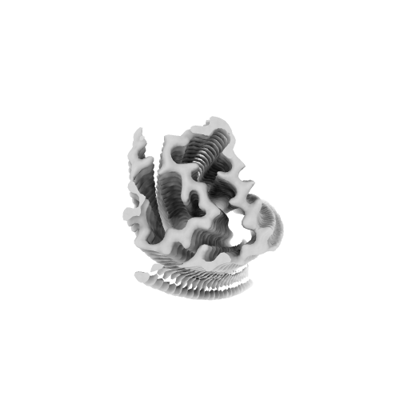
 Downloads & links
 emd_40677.png
 http://ftp.pdbj.org/pub/emdb/structures/EMD-40677
 Z (Sec.)
 Y (Row.)
 X (Col.)


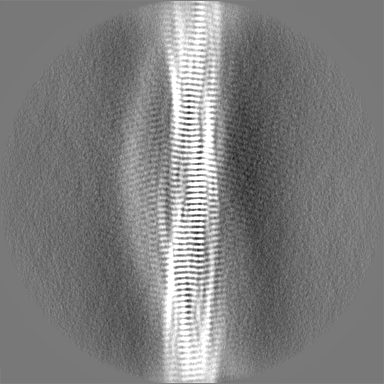

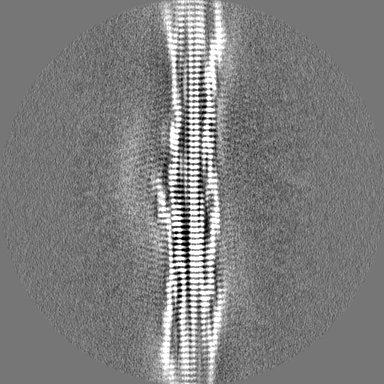
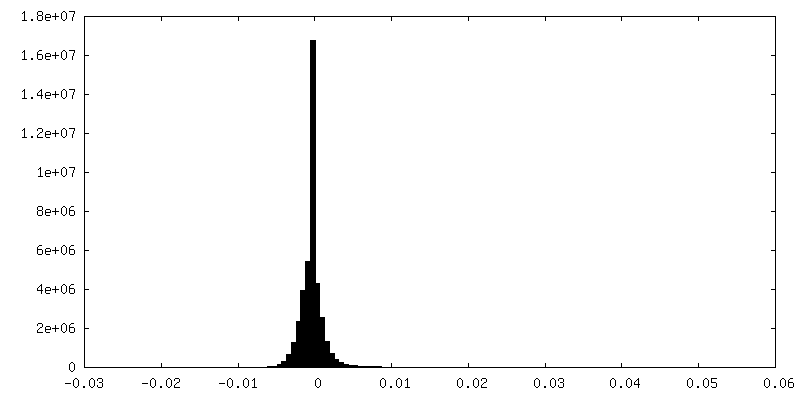

 Sample components
 Escherichia coli 'BL21-Gold(DE3)pLysS AG' (bacteria)
 Processing
 Electron microscopy
 FIELD EMISSION GUN