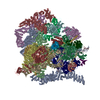
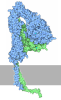
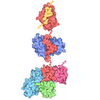
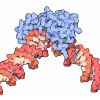
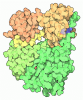
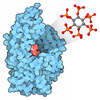
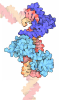
- EMDB-39338: Cryo-EM structure of the human DSS1-INTAC complex -
+
Open data
ID or keywords:
Loading...
-
Basic information
Entry
Database: EMDB / ID: EMD-39338
Title
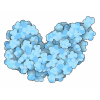
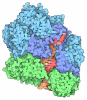
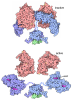
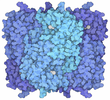
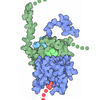
Cryo-EM structure of the human DSS1-INTAC complex
Map data
local resolution filtered map using relion
Sample
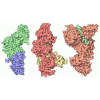
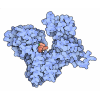
Complex: DSS1-INTAC-PEC
Protein or peptide: x 12 types
Ligand: x 2 types
Keywords
DSS1 / Integrator / INTAC / TRANSCRIPTION
Function / homology
Function and homology information
U2 snRNA 3'-end processing / snRNA 3'-end processing / PP2A-mediated dephosphorylation of key metabolic factors / RNA polymerase II CTD heptapeptide repeat S2 phosphatase activity / RNA polymerase II CTD heptapeptide repeat S7 phosphatase activity / regulation of hippo signaling / MASTL Facilitates Mitotic Progression / protein phosphatase type 2A complex / meiotic sister chromatid cohesion, centromeric / INTAC complex ...U2 snRNA 3'-end processing / snRNA 3'-end processing / PP2A-mediated dephosphorylation of key metabolic factors / RNA polymerase II CTD heptapeptide repeat S2 phosphatase activity / RNA polymerase II CTD heptapeptide repeat S7 phosphatase activity / regulation of hippo signaling / MASTL Facilitates Mitotic Progression / protein phosphatase type 2A complex / meiotic sister chromatid cohesion, centromeric / INTAC complex / RNA polymerase II CTD heptapeptide repeat S5 phosphatase activity / FAR/SIN/STRIPAK complex / Regulation of glycolysis by fructose 2,6-bisphosphate metabolism / Inhibition of replication initiation of damaged DNA by RB1/E2F1 / snRNA processing / regulation of growth / protein phosphatase regulator activity / protein antigen binding / GABA receptor binding / regulation of transcription elongation by RNA polymerase II / Hydrolases; Acting on ester bonds; Endoribonucleases producing 3'-phosphomonoesters / APC truncation mutants have impaired AXIN binding / AXIN missense mutants destabilize the destruction complex / Truncations of AMER1 destabilize the destruction complex / Impaired BRCA2 translocation to the nucleus / Impaired BRCA2 binding to SEM1 (DSS1) / ERKs are inactivated / T cell homeostasis / Beta-catenin phosphorylation cascade / Signaling by GSK3beta mutants / CTNNB1 S33 mutants aren't phosphorylated / CTNNB1 S37 mutants aren't phosphorylated / CTNNB1 S45 mutants aren't phosphorylated / CTNNB1 T41 mutants aren't phosphorylated / Initiation of Nuclear Envelope (NE) Reformation / Co-stimulation by CD28 / integrator complex / RNA polymerase II transcription initiation surveillance / transcription export complex 2 / Disassembly of the destruction complex and recruitment of AXIN to the membrane / proteasome regulatory particle, lid subcomplex / protein dephosphorylation / negative regulation of glycolytic process through fructose-6-phosphate / negative regulation of epithelial to mesenchymal transition / Co-inhibition by CTLA4 / Platelet sensitization by LDL / Regulation of ornithine decarboxylase (ODC) / Proteasome assembly / cellular response to type I interferon / protein-serine/threonine phosphatase / Cross-presentation of soluble exogenous antigens (endosomes) / Somitogenesis / ERK/MAPK targets / Homologous DNA Pairing and Strand Exchange / Defective homologous recombination repair (HRR) due to BRCA1 loss of function / Defective HDR through Homologous Recombination Repair (HRR) due to PALB2 loss of BRCA1 binding function / Defective HDR through Homologous Recombination Repair (HRR) due to PALB2 loss of BRCA2/RAD51/RAD51C binding function / Resolution of D-loop Structures through Synthesis-Dependent Strand Annealing (SDSA) / Resolution of D-loop Structures through Holliday Junction Intermediates / vascular endothelial cell response to oscillatory fluid shear stress / regulation of cell differentiation / protein serine/threonine phosphatase activity / Impaired BRCA2 binding to RAD51 / regulation of microtubule polymerization / RNA polymerase II transcribes snRNA genes / positive regulation of NLRP3 inflammasome complex assembly / chromosome, centromeric region / DARPP-32 events / lateral plasma membrane / Presynaptic phase of homologous DNA pairing and strand exchange / negative regulation of hippo signaling / mRNA export from nucleus / proteasome assembly / Cyclin A/B1/B2 associated events during G2/M transition / DNA damage checkpoint signaling / spindle assembly / regulation of G1/S transition of mitotic cell cycle / phosphoprotein phosphatase activity / Nonsense Mediated Decay (NMD) enhanced by the Exon Junction Complex (EJC) / protein localization to chromatin / RNA endonuclease activity / Loss of Nlp from mitotic centrosomes / Loss of proteins required for interphase microtubule organization from the centrosome / Amplification of signal from unattached kinetochores via a MAD2 inhibitory signal / Recruitment of mitotic centrosome proteins and complexes / Recruitment of NuMA to mitotic centrosomes / protein tyrosine phosphatase activity / Anchoring of the basal body to the plasma membrane / Mitotic Prometaphase / proteasome complex / EML4 and NUDC in mitotic spindle formation / Turbulent (oscillatory, disturbed) flow shear stress activates signaling by PIEZO1 and integrins in endothelial cells / AURKA Activation by TPX2 / negative regulation of transforming growth factor beta receptor signaling pathway / regulation of proteasomal protein catabolic process / Resolution of Sister Chromatid Cohesion / negative regulation of phosphatidylinositol 3-kinase/protein kinase B signal transduction / chromosome segregation / meiotic cell cycle / cellular response to ionizing radiation Similarity search - Function
Journal: Nat Commun / Year: 2025 Title: DSS1 is required for proper Integrator-PP2A function. Authors: Congling Xu / Qian-Xing Zhou / Hai Zheng / Aixia Song / Wen-Ying Zhao / Ting-Ting Xu / Yan Xiong / Yi-Jie Zhang / Zixuan Huang / Yanhui Xu / Jingdong Cheng / Fei Xavier Chen / Abstract: Integrator-PP2A (INTAC) is a highly modular complex orchestrating the transition of paused RNA polymerase II into productive elongation or promoter-proximal premature termination, with its loss ...Integrator-PP2A (INTAC) is a highly modular complex orchestrating the transition of paused RNA polymerase II into productive elongation or promoter-proximal premature termination, with its loss resulting in transcription dysregulation and genome instability. Here, we identify human DSS1-a flexible 70-residue protein found in multiple functionally diverse complexes including the 26S proteasome-as an integral subunit of the INTAC backbone. Structural analysis of DSS1-INTAC, both alone and in association with paused polymerase, demonstrates intimate interactions between DSS1 and the INTAC backbone. We identify tryptophan 39 of DSS1 as being critical for interacting with INTAC and find that its mutation disrupts DSS1's interaction with INTAC, while maintaining DSS1's interaction with the proteasome. This substitution not only impairs INTAC-dependent transcriptional regulation, but also reveals that INTAC is DSS1's major chromatin-bound form. Together, our findings reveal a role for DSS1 in supporting the structure and regulatory functions of INTAC.
In the structure databanks used in Yorodumi, some data are registered as the other names, "COVID-19 virus" and "2019-nCoV". Here are the details of the virus and the list of structure data.
Jan 31, 2019. EMDB accession codes are about to change! (news from PDBe EMDB page)
EMDB accession codes are about to change! (news from PDBe EMDB page)
The allocation of 4 digits for EMDB accession codes will soon come to an end. Whilst these codes will remain in use, new EMDB accession codes will include an additional digit and will expand incrementally as the available range of codes is exhausted. The current 4-digit format prefixed with “EMD-” (i.e. EMD-XXXX) will advance to a 5-digit format (i.e. EMD-XXXXX), and so on. It is currently estimated that the 4-digit codes will be depleted around Spring 2019, at which point the 5-digit format will come into force.
The EM Navigator/Yorodumi systems omit the EMD- prefix.
Related info.:Q: What is EMD? / ID/Accession-code notation in Yorodumi/EM Navigator
Yorodumi is a browser for structure data from EMDB, PDB, SASBDB, etc.
This page is also the successor to EM Navigator detail page, and also detail information page/front-end page for Omokage search.
The word "yorodu" (or yorozu) is an old Japanese word meaning "ten thousand". "mi" (miru) is to see.
Related info.:EMDB / PDB / SASBDB / Comparison of 3 databanks / Yorodumi Search / Aug 31, 2016. New EM Navigator & Yorodumi / Yorodumi Papers / Jmol/JSmol / Function and homology information / Changes in new EM Navigator and Yorodumi
 Movie
Movie Controller


 Open data
 Basic information
 Map data
 Sample
 Keywords
 Function and homology information
 Homo sapiens (human)
 Authors
 Citation
 Structure visualization
 Downloads & links
 emd_39338.png
 https://data.pdbj.org/pub/emdb/structures/EMD-39338




 Z (Sec.)
 Y (Row.)
 X (Col.)


 Sample components
 Processing
 Electron microscopy
 FIELD EMISSION GUN