National Institutes of Health/National Institute of General Medical Sciences (NIH/NIGMS)
R01GM093271
United States
National Institutes of Health/National Institute of General Medical Sciences (NIH/NIGMS)
R01GM111367
United States
National Institutes of Health/National Institute of General Medical Sciences (NIH/NIGMS)
R21GM131231
United States
National Institutes of Health/National Institute of General Medical Sciences (NIH/NIGMS)
U24GM116788
United States
National Institutes of Health/National Institute of General Medical Sciences (NIH/NIGMS)
U24GM116789
United States
National Institutes of Health/National Cancer Institute (NIH/NCI)
C06RR30414
United States
National Institutes of Health/National Cancer Institute (NIH/NCI)
U24GM129539
United States
Cancer Prevention and Research Institute of Texas (CPRIT)
RP120474
United States
American Heart Association
12IRG9400019
United States
National Institutes of Health/National Cancer Institute (NIH/NCI)
R01GM088745
United States
Cystic Fibrosis Foundation
JIANG15G0
United States
Welch Foundation
I-1684
United States
Citation
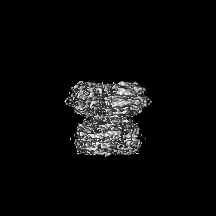
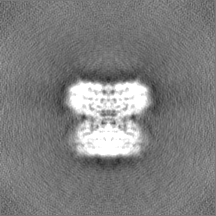
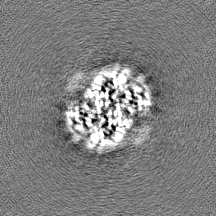
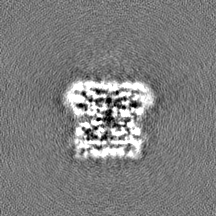
Journal: Front Mol Neurosci / Year: 2023 Title: Chromogranin B (CHGB) is dimorphic and responsible for dominant anion channels delivered to cell surface via regulated secretion. Authors: Gaya P Yadav / Haiyuan Wang / Joke Ouwendijk / Stephen Cross / Qiaochu Wang / Feng Qin / Paul Verkade / Michael X Zhu / Qiu-Xing Jiang / Abstract: Regulated secretion is conserved in all eukaryotes. In vertebrates granin family proteins function in all key steps of regulated secretion. Phase separation and amyloid-based storage of proteins and ...Regulated secretion is conserved in all eukaryotes. In vertebrates granin family proteins function in all key steps of regulated secretion. Phase separation and amyloid-based storage of proteins and small molecules in secretory granules require ion homeostasis to maintain their steady states, and thus need ion conductances in granule membranes. But granular ion channels are still elusive. Here we show that granule exocytosis in neuroendocrine cells delivers to cell surface dominant anion channels, to which chromogranin B (CHGB) is critical. Biochemical fractionation shows that native CHGB distributes nearly equally in soluble and membrane-bound forms, and both reconstitute highly selective anion channels in membrane. Confocal imaging resolves granular membrane components including proton pumps and CHGB in puncta on the cell surface after stimulated exocytosis. High pressure freezing immuno-EM reveals a major fraction of CHGB at granule membranes in rat pancreatic β-cells. A cryo-EM structure of bCHGB dimer of a nominal 3.5 Å resolution delineates a central pore with end openings, physically sufficient for membrane-spanning and large single channel conductance. Together our data support that CHGB-containing (CHGB+) channels are characteristic of regulated secretion, and function in granule ion homeostasis near the plasma membrane or possibly in other intracellular processes.
Type of model: OTHER Details: Ab initio model from cisTEM and cryoSPARC, and a reference model from angular reconstitution of a negative stain dataset.
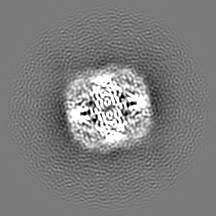
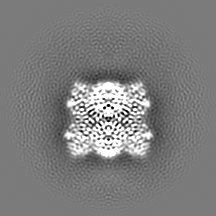
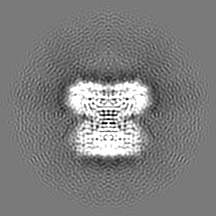
Final reconstruction
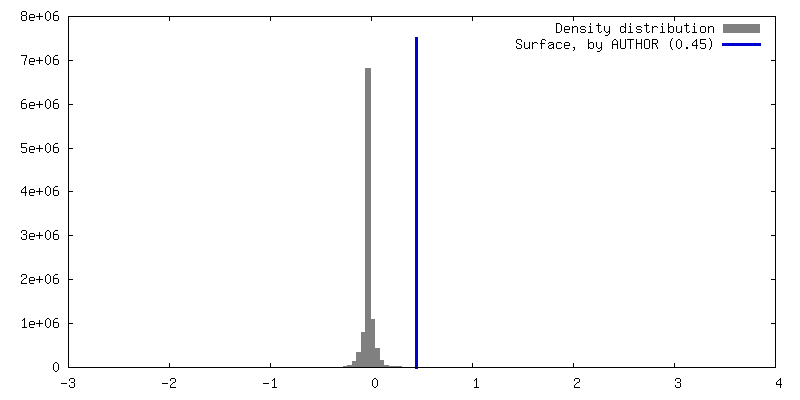
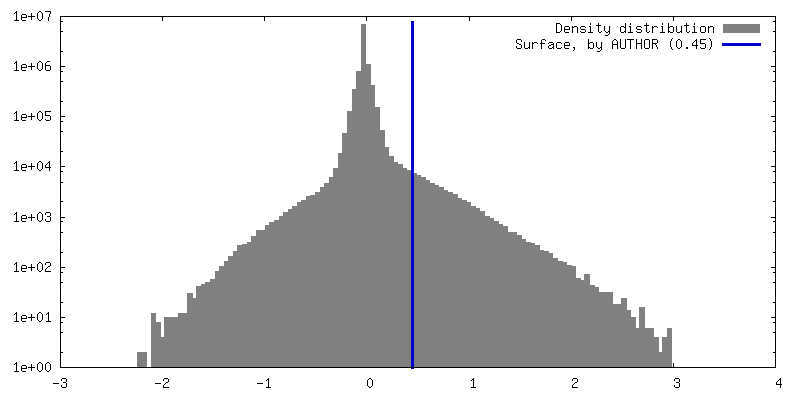
Applied symmetry - Point group: C2 (2 fold cyclic) / Resolution.type: BY AUTHOR / Resolution: 3.5 Å / Resolution method: FSC 0.143 CUT-OFF / Software - Name: cryoSPARC (ver. 3.3.2) Details: CryoSPARC and relion were used for independent analyses to generate similar results. Number images used: 70000
Initial angle assignment
Type: MAXIMUM LIKELIHOOD Details: Initial assignment was based on the reference model.
Final angle assignment
Type: MAXIMUM LIKELIHOOD Details: Refinement was done in cryoSPARC and relion separately.
+
About Yorodumi
-
News
-
Feb 9, 2022. New format data for meta-information of EMDB entries
New format data for meta-information of EMDB entries
Version 3 of the EMDB header file is now the official format.
The previous official version 1.9 will be removed from the archive.
In the structure databanks used in Yorodumi, some data are registered as the other names, "COVID-19 virus" and "2019-nCoV". Here are the details of the virus and the list of structure data.
Jan 31, 2019. EMDB accession codes are about to change! (news from PDBe EMDB page)
EMDB accession codes are about to change! (news from PDBe EMDB page)
The allocation of 4 digits for EMDB accession codes will soon come to an end. Whilst these codes will remain in use, new EMDB accession codes will include an additional digit and will expand incrementally as the available range of codes is exhausted. The current 4-digit format prefixed with “EMD-” (i.e. EMD-XXXX) will advance to a 5-digit format (i.e. EMD-XXXXX), and so on. It is currently estimated that the 4-digit codes will be depleted around Spring 2019, at which point the 5-digit format will come into force.
The EM Navigator/Yorodumi systems omit the EMD- prefix.
Related info.:Q: What is EMD? / ID/Accession-code notation in Yorodumi/EM Navigator
Yorodumi is a browser for structure data from EMDB, PDB, SASBDB, etc.
This page is also the successor to EM Navigator detail page, and also detail information page/front-end page for Omokage search.
The word "yorodu" (or yorozu) is an old Japanese word meaning "ten thousand". "mi" (miru) is to see.
Related info.:EMDB / PDB / SASBDB / Comparison of 3 databanks / Yorodumi Search / Aug 31, 2016. New EM Navigator & Yorodumi / Yorodumi Papers / Jmol/JSmol / Function and homology information / Changes in new EM Navigator and Yorodumi
 Movie
Movie Controller

 Yorodumi
 Open data
 Basic information
 Map data
 Sample
 Keywords
 Bos taurus (domestic cattle)
 Authors
 United States, 12 items
  Citation

 Structure visualization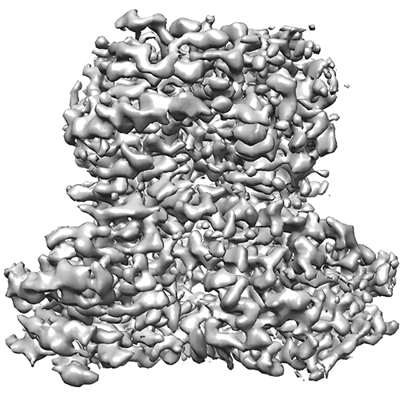
 Downloads & links
 EMDB map data format
 emd_36579.png
 https://data.pdbj.org/pub/emdb/structures/EMD-36579
 Z (Sec.)
 Y (Row.)
 X (Col.)







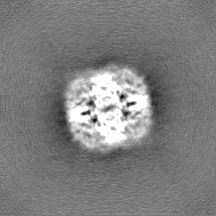

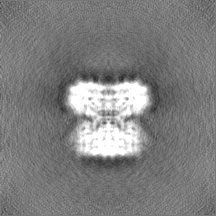


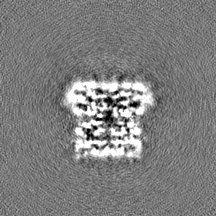
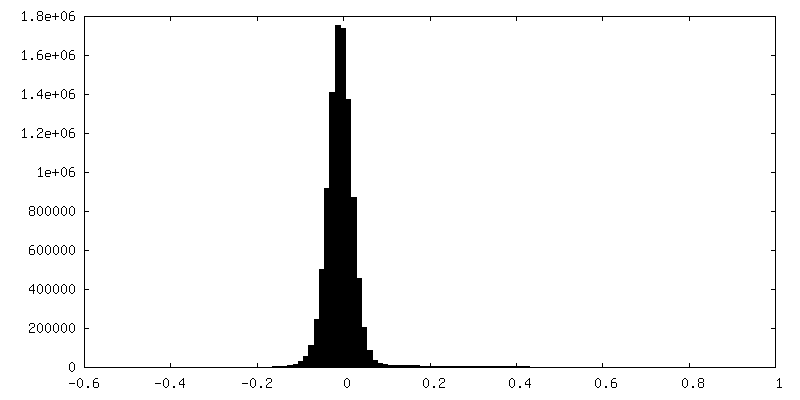

 Sample components
 Processing
 Electron microscopy
 FIELD EMISSION GUN
