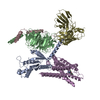
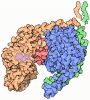
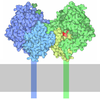
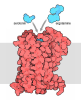
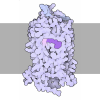
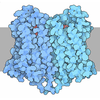
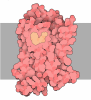
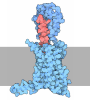
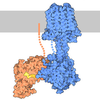
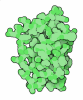
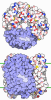
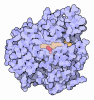
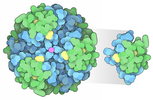
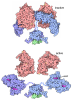
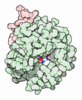
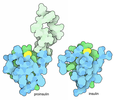
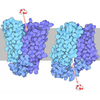
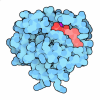
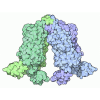
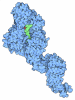
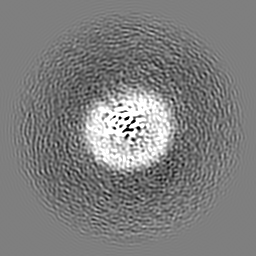
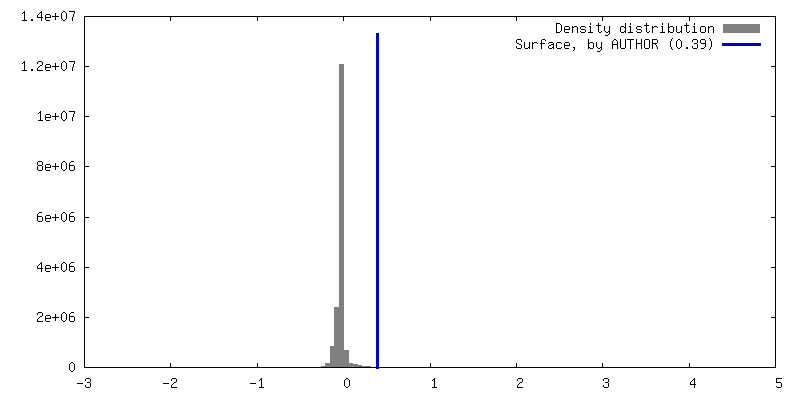
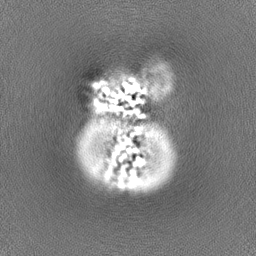
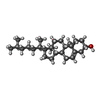
登録情報 データベース : EMDB / ID : EMD-33710 ダウンロードとリンクタイトル Octreotide-bound SSTR2-Gi complex マップデータ 詳細 試料複合体 : octreotide-bound Somatostatin receptor 2複合体 : octreotide-bound Somatostatin receptor 2タンパク質・ペプチド : Guanine nucleotide-binding protein G(i) subunit alpha-1タンパク質・ペプチド : Guanine nucleotide-binding protein G(I)/G(S)/G(T) subunit beta-1タンパク質・ペプチド : Guanine nucleotide-binding protein G(I)/G(S)/G(O) subunit gamma-2タンパク質・ペプチド : Somatostatin receptor type 2複合体 : scFv16複合体 : DPN-CYS-PHE-DTR-LYS-THR-CYS-THOタンパク質・ペプチド : DPN-CYS-PHE-DTR-LYS-THR-CYS-THOリガンド : CHOLESTEROL 詳細 キーワード agonist / membrane protein / Complex / SIGNALING PROTEIN機能・相同性 機能・相同性情報分子機能 ドメイン・相同性 構成要素
somatostatin receptor activity / neuropeptide binding / cellular response to glucocorticoid stimulus / G protein-coupled receptor signaling pathway, coupled to cyclic nucleotide second messenger / adenylate cyclase inhibitor activity / positive regulation of protein localization to cell cortex / T cell migration / positive regulation of relaxation of smooth muscle / Adenylate cyclase inhibitory pathway / D2 dopamine receptor binding ... somatostatin receptor activity / neuropeptide binding / cellular response to glucocorticoid stimulus / G protein-coupled receptor signaling pathway, coupled to cyclic nucleotide second messenger / adenylate cyclase inhibitor activity / positive regulation of protein localization to cell cortex / T cell migration / positive regulation of relaxation of smooth muscle / Adenylate cyclase inhibitory pathway / D2 dopamine receptor binding / adenylate cyclase-inhibiting serotonin receptor signaling pathway / G protein-coupled serotonin receptor binding / cellular response to forskolin / Peptide ligand-binding receptors / regulation of mitotic spindle organization / chemokine-mediated signaling pathway / PDZ domain binding / cellular response to estradiol stimulus / Regulation of insulin secretion / neuropeptide signaling pathway / response to prostaglandin E / positive regulation of cholesterol biosynthetic process / negative regulation of insulin secretion / G protein-coupled receptor binding / response to peptide hormone / adenylate cyclase-modulating G protein-coupled receptor signaling pathway / G-protein beta/gamma-subunit complex binding / centriolar satellite / adenylate cyclase-inhibiting G protein-coupled receptor signaling pathway / Olfactory Signaling Pathway / Activation of the phototransduction cascade / G protein-coupled acetylcholine receptor signaling pathway / G beta:gamma signalling through PLC beta / Presynaptic function of Kainate receptors / Thromboxane signalling through TP receptor / Activation of G protein gated Potassium channels / Inhibition of voltage gated Ca2+ channels via Gbeta/gamma subunits / G-protein activation / Glucagon signaling in metabolic regulation / G beta:gamma signalling through CDC42 / Prostacyclin signalling through prostacyclin receptor / G beta:gamma signalling through BTK / Synthesis, secretion, and inactivation of Glucagon-like Peptide-1 (GLP-1) / photoreceptor disc membrane / ADP signalling through P2Y purinoceptor 12 / Sensory perception of sweet, bitter, and umami (glutamate) taste / GDP binding / Glucagon-type ligand receptors / Adrenaline,noradrenaline inhibits insulin secretion / Vasopressin regulates renal water homeostasis via Aquaporins / Glucagon-like Peptide-1 (GLP1) regulates insulin secretion / G alpha (z) signalling events / cellular response to catecholamine stimulus / ADP signalling through P2Y purinoceptor 1 / ADORA2B mediated anti-inflammatory cytokines production / G beta:gamma signalling through PI3Kgamma / adenylate cyclase-activating dopamine receptor signaling pathway / Cooperation of PDCL (PhLP1) and TRiC/CCT in G-protein beta folding / GPER1 signaling / cellular response to prostaglandin E stimulus / heterotrimeric G-protein complex / G-protein beta-subunit binding / G alpha (12/13) signalling events / Inactivation, recovery and regulation of the phototransduction cascade / extracellular vesicle / sensory perception of taste / adenylate cyclase-activating G protein-coupled receptor signaling pathway / sperm principal piece / Thrombin signalling through proteinase activated receptors (PARs) / signaling receptor complex adaptor activity / retina development in camera-type eye / GTPase binding / G protein activity / fibroblast proliferation / Ca2+ pathway / midbody / cell cortex / High laminar flow shear stress activates signaling by PIEZO1 and PECAM1:CDH5:KDR in endothelial cells / G alpha (i) signalling events / G alpha (s) signalling events / phospholipase C-activating G protein-coupled receptor signaling pathway / G alpha (q) signalling events / 加水分解酵素; 酸無水物に作用; GTPに作用・細胞または細胞小器官の運動に関与 / Ras protein signal transduction / cell population proliferation / Extra-nuclear estrogen signaling / neuron projection / ciliary basal body / G protein-coupled receptor signaling pathway / negative regulation of cell population proliferation / cell division / lysosomal membrane / GTPase activity / centrosome / synapse / GTP binding / protein-containing complex binding / nucleolus / magnesium ion binding / Golgi apparatus 類似検索 - 分子機能 Somatostatin receptor 2 / Somatostatin receptor family / G-protein alpha subunit, group I / Serpentine type 7TM GPCR chemoreceptor Srsx / G protein alpha subunit, helical insertion / G protein alpha subunit / Guanine nucleotide binding protein (G-protein), alpha subunit / G-protein alpha subunit / G-alpha domain profile. / G-protein, gamma subunit ... Somatostatin receptor 2 / Somatostatin receptor family / G-protein alpha subunit, group I / Serpentine type 7TM GPCR chemoreceptor Srsx / G protein alpha subunit, helical insertion / G protein alpha subunit / Guanine nucleotide binding protein (G-protein), alpha subunit / G-protein alpha subunit / G-alpha domain profile. / G-protein, gamma subunit / G-protein gamma subunit domain profile. / G-protein gamma-like domain / G-protein gamma-like domain superfamily / GGL domain / G protein gamma subunit-like motifs / GGL domain / G protein beta WD-40 repeat protein / Guanine nucleotide-binding protein, beta subunit / G-protein, beta subunit / G-protein coupled receptors family 1 signature. / 7 transmembrane receptor (rhodopsin family) / G protein-coupled receptor, rhodopsin-like / GPCR, rhodopsin-like, 7TM / G-protein coupled receptors family 1 profile. / G-protein beta WD-40 repeat / WD40 repeat, conserved site / Trp-Asp (WD) repeats signature. / Trp-Asp (WD) repeats profile. / Trp-Asp (WD) repeats circular profile. / WD40 repeats / WD40 repeat / WD40-repeat-containing domain superfamily / WD40/YVTN repeat-like-containing domain superfamily / P-loop containing nucleoside triphosphate hydrolase 類似検索 - ドメイン・相同性 Somatostatin receptor type 2 / Guanine nucleotide-binding protein G(I)/G(S)/G(O) subunit gamma-2 / Guanine nucleotide-binding protein G(I)/G(S)/G(T) subunit beta-1 / Guanine nucleotide-binding protein G(i) subunit alpha-1 類似検索 - 構成要素生物種 Homo sapiens (ヒト) / Mus musculus (ハツカネズミ) / synthetic construct (人工物) 手法 単粒子再構成法 / クライオ電子顕微鏡法 / 解像度 : 3.37 Å 詳細 データ登録者Zhao J / Shao Z 資金援助 1件 詳細 詳細を隠すOrganization Grant number 国 Not funded
引用ジャーナル : Nat Commun / 年 : 2023タイトル : Prospect of acromegaly therapy: molecular mechanism of clinical drugs octreotide and paltusotine.著者 : Jie Zhao / Hong Fu / Jingjing Yu / Weiqi Hong / Xiaowen Tian / Jieyu Qi / Suyue Sun / Chang Zhao / Chao Wu / Zheng Xu / Lin Cheng / Renjie Chai / Wei Yan / Xiawei Wei / Zhenhua Shao / 要旨 : Somatostatin receptor 2 (SSTR2) is highly expressed in neuroendocrine tumors and represents as a therapeutic target. Several peptide analogs mimicking the endogenous ligand somatostatin are available ... Somatostatin receptor 2 (SSTR2) is highly expressed in neuroendocrine tumors and represents as a therapeutic target. Several peptide analogs mimicking the endogenous ligand somatostatin are available for clinical use, but poor therapeutic effects occur in a subset of patients, which may be correlated with subtype selectivity or cell surface expression. Here, we clarify the signal bias profiles of the first-generation peptide drug octreotide and a new-generation small molecule paltusotine by evaluating their pharmacological characteristics. We then perform cryo-electron microscopy analysis of SSTR2-Gi complexes to determine how the drugs activate SSTR2 in a selective manner. In this work, we decipher the mechanism of ligand recognition, subtype selectivity and signal bias property of SSTR2 sensing octreotide and paltusotine, which may aid in designing therapeutic drugs with specific pharmacological profiles against neuroendocrine tumors. 履歴 登録 2022年6月28日 - ヘッダ(付随情報) 公開 2023年4月19日 - マップ公開 2023年4月19日 - 更新 2025年7月2日 - 現状 2025年7月2日 処理サイト : PDBj / 状態 : 公開
すべて表示 表示を減らす