National Institutes of Health/National Center for Advancing Translational Sciences (NIH/NCATS)
U19 AI142764
United States
Citation
Journal: Cell Rep / Year: 2021 Title: Cooperativity mediated by rationally selected combinations of human monoclonal antibodies targeting the henipavirus receptor binding protein. Authors: Michael P Doyle / Nurgun Kose / Viktoriya Borisevich / Elad Binshtein / Moushimi Amaya / Marcus Nagel / Edward J Annand / Erica Armstrong / Robin Bombardi / Jinhui Dong / Kevin L Schey / ...Authors: Michael P Doyle / Nurgun Kose / Viktoriya Borisevich / Elad Binshtein / Moushimi Amaya / Marcus Nagel / Edward J Annand / Erica Armstrong / Robin Bombardi / Jinhui Dong / Kevin L Schey / Christopher C Broder / Larry Zeitlin / Erin A Kuang / Zachary A Bornholdt / Brandyn R West / Thomas W Geisbert / Robert W Cross / James E Crowe / Abstract: Hendra virus and Nipah virus (NiV), members of the Henipavirus (HNV) genus, are zoonotic paramyxoviruses known to cause severe disease across six mammalian orders, including humans. We isolated a ...Hendra virus and Nipah virus (NiV), members of the Henipavirus (HNV) genus, are zoonotic paramyxoviruses known to cause severe disease across six mammalian orders, including humans. We isolated a panel of human monoclonal antibodies (mAbs) from the B cells of an individual with prior exposure to equine Hendra virus (HeV) vaccine, targeting distinct antigenic sites. The most potent class of cross-reactive antibodies achieves neutralization by blocking viral attachment to the host cell receptors ephrin-B2 and ephrin-B3, with a second class being enhanced by receptor binding. mAbs from both classes display synergistic activity in vitro. In a stringent hamster model of NiV Bangladesh (NiV) infection, antibodies from both classes reduce morbidity and mortality and achieve synergistic protection in combination. These candidate mAbs might be suitable for use in a cocktail therapeutic approach to achieve synergistic potency and reduce the risk of virus escape.
History
Deposition
Feb 15, 2021
-
Header (metadata) release
Jan 12, 2022
-
Map release
Jan 12, 2022
-
Update
Jan 12, 2022
-
Current status
Jan 12, 2022
Processing site: RCSB / Status: Released
-
Structure visualization
Movie
Surface view with section colored by density value
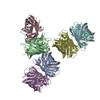
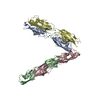
Name: HeV RBP with 2 Fabs / type: complex / ID: 1 / Parent: 0
Source (natural)
Organism: Hendra henipavirus
Recombinant expression
Organism: Homo sapiens (human)
-
Experimental details
-
Structure determination
Method
negative staining
Processing
single particle reconstruction
Aggregation state
particle
-
Sample preparation
Buffer
pH: 7.5
Staining
Type: NEGATIVE / Material: Uranyl Formate
Grid
Model: Homemade / Support film - Material: CARBON / Pretreatment - Type: GLOW DISCHARGE
-
Electron microscopy
Microscope
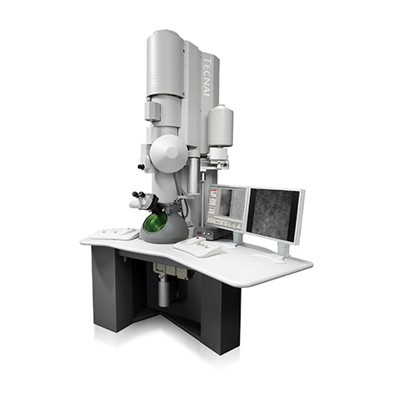
FEI TECNAI F20
Image recording
Film or detector model: GATAN ULTRASCAN 4000 (4k x 4k) / Number grids imaged: 1 / Number real images: 377 / Average exposure time: 1.0 sec. / Average electron dose: 35.0 e/Å2
Electron beam
Acceleration voltage: 200 kV / Electron source: FIELD EMISSION GUN
In the structure databanks used in Yorodumi, some data are registered as the other names, "COVID-19 virus" and "2019-nCoV". Here are the details of the virus and the list of structure data.
Jan 31, 2019. EMDB accession codes are about to change! (news from PDBe EMDB page)
EMDB accession codes are about to change! (news from PDBe EMDB page)
The allocation of 4 digits for EMDB accession codes will soon come to an end. Whilst these codes will remain in use, new EMDB accession codes will include an additional digit and will expand incrementally as the available range of codes is exhausted. The current 4-digit format prefixed with “EMD-” (i.e. EMD-XXXX) will advance to a 5-digit format (i.e. EMD-XXXXX), and so on. It is currently estimated that the 4-digit codes will be depleted around Spring 2019, at which point the 5-digit format will come into force.
The EM Navigator/Yorodumi systems omit the EMD- prefix.
Related info.:Q: What is EMD? / ID/Accession-code notation in Yorodumi/EM Navigator
Yorodumi is a browser for structure data from EMDB, PDB, SASBDB, etc.
This page is also the successor to EM Navigator detail page, and also detail information page/front-end page for Omokage search.
The word "yorodu" (or yorozu) is an old Japanese word meaning "ten thousand". "mi" (miru) is to see.
Related info.:EMDB / PDB / SASBDB / Comparison of 3 databanks / Yorodumi Search / Aug 31, 2016. New EM Navigator & Yorodumi / Yorodumi Papers / Jmol/JSmol / Function and homology information / Changes in new EM Navigator and Yorodumi
 Movie
Movie Controller

 Yorodumi
 Open data
 Basic information
 Map data
 Sample
 Hendra henipavirus
 Authors
 United States, 1 items
  Citation
 Structure visualization
 Movie viewer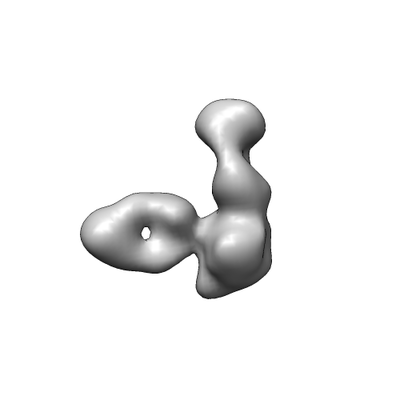
 Downloads & links
 emd_23488.png
 https://data.pdbj.org/pub/emdb/structures/EMD-23488

 Z (Sec.)
 Y (Row.)
 X (Col.)


 Sample components
 Homo sapiens (human)
 Processing
 Electron microscopy
 FIELD EMISSION GUN