positive regulation of single strand break repair / RNA polymerase inhibitor activity / negative regulation of double-strand break repair via nonhomologous end joining / nucleotide-excision repair complex / regulation of transcription-coupled nucleotide-excision repair / response to auditory stimulus / regulation of transcription elongation by RNA polymerase II / DNA protection / single strand break repair / B-WICH complex ...positive regulation of single strand break repair / RNA polymerase inhibitor activity / negative regulation of double-strand break repair via nonhomologous end joining / nucleotide-excision repair complex / regulation of transcription-coupled nucleotide-excision repair / response to auditory stimulus / regulation of transcription elongation by RNA polymerase II / DNA protection / single strand break repair / B-WICH complex / Formation of RNA Pol II elongation complex / Formation of the Early Elongation Complex / Transcriptional regulation by small RNAs / RNA Polymerase II Pre-transcription Events / TP53 Regulates Transcription of DNA Repair Genes / FGFR2 alternative splicing / RNA polymerase II transcribes snRNA genes / mRNA Capping / mRNA Splicing - Minor Pathway / Processing of Capped Intron-Containing Pre-mRNA / RNA Polymerase II Promoter Escape / RNA Polymerase II Transcription Pre-Initiation And Promoter Opening / RNA Polymerase II Transcription Initiation / RNA Polymerase II Transcription Elongation / RNA Polymerase II Transcription Initiation And Promoter Clearance / RNA Pol II CTD phosphorylation and interaction with CE / Estrogen-dependent gene expression / response to superoxide / Formation of TC-NER Pre-Incision Complex / Dual incision in TC-NER / Gap-filling DNA repair synthesis and ligation in TC-NER / mRNA Splicing - Major Pathway / double-strand break repair via classical nonhomologous end joining / photoreceptor cell maintenance / positive regulation by virus of viral protein levels in host cell / RNA polymerase binding / positive regulation of Ras protein signal transduction / chromatin-protein adaptor activity / positive regulation of DNA-templated transcription, elongation / spindle assembly involved in female meiosis / response to UV-B / ATP-dependent chromatin remodeler activity / epigenetic programming in the zygotic pronuclei / UV-damage excision repair / positive regulation of transcription by RNA polymerase III / biological process involved in interaction with symbiont / regulation of mitotic cell cycle phase transition / ATP-dependent DNA damage sensor activity / WD40-repeat domain binding / Cul4A-RING E3 ubiquitin ligase complex / Cul4-RING E3 ubiquitin ligase complex / Cul4B-RING E3 ubiquitin ligase complex / positive regulation of transcription by RNA polymerase I / ubiquitin ligase complex scaffold activity / negative regulation of reproductive process / negative regulation of developmental process / RNA polymerase II complex binding / RNA Polymerase I Transcription Initiation / protein tyrosine kinase activator activity / maintenance of transcriptional fidelity during transcription elongation by RNA polymerase II / pyrimidine dimer repair / viral release from host cell / cullin family protein binding / positive regulation of transcription initiation by RNA polymerase II / response to X-ray / ectopic germ cell programmed cell death / ATP-dependent activity, acting on DNA / RNA polymerase I complex / RNA polymerase III complex / response to UV / positive regulation of viral genome replication / transcription elongation by RNA polymerase I / protein autoubiquitination / RNA polymerase II, core complex / positive regulation of double-strand break repair via homologous recombination / tRNA transcription by RNA polymerase III / ubiquitin-like ligase-substrate adaptor activity / site of DNA damage / JNK cascade / protein localization to chromatin / transcription-coupled nucleotide-excision repair / translation initiation factor binding / proteasomal protein catabolic process / neurogenesis / positive regulation of gluconeogenesis / DNA damage checkpoint signaling / regulation of DNA-templated transcription elongation / positive regulation of DNA repair / transcription elongation factor complex / helicase activity / ERCC6 (CSB) and EHMT2 (G9a) positively regulate rRNA expression / response to gamma radiation / DNA-directed RNA polymerase complex / nucleotide-excision repair / transcription initiation at RNA polymerase II promoter / sperm end piece / DNA-templated transcription initiation / transcription elongation by RNA polymerase II / Recognition of DNA damage by PCNA-containing replication complex / regulation of circadian rhythm 類似検索 - 分子機能
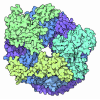
DNA-directed RNA polymerase II subunit RPB4 / DNA-directed RNA polymerase subunit / DNA-directed RNA polymerases I, II, and III subunit RPABC5 / DNA-directed RNA polymerase subunit / DNA-directed RNA polymerases I, II, and III subunit RPABC4 / DNA-directed RNA polymerases I, II, and III subunit RPABC2 / DNA-directed RNA polymerase II subunit RPB11-a / DNA-directed RNA polymerases I, II, and III subunit RPABC3 / DNA-directed RNA polymerase II subunit RPB3 / DNA-directed RNA polymerase subunit beta ...DNA-directed RNA polymerase II subunit RPB4 / DNA-directed RNA polymerase subunit / DNA-directed RNA polymerases I, II, and III subunit RPABC5 / DNA-directed RNA polymerase subunit / DNA-directed RNA polymerases I, II, and III subunit RPABC4 / DNA-directed RNA polymerases I, II, and III subunit RPABC2 / DNA-directed RNA polymerase II subunit RPB11-a / DNA-directed RNA polymerases I, II, and III subunit RPABC3 / DNA-directed RNA polymerase II subunit RPB3 / DNA-directed RNA polymerase subunit beta / DNA-directed RNA polymerases I, II, and III subunit RPABC1 / Winged helix repair factor 1 / Transcription elongation factor 1 homolog / DNA-directed RNA polymerase II subunit RPB9 / DNA excision repair protein ERCC-6 / DNA excision repair protein ERCC-8 / DNA damage-binding protein 1 / UV-stimulated scaffold protein A 類似検索 - 構成要素
Advanced Investigator Grant CHROMATRANS (grant agreement No. 882357)
European Union
引用
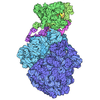
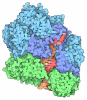
ジャーナル: Cell / 年: 2024 タイトル: STK19 facilitates the clearance of lesion-stalled RNAPII during transcription-coupled DNA repair. 著者: Diana van den Heuvel / Marta Rodríguez-Martínez / Paula J van der Meer / Nicolas Nieto Moreno / Jiyoung Park / Hyun-Suk Kim / Janne J M van Schie / Annelotte P Wondergem / Areetha D'Souza / ...著者: Diana van den Heuvel / Marta Rodríguez-Martínez / Paula J van der Meer / Nicolas Nieto Moreno / Jiyoung Park / Hyun-Suk Kim / Janne J M van Schie / Annelotte P Wondergem / Areetha D'Souza / George Yakoub / Anna E Herlihy / Krushanka Kashyap / Thierry Boissière / Jane Walker / Richard Mitter / Katja Apelt / Klaas de Lint / Idil Kirdök / Mats Ljungman / Rob M F Wolthuis / Patrick Cramer / Orlando D Schärer / Goran Kokic / Jesper Q Svejstrup / Martijn S Luijsterburg / 要旨: Transcription-coupled DNA repair (TCR) removes bulky DNA lesions impeding RNA polymerase II (RNAPII) transcription. Recent studies have outlined the stepwise assembly of TCR factors CSB, CSA, UVSSA, ...Transcription-coupled DNA repair (TCR) removes bulky DNA lesions impeding RNA polymerase II (RNAPII) transcription. Recent studies have outlined the stepwise assembly of TCR factors CSB, CSA, UVSSA, and transcription factor IIH (TFIIH) around lesion-stalled RNAPII. However, the mechanism and factors required for the transition to downstream repair steps, including RNAPII removal to provide repair proteins access to the DNA lesion, remain unclear. Here, we identify STK19 as a TCR factor facilitating this transition. Loss of STK19 does not impact initial TCR complex assembly or RNAPII ubiquitylation but delays lesion-stalled RNAPII clearance, thereby interfering with the downstream repair reaction. Cryoelectron microscopy (cryo-EM) and mutational analysis reveal that STK19 associates with the TCR complex, positioning itself between RNAPII, UVSSA, and CSA. The structural insights and molecular modeling suggest that STK19 positions the ATPase subunits of TFIIH onto DNA in front of RNAPII. Together, these findings provide new insights into the factors and mechanisms required for TCR.
 ムービー
ムービー コントローラー


 データを開く
 基本情報
基本情報
 マップデータ
 試料
試料 キーワード
キーワード 機能・相同性情報
 Homo sapiens (ヒト) /
 Sus scrofa (ブタ)
 データ登録者
 ドイツ, European Union, 2件
  引用
引用


 構造の表示
構造の表示
 ダウンロードとリンク
 emd_19909.png
 http://ftp.pdbj.org/pub/emdb/structures/EMD-19909



 Z (Sec.)
 Y (Row.)
 X (Col.)


 試料の構成要素
 Escherichia coli (大腸菌)
 Trichoplusia ni (イラクサキンウワバ)
 解析
解析 電子顕微鏡法
 FIELD EMISSION GUN