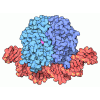
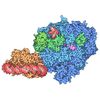
- EMDB-18682: In condensate RNAPII elongation complex bound to RECQ5 -
+
Open data
ID or keywords:
Loading...
-
Basic information
Entry
Database: EMDB / ID: EMD-18682
Title
In condensate RNAPII elongation complex bound to RECQ5
Map data
Sample
Complex: RNAP II EC -- RECQ5(1-650)
Complex: DNA-directed RNA polymerase
Protein or peptide: x 12 types
Complex: DNA-RNA ELONGATION SCAFFOLD
RNA: x 1 types
DNA: x 2 types
Complex: ATP-dependent DNA helicase Q5
Protein or peptide: x 1 types
Ligand: x 2 types
Keywords
RNA polymerase II / transcription inhibition / electron cryomicroscopy / electron cryotomography / TRANSCRIPTION
Function / homology
Function and homology information
Formation of RNA Pol II elongation complex / Formation of the Early Elongation Complex / B-WICH complex positively regulates rRNA expression / Transcriptional regulation by small RNAs / FGFR2 alternative splicing / mRNA Capping / mRNA Splicing - Minor Pathway / Processing of Capped Intron-Containing Pre-mRNA / RNA Polymerase I Transcription Initiation / RNA Polymerase I Promoter Escape ...Formation of RNA Pol II elongation complex / Formation of the Early Elongation Complex / B-WICH complex positively regulates rRNA expression / Transcriptional regulation by small RNAs / FGFR2 alternative splicing / mRNA Capping / mRNA Splicing - Minor Pathway / Processing of Capped Intron-Containing Pre-mRNA / RNA Polymerase I Transcription Initiation / RNA Polymerase I Promoter Escape / RNA Polymerase I Transcription Termination / RNA Polymerase III Transcription Initiation From Type 1 Promoter / RNA Polymerase III Transcription Initiation From Type 2 Promoter / RNA Polymerase III Transcription Initiation From Type 3 Promoter / RNA Pol II CTD phosphorylation and interaction with CE / Estrogen-dependent gene expression / TP53 Regulates Transcription of DNA Repair Genes / RNA Polymerase II Transcription Elongation / RNA polymerase II transcribes snRNA genes / RNA Polymerase II Promoter Escape / RNA Polymerase II Transcription Pre-Initiation And Promoter Opening / RNA Polymerase II Transcription Initiation / RNA Polymerase II Transcription Initiation And Promoter Clearance / RNA Polymerase II Pre-transcription Events / mitotic DNA-templated DNA replication / mRNA Splicing - Major Pathway / Formation of TC-NER Pre-Incision Complex / Dual incision in TC-NER / Gap-filling DNA repair synthesis and ligation in TC-NER / mRNA Polyadenylation / chromosome separation / DNA/RNA hybrid binding / transcription preinitiation complex / DNA metabolic process / negative regulation of transcription elongation by RNA polymerase II / positive regulation of nuclear-transcribed mRNA poly(A) tail shortening / RNA polymerase II complex binding / termination of RNA polymerase II transcription / DNA 3'-5' helicase / maintenance of transcriptional fidelity during transcription elongation by RNA polymerase II / positive regulation of translational initiation / nuclear-transcribed mRNA catabolic process / 3'-5' DNA helicase activity / core promoter sequence-specific DNA binding / termination of RNA polymerase III transcription / transcription initiation at RNA polymerase III promoter / RNA polymerase I complex / RNA polymerase III complex / transcription elongation by RNA polymerase I / RNA polymerase II, core complex / tRNA transcription by RNA polymerase III / transcription by RNA polymerase I / helicase activity / transcription-coupled nucleotide-excision repair / translation initiation factor binding / DNA-templated transcription elongation / replication fork / P-body / transcription initiation at RNA polymerase II promoter / euchromatin / protein-DNA complex / transcription elongation by RNA polymerase II / mRNA transcription by RNA polymerase II / fibrillar center / transcription by RNA polymerase II / ribonucleoside binding / DNA-directed RNA polymerase / DNA-directed RNA polymerase activity / mitotic cell cycle / single-stranded DNA binding / DNA recombination / hydrolase activity / Hydrolases; Acting on ester bonds; Exoribonucleases producing 5'-phosphomonoesters / DNA replication / 5'-3' RNA polymerase activity / nucleic acid binding / DNA helicase activity / chromosome, telomeric region / protein dimerization activity / single-stranded RNA binding / nucleotide binding / chromosome / DNA repair / RNA-directed RNA polymerase / RNA-directed RNA polymerase activity / chromatin binding / nucleolus / magnesium ion binding / ATP hydrolysis activity / DNA binding / zinc ion binding / nucleoplasm / ATP binding / identical protein binding / nucleus / cytosol / cytoplasm Similarity search - Function
DNA-directed RNA polymerase II subunit RPB2 / DNA-directed RNA polymerases I, II, and III subunit RPABC3 / DNA-directed RNA polymerase II subunit RPB1 / ATP-dependent DNA helicase Q5 / DNA-directed RNA polymerase II subunit RPB4 / DNA-directed RNA polymerases I, II, and III subunit RPABC1 / DNA-directed RNA polymerase II subunit RPB9 / DNA-directed RNA polymerases I, II, and III subunit RPABC5 / DNA-directed RNA polymerase II subunit RPB11 / DNA-directed RNA polymerases I, II, and III subunit RPABC2 ...DNA-directed RNA polymerase II subunit RPB2 / DNA-directed RNA polymerases I, II, and III subunit RPABC3 / DNA-directed RNA polymerase II subunit RPB1 / ATP-dependent DNA helicase Q5 / DNA-directed RNA polymerase II subunit RPB4 / DNA-directed RNA polymerases I, II, and III subunit RPABC1 / DNA-directed RNA polymerase II subunit RPB9 / DNA-directed RNA polymerases I, II, and III subunit RPABC5 / DNA-directed RNA polymerase II subunit RPB11 / DNA-directed RNA polymerases I, II, and III subunit RPABC2 / DNA-directed RNA polymerase II subunit RPB3 / DNA-directed RNA polymerases I, II, and III subunit RPABC4 / DNA-directed RNA polymerase II subunit RPB7 Similarity search - Component
Name: ZINC ION / type: ligand / ID: 17 / Number of copies: 7 / Formula: ZN
Molecular weight
Theoretical: 65.409 Da
+
Macromolecule #18: MAGNESIUM ION
Macromolecule
Name: MAGNESIUM ION / type: ligand / ID: 18 / Number of copies: 1 / Formula: MG
Molecular weight
Theoretical: 24.305 Da
-
Experimental details
-
Structure determination
Method
cryo EM
Processing
subtomogram averaging
Aggregation state
particle
-
Sample preparation
Buffer
pH: 7.5
Grid
Model: Quantifoil R1.2/1.3 / Material: GOLD / Mesh: 300 / Support film - Material: GRAPHENE / Support film - topology: CONTINUOUS / Support film - Film thickness: 0.7
Vitrification
Cryogen name: ETHANE-PROPANE / Chamber humidity: 100 % / Chamber temperature: 278 K / Instrument: FEI VITROBOT MARK IV
-
Electron microscopy
Microscope
FEI TITAN KRIOS
Image recording
Film or detector model: GATAN K3 BIOQUANTUM (6k x 4k) / Digitization - Dimensions - Width: 5790 pixel / Digitization - Dimensions - Height: 4092 pixel / Number real images: 1 / Average electron dose: 3.6 e/Å2
Electron beam
Acceleration voltage: 300 kV / Electron source: FIELD EMISSION GUN
In the structure databanks used in Yorodumi, some data are registered as the other names, "COVID-19 virus" and "2019-nCoV". Here are the details of the virus and the list of structure data.
Jan 31, 2019. EMDB accession codes are about to change! (news from PDBe EMDB page)
EMDB accession codes are about to change! (news from PDBe EMDB page)
The allocation of 4 digits for EMDB accession codes will soon come to an end. Whilst these codes will remain in use, new EMDB accession codes will include an additional digit and will expand incrementally as the available range of codes is exhausted. The current 4-digit format prefixed with “EMD-” (i.e. EMD-XXXX) will advance to a 5-digit format (i.e. EMD-XXXXX), and so on. It is currently estimated that the 4-digit codes will be depleted around Spring 2019, at which point the 5-digit format will come into force.
The EM Navigator/Yorodumi systems omit the EMD- prefix.
Related info.:Q: What is EMD? / ID/Accession-code notation in Yorodumi/EM Navigator
Yorodumi is a browser for structure data from EMDB, PDB, SASBDB, etc.
This page is also the successor to EM Navigator detail page, and also detail information page/front-end page for Omokage search.
The word "yorodu" (or yorozu) is an old Japanese word meaning "ten thousand". "mi" (miru) is to see.
Related info.:EMDB / PDB / SASBDB / Comparison of 3 databanks / Yorodumi Search / Aug 31, 2016. New EM Navigator & Yorodumi / Yorodumi Papers / Jmol/JSmol / Function and homology information / Changes in new EM Navigator and Yorodumi
 Movie
Movie Controller


 Open data
 Basic information
 Map data
 Sample
 Keywords
 Function and homology information
 Bos taurus (domestic cattle) / synthetic construct (others) /
  Homo sapiens (human)
 Authors
 Czech Republic, 1 items
  Citation
 Structure visualization
 Downloads & links
 emd_18682.png
 https://data.pdbj.org/pub/emdb/structures/EMD-18682




 Z (Sec.)
 Y (Row.)
 X (Col.)


 Sample components
 Escherichia coli (E. coli)
 Processing
 Electron microscopy
 FIELD EMISSION GUN

