 Movie
Movie Controller

[English] 日本語
 Yorodumi
- SASDAX4: uPAR wild-type ATF complex (Urokinase plasminogen activator surfa... -
+ Open data

- Basic information
| Entry |  |
|---|---|
 Sample Sample | uPAR wild-type ATF complex
|
| Function / homology |  Function and homology information Function and homology informationurokinase plasminogen activator receptor activity / cell-matrix adhesion mediator activity / Attachment of GPI anchor to uPAR / protein complex involved in cell-matrix adhesion / Regulation of FXIIa and plasma kallikrein activity / positive regulation of extracellular matrix disassembly / u-plasminogen activator / regulation of smooth muscle cell-matrix adhesion / urokinase plasminogen activator signaling pathway / regulation of plasminogen activation ...urokinase plasminogen activator receptor activity / cell-matrix adhesion mediator activity / Attachment of GPI anchor to uPAR / protein complex involved in cell-matrix adhesion / Regulation of FXIIa and plasma kallikrein activity / positive regulation of extracellular matrix disassembly / u-plasminogen activator / regulation of smooth muscle cell-matrix adhesion / urokinase plasminogen activator signaling pathway / regulation of plasminogen activation / regulation of integrin-mediated signaling pathway / positive regulation of homotypic cell-cell adhesion / regulation of fibrinolysis / regulation of wound healing / negative regulation of plasminogen activation / serine-type endopeptidase complex / regulation of smooth muscle cell migration / Dissolution of Fibrin Clot / regulation of cell adhesion mediated by integrin / protein localization to cell surface / positive regulation of DNA binding / extrinsic component of membrane / plasminogen activation / negative regulation of intrinsic apoptotic signaling pathway / positive regulation of epidermal growth factor receptor signaling pathway / positive regulation of release of cytochrome c from mitochondria / regulation of proteolysis / tertiary granule membrane / negative regulation of fibrinolysis / regulation of cell adhesion / FXIIa activates plasma kallikrein-kinin system / fibrinolysis / cell-matrix adhesion / specific granule membrane / positive regulation of protein phosphorylation / chemotaxis / blood coagulation / enzyme activator activity / signaling receptor activity / positive regulation of cell migration / receptor ligand activity / endoplasmic reticulum lumen / serine-type endopeptidase activity / external side of plasma membrane / protein domain specific binding / signaling receptor binding / focal adhesion / negative regulation of apoptotic process / Neutrophil degranulation / endoplasmic reticulum membrane / enzyme binding / signal transduction / cell surface / : / proteolysis / extracellular exosome / extracellular region / membrane / plasma membrane Similarity search - Function |
| Biological species |  Homo sapiens (human) Homo sapiens (human) |
 Citation Citation | Journal: J Biol Chem / Year: 2012 Title: A flexible multidomain structure drives the function of the urokinase-type plasminogen activator receptor (uPAR). Authors: Haydyn D T Mertens / Magnus Kjaergaard / Simon Mysling / Henrik Gårdsvoll / Thomas J D Jørgensen / Dmitri I Svergun / Michael Ploug /  Abstract: The urokinase-type plasminogen activator receptor (uPAR) provides a rendezvous between proteolytic degradation of the extracellular matrix and integrin-mediated adhesion to vitronectin. These ...The urokinase-type plasminogen activator receptor (uPAR) provides a rendezvous between proteolytic degradation of the extracellular matrix and integrin-mediated adhesion to vitronectin. These processes are, however, tightly linked because the high affinity binding of urokinase regulates the binding of uPAR to matrix-embedded vitronectin. Although crystal structures exist to define the corresponding static bi- and trimolecular receptor complexes, it is evident that the dynamic property of uPAR plays a decisive role in its function. In the present study, we combine small angle x-ray scattering, hydrogen-deuterium exchange, and surface plasmon resonance to develop a structural model describing the allosteric regulation of uPAR. We show that the flexibility of its N-terminal domain provides the key for understanding this allosteric mechanism. Importantly, our model has direct implications for understanding uPAR-assisted cell adhesion and migration as well as for translational research, including targeted intervention therapy and non-invasive tumor imaging in vivo. |
 Contact author Contact author |
|
- Structure visualization
- Downloads & links
-Data source
| SASBDB page |  SASDAX4 SASDAX4 |
|---|
-Related structure data
| Related structure data | C: citing same article ( |
|---|---|
| Similar structure data |
-External links
| Related items in Molecule of the Month |
|---|
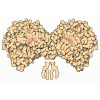
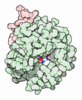
-Models
-Sample
| Sample | Name: uPAR wild-type ATF complex / Sample MW: 85.49 kDa / Specimen concentration: 1.50-4.40 / Concentration method: A280 / Entity id: 66 / 67 |
|---|---|
| Buffer | Name: Sodium Phosphate / Concentration: 25.00 mM / pH: 7.2 / Composition: Glycerol 5.000 %, NaSO4 50.000 mM |
| Entity #66 | Name: uPAR / Type: protein Description: Urokinase plasminogen activator surface receptor Formula weight: 36.98 / Num. of mol.: 1 / Source: Homo sapiens / References: UniProt: Q03405 Sequence: MGHPPLLPLL LLLHTCVPAS WGLRCMQCKT NGDCRVEECA LGQDLCRTTI VRLWEEGEEL ELVEKSCTHS EKTNRTLSYR TGLKITSLTE VVCGLDLCNQ GNSGRAVTYS RSRYLECISC GSSDMSCERG RHQSLQCRSP EEQCLDVVTH WIQEGEEGRP KDDRHLRGCG ...Sequence: MGHPPLLPLL LLLHTCVPAS WGLRCMQCKT NGDCRVEECA LGQDLCRTTI VRLWEEGEEL ELVEKSCTHS EKTNRTLSYR TGLKITSLTE VVCGLDLCNQ GNSGRAVTYS RSRYLECISC GSSDMSCERG RHQSLQCRSP EEQCLDVVTH WIQEGEEGRP KDDRHLRGCG YLPGCPGSNG FHNNDTFHFL KCCNTTKCNE GPILELENLP QNGRQCYSCK GNSTHGCSSE ETFLIDCRGP MNQCLVATGT HEPKNQSYMV RGCATASMCQ HAHLGDAFSM NHIDVSCCTK SGCNHPDLDV QYRSGAAPQP GPAHLSLTIT LLMTARLWGG TLLWT |
| Entity #67 | Name: ATF / Type: protein / Description: Urokinase-type plasminogen activator / Formula weight: 48.51 / Num. of mol.: 1 / Source: Homo sapiens / References: UniProt: P00749 Sequence: MRALLARLLL CVLVVSDSKG SNELHQVPSN CDCLNGGTCV SNKYFSNIHW CNCPKKFGGQ HCEIDKSKTC YEGNGHFYRG KASTDTMGRP CLPWNSATVL QQTYHAHRSD ALQLGLGKHN YCRNPDNRRR PWCYVQVGLK PLVQECMVHD CADGKKPSSP PEELKFQCGQ ...Sequence: MRALLARLLL CVLVVSDSKG SNELHQVPSN CDCLNGGTCV SNKYFSNIHW CNCPKKFGGQ HCEIDKSKTC YEGNGHFYRG KASTDTMGRP CLPWNSATVL QQTYHAHRSD ALQLGLGKHN YCRNPDNRRR PWCYVQVGLK PLVQECMVHD CADGKKPSSP PEELKFQCGQ KTLRPRFKII GGEFTTIENQ PWFAAIYRRH RGGSVTYVCG GSLISPCWVI SATHCFIDYP KKEDYIVYLG RSRLNSNTQG EMKFEVENLI LHKDYSADTL AHHNDIALLK IRSKEGRCAQ PSRTIQTICL PSMYNDPQFG TSCEITGFGK ENSTDYLYPE QLKMTVVKLI SHRECQQPHY YGSEVTTKML CAADPQWKTD SCQGDSGGPL VCSLQGRMTL TGIVSWGRGC ALKDKPGVYT RVSHFLPWIR SHTKEENGLA L |
-Experimental information
| Beam | Instrument name:  DORIS III X33 DORIS III X33  / City: Hamburg / 国: Germany / Shape: 0.6 / Type of source: X-ray synchrotron / Wavelength: 0.15 Å / Dist. spec. to detc.: 2.7 mm / City: Hamburg / 国: Germany / Shape: 0.6 / Type of source: X-ray synchrotron / Wavelength: 0.15 Å / Dist. spec. to detc.: 2.7 mm | ||||||||||||||||||||||||||||||
|---|---|---|---|---|---|---|---|---|---|---|---|---|---|---|---|---|---|---|---|---|---|---|---|---|---|---|---|---|---|---|---|
| Detector | Name: Pilatus 1M-W / Pixsize x: 0.172 mm | ||||||||||||||||||||||||||||||
| Scan | 
| ||||||||||||||||||||||||||||||
| Distance distribution function P(R) | 
| ||||||||||||||||||||||||||||||
| Result | 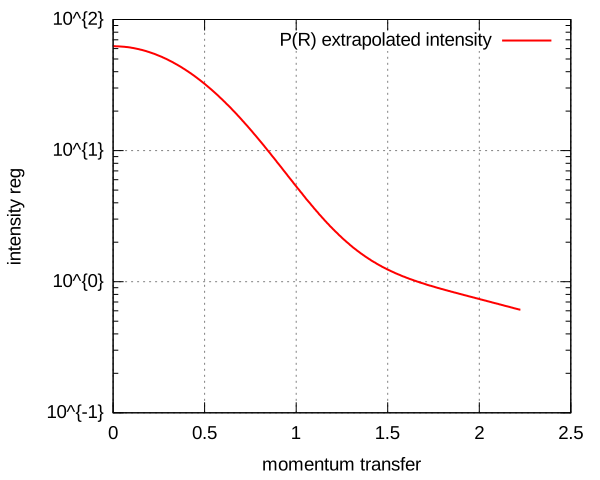
|
