National Institutes of Health/National Institute Of Allergy and Infectious Diseases (NIH/NIAID)
R21AI156846
United States
National Science Foundation (NSF, United States)
MCB-1902392
United States
Other private
exas A&M University T3
United States
Other private
Texas A&M University X-grant
United States
Other private
CPT- Texas AgriLife and Texas A&M University
United States
Citation
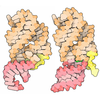
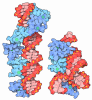
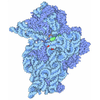
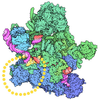
Journal: bioRxiv / Year: 2026 Title: Suppressing Transfer of Antibiotic Resistance by a Small RNA Virus. Authors: Zachary Lill / Jirapat Thongchol / David Solis / Junjie Zhang / Abstract: The global rise of antimicrobial resistance (AMR) demands innovative strategies to limit the spread of multidrug-resistant bacteria. Conjugative plasmids, particularly those in the incompatibility ...The global rise of antimicrobial resistance (AMR) demands innovative strategies to limit the spread of multidrug-resistant bacteria. Conjugative plasmids, particularly those in the incompatibility group P (IncP), play a central role in disseminating resistance genes across diverse bacterial species via their encoded Type IV secretion systems (T4SS). Here, we characterize the single-stranded RNA bacteriophage (ssRNA phage) PRR1, which selectively targets AMR ESKAPEE pathogens carrying the IncP plasmid RP4, and assess its ability to inhibit conjugation. Using cryo-electron microscopy, we first resolved the mature PRR1 virion at 3.45 Å resolution revealing two phage maturation protein (Mat)-RNA interactions within the 3' untranslated region (UTR) - a conserved interaction (Mat-U1) and a novel interaction (Mat-V1) for ssRNA phages. To characterize the PRR1-RP4 pilus interaction, we performed alanine-scanning mutagenesis and pinpointed four critical TrbC pilin residues (S12, W13, S72, and R77) for infection. Computational modeling revealed that these residues are located near the termini of the pilin at the phage-pilus interface. Notably, native and non-infectious, UV-crosslinked PRR1 were sufficient to block RP4 transfer, indicating conjugation inhibition does not require a complete infection cycle. Finally, combining PRR1 and antibiotic treatment yielded nine unique phage-resistant mutants within T4SS-associated genes on the RP4 plasmid. Eight of these mutants nearly abolished conjugation, while the frameshift mutant retained ~30% of wild-type efficiency, which is pivotal to clarifying the relationship between phage infection and pilus function. Collectively, these results establish ssRNA phages as specific T4SS plasmid targeting agents and underscore their potential to limit horizontal gene transfer in AMR pathogens.
History
Deposition
Jan 8, 2026
Deposition site: RCSB / Processing site: RCSB
Revision 1.0
Apr 29, 2026
Provider: repository / Type: Initial release
Revision 1.0
Apr 29, 2026
Data content type: EM metadata / Data content type: EM metadata / Provider: repository / Type: Initial release
Revision 1.0
Apr 29, 2026
Data content type: FSC / Data content type: FSC / Provider: repository / Type: Initial release
Revision 1.0
Apr 29, 2026
Data content type: Half map / Part number: 1 / Data content type: Half map / Provider: repository / Type: Initial release
Revision 1.0
Apr 29, 2026
Data content type: Half map / Part number: 2 / Data content type: Half map / Provider: repository / Type: Initial release
Revision 1.0
Apr 29, 2026
Data content type: Image / Data content type: Image / Provider: repository / Type: Initial release
Revision 1.0
Apr 29, 2026
Data content type: Primary map / Data content type: Primary map / Provider: repository / Type: Initial release
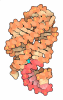
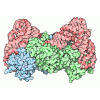
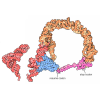
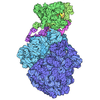
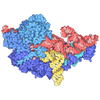
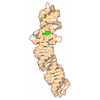
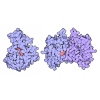
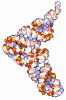
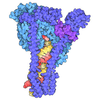
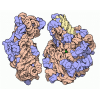
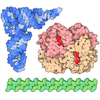
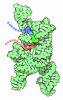
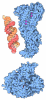
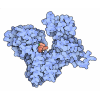
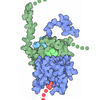
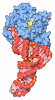
F: Maturation Protein AE: 3' gRNA 0: Coat Protein 1: Coat Protein 2: Coat Protein 3: Coat Protein 4: Coat Protein 5: Coat Protein 6: Coat Protein 7: Coat Protein 8: Coat Protein 9: Coat Protein A: Coat Protein B: Coat Protein C: Coat Protein D: Coat Protein E: Coat Protein O: Coat Protein P: Coat Protein Q: Coat Protein R: Coat Protein S: Coat Protein T: Coat Protein U: Coat Protein V: Coat Protein W: Coat Protein X: Coat Protein Y: Coat Protein Z: Coat Protein a: Coat Protein b: Coat Protein c: Coat Protein d: Coat Protein e: Coat Protein f: Coat Protein g: Coat Protein h: Coat Protein i: Coat Protein j: Coat Protein k: Coat Protein l: Coat Protein m: Coat Protein n: Coat Protein o: Coat Protein p: Coat Protein q: Coat Protein r: Coat Protein s: Coat Protein t: Coat Protein u: Coat Protein v: Coat Protein w: Coat Protein x: Coat Protein y: Coat Protein z: Coat Protein G: Coat Protein H: Coat Protein I: Coat Protein J: Coat Protein K: Coat Protein L: Coat Protein M: Coat Protein N: Coat Protein AA: Coat Protein AB: Coat Protein AC: Coat Protein AD: Coat Protein AO: Coat Protein AP: Coat Protein AQ: Coat Protein AR: Coat Protein AS: Coat Protein AT: Coat Protein AU: Coat Protein AV: Coat Protein AW: Coat Protein AX: Coat Protein AY: Coat Protein AZ: Coat Protein Aa: Coat Protein Ab: Coat Protein Ac: Coat Protein Ad: Coat Protein Ae: Coat Protein Af: Coat Protein Ag: Coat Protein Ah: Coat Protein Ai: Coat Protein Aj: Coat Protein Ak: Coat Protein Al: Coat Protein Am: Coat Protein An: Coat Protein Ao: Coat Protein Ap: Coat Protein Aq: Coat Protein Ar: Coat Protein As: Coat Protein At: Coat Protein Au: Coat Protein Av: Coat Protein Aw: Coat Protein Ax: Coat Protein Ay: Coat Protein Az: Coat Protein A1: Coat Protein A2: Coat Protein A3: Coat Protein A4: Coat Protein A5: Coat Protein A6: Coat Protein A7: Coat Protein A8: Coat Protein A9: Coat Protein A0: Coat Protein BA: Coat Protein BB: Coat Protein BC: Coat Protein BD: Coat Protein BE: Coat Protein BF: Coat Protein BG: Coat Protein BH: Coat Protein BI: Coat Protein BJ: Coat Protein BK: Coat Protein BL: Coat Protein BM: Coat Protein BN: Coat Protein BO: Coat Protein BP: Coat Protein BQ: Coat Protein BR: Coat Protein BS: Coat Protein BV: Coat Protein BY: Coat Protein BZ: Coat Protein Bb: Coat Protein Bc: Coat Protein Bd: Coat Protein Bg: Coat Protein Bh: Coat Protein Bi: Coat Protein Bj: Coat Protein Bk: Coat Protein Bl: Coat Protein Bm: Coat Protein Bn: Coat Protein Bu: Coat Protein Bv: Coat Protein Bw: Coat Protein Bx: Coat Protein By: Coat Protein Bz: Coat Protein B1: Coat Protein B2: Coat Protein B3: Coat Protein B4: Coat Protein B5: Coat Protein B6: Coat Protein B7: Coat Protein B8: Coat Protein B9: Coat Protein B0: Coat Protein CA: Coat Protein CB: Coat Protein CC: Coat Protein CD: Coat Protein CH: Coat Protein CI: Coat Protein CK: Coat Protein CL: Coat Protein CM: Coat Protein CN: Coat Protein CO: Coat Protein CP: Coat Protein CQ: Coat Protein CR: Coat Protein CS: Coat Protein CT: Coat Protein
In the structure databanks used in Yorodumi, some data are registered as the other names, "COVID-19 virus" and "2019-nCoV". Here are the details of the virus and the list of structure data.
Jan 31, 2019. EMDB accession codes are about to change! (news from PDBe EMDB page)
EMDB accession codes are about to change! (news from PDBe EMDB page)
The allocation of 4 digits for EMDB accession codes will soon come to an end. Whilst these codes will remain in use, new EMDB accession codes will include an additional digit and will expand incrementally as the available range of codes is exhausted. The current 4-digit format prefixed with “EMD-” (i.e. EMD-XXXX) will advance to a 5-digit format (i.e. EMD-XXXXX), and so on. It is currently estimated that the 4-digit codes will be depleted around Spring 2019, at which point the 5-digit format will come into force.
The EM Navigator/Yorodumi systems omit the EMD- prefix.
Related info.:Q: What is EMD? / ID/Accession-code notation in Yorodumi/EM Navigator
Yorodumi is a browser for structure data from EMDB, PDB, SASBDB, etc.
This page is also the successor to EM Navigator detail page, and also detail information page/front-end page for Omokage search.
The word "yorodu" (or yorozu) is an old Japanese word meaning "ten thousand". "mi" (miru) is to see.
Related info.:EMDB / PDB / SASBDB / Comparison of 3 databanks / Yorodumi Search / Aug 31, 2016. New EM Navigator & Yorodumi / Yorodumi Papers / Jmol/JSmol / Function and homology information / Changes in new EM Navigator and Yorodumi
 Movie
Movie Controller


 Open data
 Basic information
 Components
 Keywords
 Function and homology information
 Perrunavirus olsenii
 Authors
 United States, 5items
  Citation
 Structure visualization
 Downloads & links
 Other downloads
 PDBj
PDBj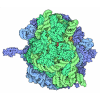
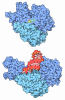
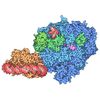
 Assembly
 Sample preparation
 Electron microscopy imaging
 FIELD EMISSION GUN / Accelerating voltage: 300 kV / Illumination mode: FLOOD BEAM
 Processing