 Movie
Movie Controller

[English] 日本語
 Yorodumi
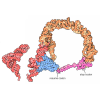
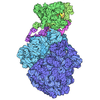
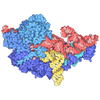
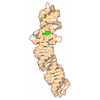
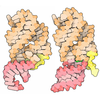
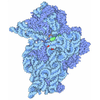
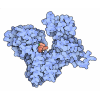
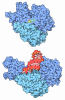
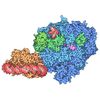
- PDB-9zq6: Structure of SpyCas9 in complex with the anti-CRISPR protein AcrIIA26 -
+ Open data

- Basic information
| Entry | Database: PDB / ID: 9zq6 | |||||||||||||||||||||||||||
|---|---|---|---|---|---|---|---|---|---|---|---|---|---|---|---|---|---|---|---|---|---|---|---|---|---|---|---|---|
| Title | Structure of SpyCas9 in complex with the anti-CRISPR protein AcrIIA26 | |||||||||||||||||||||||||||
 Components Components |
| |||||||||||||||||||||||||||
 Keywords Keywords | IMMUNE SYSTEM / CRISPR / Cas9 / Acr | |||||||||||||||||||||||||||
| Function / homology |  Function and homology information Function and homology informationmaintenance of CRISPR repeat elements / 3'-5' exonuclease activity / DNA endonuclease activity / defense response to virus / Hydrolases; Acting on ester bonds / DNA binding / RNA binding / metal ion binding Similarity search - Function | |||||||||||||||||||||||||||
| Biological species |  Streptococcus pyogenes M1 GAS (bacteria)Streptococcus (bacteria) Streptococcus pyogenes M1 GAS (bacteria)Streptococcus (bacteria) | |||||||||||||||||||||||||||
| Method | ELECTRON MICROSCOPY / single particle reconstruction / cryo EM / Resolution: 2.98 Å | |||||||||||||||||||||||||||
 Authors Authors | Zheng, I. / Learn, B. / Bailey, S. | |||||||||||||||||||||||||||
| Funding support |  United States, 1items United States, 1items
| |||||||||||||||||||||||||||
 Citation Citation | Journal: Biochem J / Year: 2026 Title: Structural basis for inhibition of SpyCas9 by the anti-CRISPR protein AcrIIA26. Authors: Iris Zheng / Brian Learn / Scott Bailey / Abstract: CRISPR-Cas9 systems provide adaptive immunity in prokaryotes by targeting and cleaving invading phage DNA. In response, phages have evolved anti-CRISPR (Acr) proteins to inhibit Cas9 and evade this ...CRISPR-Cas9 systems provide adaptive immunity in prokaryotes by targeting and cleaving invading phage DNA. In response, phages have evolved anti-CRISPR (Acr) proteins to inhibit Cas9 and evade this immune response. AcrIIA26 is a type II-A anti-CRISPR protein that inhibits Streptococcus pyogenes Cas9 (SpyCas9) DNA binding, but its molecular mechanism remains unclear. Here, we determined the 3.0 Å resolution cryo-EM structure of AcrIIA26 in complex with SpyCas9-single-guide RNA, revealing a dual inhibition mechanism. AcrIIA26 adopts a novel fold comprising a central β-sheet flanked by two α-helical bundles. The 5-helix bundle, which features a negatively charged surface whose shape mimics duplex DNA, occupies the same position as the protospacer adjacent motif (PAM) duplex in target-bound Cas9. This directly blocks PAM recognition by burying critical residues R1333 and R1335 in the PAM-interacting domain. Mutagenesis confirmed that residues E49 and D50 in AcrIIA26 are essential for this interaction. Simultaneously, the 4-helix bundle binds the Cas9 REC lobe and sterically prevents the conformational changes required for Cas9 activation, with mutation of AcrIIA26 F121 completely eliminating inhibitory activity. Structural comparisons reveal that despite diverse folds, multiple anti-CRISPRs convergently evolved to block PAM recognition, highlighting this as a critical vulnerability in Cas9 function. Our findings provide mechanistic insights into AcrIIA26 inhibition and offer a foundation for engineering improved Cas9 off-switches for genome editing applications. #1: Journal: Commun Biol / Year: 2019 Title: SPHIRE-crYOLO is a fast and accurate fully automated particle picker for cryo-EM. Authors: Thorsten Wagner / Felipe Merino / Markus Stabrin / Toshio Moriya / Claudia Antoni / Amir Apelbaum / Philine Hagel / Oleg Sitsel / Tobias Raisch / Daniel Prumbaum / Dennis Quentin / Daniel ...Authors: Thorsten Wagner / Felipe Merino / Markus Stabrin / Toshio Moriya / Claudia Antoni / Amir Apelbaum / Philine Hagel / Oleg Sitsel / Tobias Raisch / Daniel Prumbaum / Dennis Quentin / Daniel Roderer / Sebastian Tacke / Birte Siebolds / Evelyn Schubert / Tanvir R Shaikh / Pascal Lill / Christos Gatsogiannis / Stefan Raunser /  Abstract: Selecting particles from digital micrographs is an essential step in single-particle electron cryomicroscopy (cryo-EM). As manual selection of complete datasets-typically comprising thousands of ...Selecting particles from digital micrographs is an essential step in single-particle electron cryomicroscopy (cryo-EM). As manual selection of complete datasets-typically comprising thousands of particles-is a tedious and time-consuming process, numerous automatic particle pickers have been developed. However, non-ideal datasets pose a challenge to particle picking. Here we present the particle picking software crYOLO which is based on the deep-learning object detection system You Only Look Once (YOLO). After training the network with 200-2500 particles per dataset it automatically recognizes particles with high recall and precision while reaching a speed of up to five micrographs per second. Further, we present a general crYOLO network able to pick from previously unseen datasets, allowing for completely automated on-the-fly cryo-EM data preprocessing during data acquisition. crYOLO is available as a standalone program under http://sphire.mpg.de/ and is distributed as part of the image processing workflow in SPHIRE. #2: Journal: Nat Methods / Year: 2020 Title: Non-uniform refinement: adaptive regularization improves single-particle cryo-EM reconstruction. Authors: Ali Punjani / Haowei Zhang / David J Fleet /  Abstract: Cryogenic electron microscopy (cryo-EM) is widely used to study biological macromolecules that comprise regions with disorder, flexibility or partial occupancy. For example, membrane proteins are ...Cryogenic electron microscopy (cryo-EM) is widely used to study biological macromolecules that comprise regions with disorder, flexibility or partial occupancy. For example, membrane proteins are often kept in solution with detergent micelles and lipid nanodiscs that are locally disordered. Such spatial variability negatively impacts computational three-dimensional (3D) reconstruction with existing iterative refinement algorithms that assume rigidity. We introduce non-uniform refinement, an algorithm based on cross-validation optimization, which automatically regularizes 3D density maps during refinement to account for spatial variability. Unlike common shift-invariant regularizers, non-uniform refinement systematically removes noise from disordered regions, while retaining signal useful for aligning particle images, yielding dramatically improved resolution and 3D map quality in many cases. We obtain high-resolution reconstructions for multiple membrane proteins as small as 100 kDa, demonstrating increased effectiveness of cryo-EM for this class of targets critical in structural biology and drug discovery. Non-uniform refinement is implemented in the cryoSPARC software package. | |||||||||||||||||||||||||||
| History |
|
- Structure visualization
| Structure viewer | Molecule: MolmilJmol/JSmol |
|---|
- Downloads & links
-Download
| PDBx/mmCIF format | 9zq6.cif.gz | 438.4 KB | Display | PDBx/mmCIF format |
|---|---|---|---|---|
| PDB format | pdb9zq6.ent.gz | 279.3 KB | Display | PDB format |
| PDBx/mmJSON format | 9zq6.json.gz | Tree view | PDBx/mmJSON format | |
| Others |  Other downloads Other downloads |
-Validation report
| Arichive directory | https://data.pdbj.org/pub/pdb/validation_reports/zq/9zq6ftp://data.pdbj.org/pub/pdb/validation_reports/zq/9zq6 | HTTPS FTP |
|---|
-Related structure data
| Related structure data |  74542MC M: map data used to model this data C: citing same article ( |
|---|---|
| Similar structure data |
-Links
 PDBj
PDBj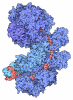
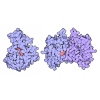
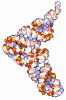
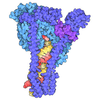
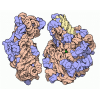
- Assembly
| Deposited unit | 
|
|---|---|
| 1 |
|
-Components
| #1: Protein | Mass: 158699.844 Da / Num. of mol.: 1 Source method: isolated from a genetically manipulated source Source: (gene. exp.) Streptococcus pyogenes M1 GAS (bacteria)Gene: cas9, csn1, SPy_1046 / Production host:  Escherichia coli B (bacteria) Escherichia coli B (bacteria)References: UniProt: Q99ZW2, Hydrolases; Acting on ester bonds |
|---|---|
| #2: Protein | Mass: 21449.260 Da / Num. of mol.: 1 Source method: isolated from a genetically manipulated source Source: (gene. exp.) Streptococcus (bacteria) / Production host: Escherichia coli B (bacteria) |
| #3: RNA chain | Mass: 38697.953 Da / Num. of mol.: 1 / Source method: obtained synthetically / Source: (synth.) Streptococcus pyogenes M1 GAS (bacteria) |
| Has protein modification | N |
-Experimental details
-Experiment
| Experiment | Method: ELECTRON MICROSCOPY |
|---|---|
| EM experiment | Aggregation state: PARTICLE / 3D reconstruction method: single particle reconstruction |
- Sample preparation
| Component | Name: Cas9-sgRNA-AcrIIA26 complex / Type: COMPLEX / Entity ID: all / Source: RECOMBINANT |
|---|---|
| Source (natural) | Organism: Streptococcus pyogenes M1 GAS (bacteria) |
| Source (recombinant) | Organism: Escherichia coli B (bacteria) |
| Buffer solution | pH: 7.5 |
| Specimen | Embedding applied: NO / Shadowing applied: NO / Staining applied: NO / Vitrification applied: YES |
| Vitrification | Cryogen name: ETHANE |
- Electron microscopy imaging
| Experimental equipment |  Model: Titan Krios / Image courtesy: FEI Company |
|---|---|
| Microscopy | Model: TFS KRIOS |
| Electron gun | Electron source:  FIELD EMISSION GUN / Accelerating voltage: 300 kV / Illumination mode: OTHER FIELD EMISSION GUN / Accelerating voltage: 300 kV / Illumination mode: OTHER |
| Electron lens | Mode: BRIGHT FIELD / Nominal defocus max: 3000 nm / Nominal defocus min: 500 nm |
| Image recording | Electron dose: 40 e/Å2 / Film or detector model: FEI FALCON IV (4k x 4k) |
- Processing
| EM software |
| ||||||||||||||||||||||||
|---|---|---|---|---|---|---|---|---|---|---|---|---|---|---|---|---|---|---|---|---|---|---|---|---|---|
| CTF correction | Type: PHASE FLIPPING AND AMPLITUDE CORRECTION | ||||||||||||||||||||||||
| 3D reconstruction | Resolution: 2.98 Å / Resolution method: FSC 0.143 CUT-OFF / Num. of particles: 59914 / Symmetry type: POINT | ||||||||||||||||||||||||
| Refinement | Cross valid method: NONE Stereochemistry target values: GeoStd + Monomer Library + CDL v1.2 | ||||||||||||||||||||||||
| Displacement parameters | Biso mean: 68.61 Å2 | ||||||||||||||||||||||||
| Refine LS restraints |
|
