 Movie
Movie Controller

[English] 日本語
 Yorodumi
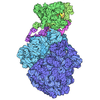
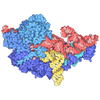
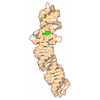
- PDB-9zi7: Cryo-EM structure of RNase P RNA from Geobacillus stearothermophi... -
+ Open data

- Basic information
| Entry | Database: PDB / ID: 9zi7 | |||||||||||||||||||||||||||
|---|---|---|---|---|---|---|---|---|---|---|---|---|---|---|---|---|---|---|---|---|---|---|---|---|---|---|---|---|
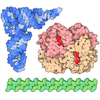
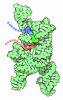
| Title | Cryo-EM structure of RNase P RNA from Geobacillus stearothermophilus, conformer 54 | |||||||||||||||||||||||||||
 Components Components | RNase P RNA | |||||||||||||||||||||||||||
 Keywords Keywords | RNA / RNase P RNA / Geobacillus stearothermophilus / catalytic RNA / cryo-EM structure / conformational heterogeneity | |||||||||||||||||||||||||||
| Function / homology | : / RNA / RNA (> 10) / RNA (> 100) Function and homology information Function and homology information | |||||||||||||||||||||||||||
| Biological species |   Geobacillus stearothermophilus (bacteria) Geobacillus stearothermophilus (bacteria) | |||||||||||||||||||||||||||
| Method | ELECTRON MICROSCOPY / single particle reconstruction / cryo EM / Resolution: 3.3 Å | |||||||||||||||||||||||||||
 Authors Authors | Degenhardt, M.F.S. / Stagno, J. / Wang, Y.X. | |||||||||||||||||||||||||||
| Funding support |  United States, 1items United States, 1items
| |||||||||||||||||||||||||||
 Citation Citation | Journal: To Be Published Title: Cryo-EM structure of RNase P RNA from Geobacillus stearothermophilus, conformer 54 Authors: Degenhardt, M.F.S. / Stagno, J. / Wang, Y.X. | |||||||||||||||||||||||||||
| History |
|
- Structure visualization
| Structure viewer | Molecule: MolmilJmol/JSmol |
|---|
- Downloads & links
-Download
| PDBx/mmCIF format | 9zi7.cif.gz | 240.8 KB | Display | PDBx/mmCIF format |
|---|---|---|---|---|
| PDB format | pdb9zi7.ent.gz | Display | PDB format | |
| PDBx/mmJSON format | 9zi7.json.gz | Tree view | PDBx/mmJSON format | |
| Others |  Other downloads Other downloads |
-Validation report
| Arichive directory | https://data.pdbj.org/pub/pdb/validation_reports/zi/9zi7ftp://data.pdbj.org/pub/pdb/validation_reports/zi/9zi7 | HTTPS FTP |
|---|
-Related structure data
| Related structure data |  74264MC M: map data used to model this data C: citing same article ( |
|---|---|
| Similar structure data |
-Links
 PDBj
PDBj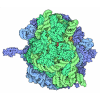
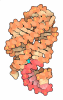
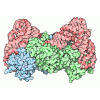
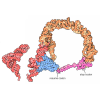
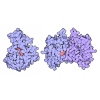
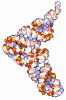
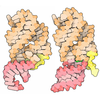
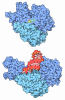
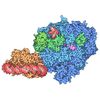
- Assembly
| Deposited unit | 
|
|---|---|
| 1 |
|
-Components
| #1: RNA chain | Mass: 135305.156 Da / Num. of mol.: 1 Source method: isolated from a genetically manipulated source Source: (gene. exp.) Geobacillus stearothermophilus (bacteria)Production host: in vitro transcription vector pT7-TP(deltai) (others) References: GenBank: 143442 | ||||
|---|---|---|---|---|---|
| #2: Chemical | ChemComp-MG /   Mass: 24.305 Da / Num. of mol.: 40 / Source method: obtained synthetically / Formula: Mg Mass: 24.305 Da / Num. of mol.: 40 / Source method: obtained synthetically / Formula: MgHas ligand of interest | N | Has protein modification | N | |
-Experimental details
-Experiment
| Experiment | Method: ELECTRON MICROSCOPY |
|---|---|
| EM experiment | Aggregation state: PARTICLE / 3D reconstruction method: single particle reconstruction |
- Sample preparation
| Component | Name: ribonuclease P RNA / Type: COMPLEX / Entity ID: #1 / Source: RECOMBINANT | ||||||||||||||||||||
|---|---|---|---|---|---|---|---|---|---|---|---|---|---|---|---|---|---|---|---|---|---|
| Molecular weight | Value: 0.1355 MDa / Experimental value: NO | ||||||||||||||||||||
| Source (natural) | Organism: Geobacillus stearothermophilus (bacteria) | ||||||||||||||||||||
| Source (recombinant) | Organism: in vitro transcription vector pT7-TP(deltai) (others) | ||||||||||||||||||||
| Buffer solution | pH: 7.5 / Details: 25 mM Tris-HCl,pH 7.5, 100 mM NaCl, 1 mM MgCl2 | ||||||||||||||||||||
| Buffer component |
| ||||||||||||||||||||
| Specimen | Conc.: 2.8 mg/ml / Embedding applied: NO / Shadowing applied: NO / Staining applied: NO / Vitrification applied: YES Details: The specimen consisted of monomeric RNase P RNA from Geobacillus stearothermophilus purified and prepared in buffer containing 1 mM Magnesium. Samples were applied directly to cryo-EM grids for vitrification | ||||||||||||||||||||
| Specimen support | Details: Glow-discharged Quantifoil R1.2/1.3 Au 300 mesh grids prepared on a Vitrobot. Grids were glow-discharged on both sides for 60 s at 25 mA prior to sample application. Sample concentration was ...Details: Glow-discharged Quantifoil R1.2/1.3 Au 300 mesh grids prepared on a Vitrobot. Grids were glow-discharged on both sides for 60 s at 25 mA prior to sample application. Sample concentration was 2.7 mg/mL. A 10 s wait time and 3 s blot with force 3 to 10 at 277K were used during vitrification. Grid material: GOLD / Grid mesh size: 300 divisions/in. / Grid type: Quantifoil R1.2/1.3 | ||||||||||||||||||||
| Vitrification | Instrument: FEI VITROBOT MARK IV / Cryogen name: ETHANE / Humidity: 90 % / Chamber temperature: 279 K Details: Grids were glow-discharged on both sides prior to vitrification. Vitrification was performed using a Vitrobot Mark IV with a 10s wait time, followed by a 3s blot and blot force 3 to 10 in air |
- Electron microscopy imaging
| Experimental equipment |  Model: Titan Krios / Image courtesy: FEI Company |
|---|---|
| Microscopy | Model: TFS KRIOS Details: The alignment procedure was performed using the EPU software utilizing its autofocus and auto-tuning functions for initial microscope alignment. This was followed by manual fine-tuning ...Details: The alignment procedure was performed using the EPU software utilizing its autofocus and auto-tuning functions for initial microscope alignment. This was followed by manual fine-tuning adjustments of the beam shift, stigmation, and focus controls to ensure optimal image quality. Grid squares were screened systematically, ensuring the selection of areas with appropriate ice thickness and particle distribution. Image shift calibration and eucentric height adjustment were performed within EPU to maintain beam alignment during data acquisition |
| Electron gun | Electron source:  FIELD EMISSION GUN / Accelerating voltage: 300 kV / Illumination mode: FLOOD BEAM FIELD EMISSION GUN / Accelerating voltage: 300 kV / Illumination mode: FLOOD BEAM |
| Electron lens | Mode: BRIGHT FIELD / Nominal magnification: 165000 X / Nominal defocus max: 2000 nm / Nominal defocus min: 500 nm / Cs: 2.7 mm / Alignment procedure: OTHER |
| Specimen holder | Cryogen: NITROGEN / Specimen holder model: FEI TITAN KRIOS AUTOGRID HOLDER / Temperature (max): 100 K / Temperature (min): 80 K |
| Image recording | Average exposure time: 2.5 sec. / Electron dose: 53 e/Å2 / Film or detector model: FEI FALCON IV (4k x 4k) / Num. of grids imaged: 5 / Num. of real images: 78777 |
| EM imaging optics | Energyfilter name: TFS Selectris X / Energyfilter slit width: 10 eV |
| Image scans | Width: 4096 / Height: 4096 |
- Processing
| EM software |
| |||||||||||||||||||||||||||||||||||||||||||||
|---|---|---|---|---|---|---|---|---|---|---|---|---|---|---|---|---|---|---|---|---|---|---|---|---|---|---|---|---|---|---|---|---|---|---|---|---|---|---|---|---|---|---|---|---|---|---|
| CTF correction | Details: CTF correction was performed in cryoSPARC by patch-based motion correction followed by patch-based CTF estimation, providing per-particle local CTF parameters that were applied during 3D ...Details: CTF correction was performed in cryoSPARC by patch-based motion correction followed by patch-based CTF estimation, providing per-particle local CTF parameters that were applied during 3D refinement for phase and amplitude correction of all particles Type: PHASE FLIPPING AND AMPLITUDE CORRECTION | |||||||||||||||||||||||||||||||||||||||||||||
| Particle selection | Num. of particles selected: 21475910 Details: An iterative particle-cleaning workflow was applied, combining 2D classification and heterogeneous refinement with decoy classes to achieve exhaustive particle selection. | |||||||||||||||||||||||||||||||||||||||||||||
| 3D reconstruction | Resolution: 3.3 Å / Resolution method: FSC 0.143 CUT-OFF / Num. of particles: 45331 / Symmetry type: POINT | |||||||||||||||||||||||||||||||||||||||||||||
| Atomic model building | B value: 57 / Protocol: FLEXIBLE FIT / Space: REAL / Target criteria: maximization of map-to-model correlation | |||||||||||||||||||||||||||||||||||||||||||||
| Atomic model building | PDB-ID: 9OV3 Pdb chain-ID: A / Accession code: 9OV3 / Chain residue range: 1-417 Details: The initial model consisted of the complete biological assembly Pdb chain residue range: 1-417 / Source name: PDB / Type: experimental model | |||||||||||||||||||||||||||||||||||||||||||||
| Refinement | Highest resolution: 3.3 Å Stereochemistry target values: REAL-SPACE (WEIGHTED MAP SUM AT ATOM CENTERS) | |||||||||||||||||||||||||||||||||||||||||||||
| Refine LS restraints |
|

