 Movie
Movie Controller

[English] 日本語
 Yorodumi
- PDB-9x6d: The cryo-EM structure of phycobilisome rod from Synechococcus elo... -
+ Open data

- Basic information
| Entry | Database: PDB / ID: 9x6d | ||||||
|---|---|---|---|---|---|---|---|
| Title | The cryo-EM structure of phycobilisome rod from Synechococcus elongatus PCC 7942 | ||||||
 Components Components |
| ||||||
 Keywords Keywords | ELECTRON TRANSPORT / phycobilisome PBS | ||||||
| Function / homology |  Function and homology information Function and homology informationphycobilisome / plasma membrane-derived thylakoid membrane / photosynthesis Similarity search - Function | ||||||
| Biological species |  Synechococcus elongatus PCC 7942 = FACHB-805 (bacteria) Synechococcus elongatus PCC 7942 = FACHB-805 (bacteria) | ||||||
| Method | ELECTRON MICROSCOPY / single particle reconstruction / cryo EM / Resolution: 2.92 Å | ||||||
 Authors Authors | Zheng, Z.G. / Ma, C.Y. / Wang, H.R. / Wang, G.P. / Dong, C.X. / Gao, N. / Zhao, J.D. | ||||||
| Funding support | 1items
| ||||||
 Citation Citation | Journal: Photosynth Res / Year: 2025 Title: The structure of phycobilisome with a bicylindrical core from the cyanobacterium Synechococcus elongatus PCC 7942. Authors: Zhenggao Zheng / Chengying Ma / Hongrui Wang / Guopeng Wang / Chunxia Dong / Ning Gao / Jindong Zhao /  Abstract: Phycobilisomes (PBSs) are the major light-harvesting complexes in the cyanobacteria and red algae and they consist of a central core and peripheral rods that are attached to the core. The PBS cores ...Phycobilisomes (PBSs) are the major light-harvesting complexes in the cyanobacteria and red algae and they consist of a central core and peripheral rods that are attached to the core. The PBS cores contain 2-5 allophycocyanin cylinders that are organized by ApcE. At the present, structures of PBS with tricylindrical and pentacylindrical cores have been determined while the structure of the PBS with a bicylindrical core is yet to be revealed. Here we report the cryo-EM structure of PBS with bicylindrical core from Synechococcus elongatus PCC 7942 (Synechococcus 7942) at an overall resolution of approximately 3 Å. Similar to the PBS with a tricylindrical core, six peripheral rods are attached to the core by the rod-core linker protein CpcG in the PBS of Synechococcus 7942 even though the core lacks the top AP cylinder, which is important for the attachment of peripheral rods to the tricylindrical cores. We found that the C-terminus of ApcE in the Synechococcus 7942 was involved in interacting with both CpcG and CpcB of a top peripheral rod, compensating for the absence of the top AP cylinder of the core and maintaining PBS stability. Analysis of the bilin distribution reveals that distance of excitation energy transfer from top peripheral rods to the terminal emitters is approximately 15% shorter compared to the PBS with tricylindrical cores. Although there are 30% fewer bilin chromophores in the Synechococcus 7942 PBS core compared with the tricylindrical core, the aromatic residue ring in the Synechococcus 7942 PBS core is conserved, supporting the suggestion that these aromatic residues from AP and linker proteins are critical to the energy transfer of PBS. | ||||||
| History |
|
- Structure visualization
| Structure viewer | Molecule: MolmilJmol/JSmol |
|---|
- Downloads & links
-Download
| PDBx/mmCIF format | 9x6d.cif.gz | 753.9 KB | Display | PDBx/mmCIF format |
|---|---|---|---|---|
| PDB format | pdb9x6d.ent.gz | 641.7 KB | Display | PDB format |
| PDBx/mmJSON format | 9x6d.json.gz | Tree view | PDBx/mmJSON format | |
| Others |  Other downloads Other downloads |
-Validation report
| Arichive directory | https://data.pdbj.org/pub/pdb/validation_reports/x6/9x6dftp://data.pdbj.org/pub/pdb/validation_reports/x6/9x6d | HTTPS FTP |
|---|
-Related structure data
| Related structure data |  66300MC  9wg7C  9x69C M: map data used to model this data C: citing same article ( |
|---|---|
| Similar structure data |


-Links
 PDBj
PDBj- Assembly
| Deposited unit | 
|
|---|---|
| 1 |
|
-Components
-C-phycocyanin ... , 2 types, 24 molecules BFGHIKNRSTUWCDEJLMOPQVXa
| #2: Protein | Mass: 17303.238 Da / Num. of mol.: 12 / Source method: isolated from a natural source Source: (natural) Synechococcus elongatus PCC 7942 = FACHB-805 (bacteria)References: UniProt: P13530 #3: Protein | Mass: 18287.713 Da / Num. of mol.: 12 / Source method: isolated from a natural source Source: (natural) Synechococcus elongatus PCC 7942 = FACHB-805 (bacteria)References: UniProt: P06539 |
|---|
-Phycobilisome rod linker ... , 2 types, 2 molecules YZ
| #4: Protein | Mass: 30392.764 Da / Num. of mol.: 1 / Source method: isolated from a natural source Source: (natural) Synechococcus elongatus PCC 7942 = FACHB-805 (bacteria)References: UniProt: Q31PE0 |
|---|---|
| #5: Protein | Mass: 31734.639 Da / Num. of mol.: 1 / Source method: isolated from a natural source Source: (natural) Synechococcus elongatus PCC 7942 = FACHB-805 (bacteria)References: UniProt: Q31PD9 |
-Protein / Non-polymers , 2 types, 35 molecules A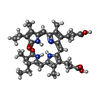
| #1: Protein | Mass: 28372.934 Da / Num. of mol.: 1 / Source method: isolated from a natural source Source: (natural) Synechococcus elongatus PCC 7942 = FACHB-805 (bacteria)References: UniProt: Q31LK9 |
|---|---|
| #6: Chemical | ChemComp-CYC /  Mass: 588.694 Da / Num. of mol.: 34 / Source method: obtained synthetically / Formula: C33H40N4O6 Mass: 588.694 Da / Num. of mol.: 34 / Source method: obtained synthetically / Formula: C33H40N4O6 |
-Details
| Has ligand of interest | N |
|---|---|
| Has protein modification | Y |
-Experimental details
-Experiment
| Experiment | Method: ELECTRON MICROSCOPY |
|---|---|
| EM experiment | Aggregation state: PARTICLE / 3D reconstruction method: single particle reconstruction |
- Sample preparation
| Component | Name: The rod of phycobilisome / Type: COMPLEX / Entity ID: #1-#5 / Source: NATURAL |
|---|---|
| Source (natural) | Organism: Synechococcus elongatus PCC 7942 = FACHB-805 (bacteria) |
| Buffer solution | pH: 7 |
| Specimen | Embedding applied: NO / Shadowing applied: NO / Staining applied: NO / Vitrification applied: YES |
| Vitrification | Cryogen name: ETHANE |
- Electron microscopy imaging
| Experimental equipment |  Model: Titan Krios / Image courtesy: FEI Company |
|---|---|
| Microscopy | Model: TFS KRIOS |
| Electron gun | Electron source:  FIELD EMISSION GUN / Accelerating voltage: 300 kV / Illumination mode: FLOOD BEAM FIELD EMISSION GUN / Accelerating voltage: 300 kV / Illumination mode: FLOOD BEAM |
| Electron lens | Mode: BRIGHT FIELD / Nominal defocus max: 1600 nm / Nominal defocus min: 1000 nm |
| Image recording | Electron dose: 60 e/Å2 / Film or detector model: GATAN K3 BIOQUANTUM (6k x 4k) |
- Processing
| EM software |
| ||||||||||||||||||||||||
|---|---|---|---|---|---|---|---|---|---|---|---|---|---|---|---|---|---|---|---|---|---|---|---|---|---|
| CTF correction | Type: NONE | ||||||||||||||||||||||||
| 3D reconstruction | Resolution: 2.92 Å / Resolution method: FSC 0.143 CUT-OFF / Num. of particles: 258722 / Symmetry type: POINT | ||||||||||||||||||||||||
| Refinement | Highest resolution: 2.92 Å Stereochemistry target values: REAL-SPACE (WEIGHTED MAP SUM AT ATOM CENTERS) | ||||||||||||||||||||||||
| Refine LS restraints |
|
