Japan Agency for Medical Research and Development (AMED)
JP24ama121012
Japan
Japan Agency for Medical Research and Development (AMED)
JP24ama121002
Japan
Citation
Journal: Commun Biol / Year: 2025 Title: Light-harvesting by antenna-containing xanthorhodopsin from an Antarctic Pseudanabaenaceae cyanobacterium. Authors: María Del Carmen Marín / Shunya Murakoshi / Andrey Rozenberg / Tatsuki Tanaka / Masae Konno / Wataru Shihoya / Osamu Nureki / Oded Béjà / Keiichi Inoue / Abstract: Microbial rhodopsins are light-sensitive proteins vital to various phototrophic and sensory processes in microorganisms. Xanthorhodopsins, with their dual chromophore system involving retinal and ...Microbial rhodopsins are light-sensitive proteins vital to various phototrophic and sensory processes in microorganisms. Xanthorhodopsins, with their dual chromophore system involving retinal and carotenoids, have been predominantly studied in the extreme halophilic bacterium Salinibacter ruber and in the early-branching thylakoid-less cyanobacterium Gloeobacter violaceus, where they facilitate light-driven outward proton pumping. However, their distribution, binding specificity, and ecological significance in cyanobacteria remain poorly understood. Here we report the incidence of xanthorhodopsin genes in cyanobacterial genomes and characterize psXR, a xanthorhodopsin from an uncultured Antarctic cyanobacterium from the filamentous family of Pseudanabaenaceae that binds a hydroxylated carotenoid antenna. Through bioinformatic, spectroscopic, functional and structural analyses, we determine the properties of psXR and potential physiological roles of cyanobacterial xanthorhodopsins. Our findings suggest xanthorhodopsins' role in modulating light-harvesting efficiency in cyanobacteria, particularly in extreme environments. The antenna binding and associated structural changes likely provide selective advantages for adapting to polar light conditions such as prolonged low light intensities and spectral shifts, contributing to cyanobacterial survival in harsh habitats.
History
Deposition
Aug 21, 2025
Deposition site: PDBJ / Processing site: PDBJ
Revision 1.0
Mar 18, 2026
Provider: repository / Type: Initial release
Revision 1.0
Mar 18, 2026
Data content type: EM metadata / Data content type: EM metadata / Provider: repository / Type: Initial release
Revision 1.0
Mar 18, 2026
Data content type: FSC / Data content type: FSC / Provider: repository / Type: Initial release
Revision 1.0
Mar 18, 2026
Data content type: Half map / Part number: 1 / Data content type: Half map / Provider: repository / Type: Initial release
Revision 1.0
Mar 18, 2026
Data content type: Half map / Part number: 2 / Data content type: Half map / Provider: repository / Type: Initial release
Revision 1.0
Mar 18, 2026
Data content type: Image / Data content type: Image / Provider: repository / Type: Initial release
Revision 1.0
Mar 18, 2026
Data content type: Mask / Part number: 1 / Data content type: Mask / Provider: repository / Type: Initial release
Revision 1.0
Mar 18, 2026
Data content type: Primary map / Data content type: Primary map / Provider: repository / Type: Initial release
In the structure databanks used in Yorodumi, some data are registered as the other names, "COVID-19 virus" and "2019-nCoV". Here are the details of the virus and the list of structure data.
Jan 31, 2019. EMDB accession codes are about to change! (news from PDBe EMDB page)
EMDB accession codes are about to change! (news from PDBe EMDB page)
The allocation of 4 digits for EMDB accession codes will soon come to an end. Whilst these codes will remain in use, new EMDB accession codes will include an additional digit and will expand incrementally as the available range of codes is exhausted. The current 4-digit format prefixed with “EMD-” (i.e. EMD-XXXX) will advance to a 5-digit format (i.e. EMD-XXXXX), and so on. It is currently estimated that the 4-digit codes will be depleted around Spring 2019, at which point the 5-digit format will come into force.
The EM Navigator/Yorodumi systems omit the EMD- prefix.
Related info.:Q: What is EMD? / ID/Accession-code notation in Yorodumi/EM Navigator
Yorodumi is a browser for structure data from EMDB, PDB, SASBDB, etc.
This page is also the successor to EM Navigator detail page, and also detail information page/front-end page for Omokage search.
The word "yorodu" (or yorozu) is an old Japanese word meaning "ten thousand". "mi" (miru) is to see.
Related info.:EMDB / PDB / SASBDB / Comparison of 3 databanks / Yorodumi Search / Aug 31, 2016. New EM Navigator & Yorodumi / Yorodumi Papers / Jmol/JSmol / Function and homology information / Changes in new EM Navigator and Yorodumi
 Movie
Movie Controller


 Open data
 Basic information
 Components
 Keywords
 Function and homology information
 Gloeobacter violaceus (bacteria)
 Authors
 Japan, 5items
  Citation

 Structure visualization
 Downloads & links
 Other downloads
 PDBj
PDBj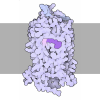
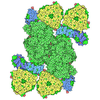
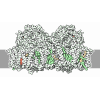
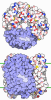
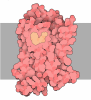
 Assembly

 Escherichia coli (E. coli)
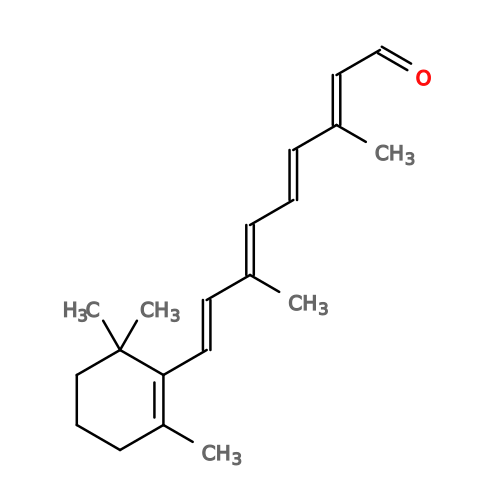 Mass: 284.436 Da / Num. of mol.: 1 / Source method: obtained synthetically / Formula: C20H28O / Feature type: SUBJECT OF INVESTIGATION
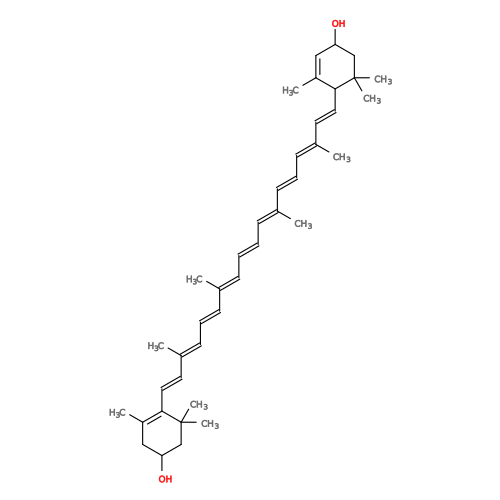 Mass: 568.871 Da / Num. of mol.: 1 / Source method: obtained synthetically / Formula: C40H56O2 / Feature type: SUBJECT OF INVESTIGATION
 Mass: 18.015 Da / Num. of mol.: 25 / Source method: isolated from a natural source / Formula: H2O
 Sample preparation
 Electron microscopy imaging
 FIELD EMISSION GUN / Accelerating voltage: 300 kV / Illumination mode: FLOOD BEAM
 Processing