 Movie
Movie Controller


+ Open data

- Basic information
| Entry | Database: PDB / ID: 9w2f | ||||||||||||||||||||||||||||||
|---|---|---|---|---|---|---|---|---|---|---|---|---|---|---|---|---|---|---|---|---|---|---|---|---|---|---|---|---|---|---|---|
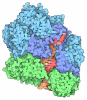
| Title | Cryo-EM structure of DDB1-CRBN in complex with dHuR-2 and HuR | ||||||||||||||||||||||||||||||
 Components Components |
| ||||||||||||||||||||||||||||||
 Keywords Keywords | RNA BINDING PROTEIN / Molecular glue degrader / Complex | ||||||||||||||||||||||||||||||
| Function / homology |  Function and homology information Function and homology informationpositive regulation of autophagosome size / lncRNA-mediated post-transcriptional gene silencing / negative regulation of miRNA-mediated gene silencing / HuR (ELAVL1) binds and stabilizes mRNA / protein-RNA adaptor activity / negative regulation of monoatomic ion transmembrane transport / mRNA 3'-UTR AU-rich region binding / positive regulation by virus of viral protein levels in host cell / spindle assembly involved in female meiosis / 3'-UTR-mediated mRNA stabilization ...positive regulation of autophagosome size / lncRNA-mediated post-transcriptional gene silencing / negative regulation of miRNA-mediated gene silencing / HuR (ELAVL1) binds and stabilizes mRNA / protein-RNA adaptor activity / negative regulation of monoatomic ion transmembrane transport / mRNA 3'-UTR AU-rich region binding / positive regulation by virus of viral protein levels in host cell / spindle assembly involved in female meiosis / 3'-UTR-mediated mRNA stabilization / epigenetic programming in the zygotic pronuclei / miRNA binding / mRNA stabilization / UV-damage excision repair / biological process involved in interaction with symbiont / regulation of mitotic cytokinesis / regulation of mitotic cell cycle phase transition / mRNA destabilization / regulation of miRNA-mediated gene silencing / regulation of natural killer cell activation / WD40-repeat domain binding / locomotory exploration behavior / regulation of cell cycle phase transition / lncRNA binding / Cul4A-RING E3 ubiquitin ligase complex / Cul4-RING E3 ubiquitin ligase complex / regulation of stem cell population maintenance / Cul4B-RING E3 ubiquitin ligase complex / ubiquitin ligase complex scaffold activity / negative regulation of adipose tissue development / regulation of cellular response to stress / response to glucose / limb development / viral release from host cell / cullin family protein binding / positive regulation of Wnt signaling pathway / negative regulation of protein-containing complex assembly / regulation of DNA-templated DNA replication initiation / positive regulation of viral genome replication / positive regulation of gluconeogenesis / positive regulation of superoxide anion generation / positive regulation of autophagy / regulation of embryonic development / replication fork processing / protein import into nucleus / positive regulation of translation / mRNA 3'-UTR binding / proteasomal protein catabolic process / epigenetic regulation of gene expression / P-body / positive regulation of protein-containing complex assembly / nucleotide-excision repair / regulation of autophagy / protein homooligomerization / Recognition of DNA damage by PCNA-containing replication complex / regulation of circadian rhythm / cell population proliferation / DNA Damage Recognition in GG-NER / Dual Incision in GG-NER / Transcription-Coupled Nucleotide Excision Repair (TC-NER) / Formation of TC-NER Pre-Incision Complex / Formation of Incision Complex in GG-NER / cytoplasmic stress granule / positive regulation of protein catabolic process / cellular response to UV / Dual incision in TC-NER / Gap-filling DNA repair synthesis and ligation in TC-NER / rhythmic process / regulation of cell population proliferation / site of double-strand break / double-stranded RNA binding / Neddylation / Dengue Virus-Host Interactions / cytoplasmic vesicle / spermatogenesis / ubiquitin-dependent protein catabolic process / Potential therapeutics for SARS / damaged DNA binding / proteasome-mediated ubiquitin-dependent protein catabolic process / regulation of apoptotic process / transmembrane transporter binding / protein-macromolecule adaptor activity / chromosome, telomeric region / postsynapse / protein ubiquitination / ribonucleoprotein complex / DNA repair / mRNA binding / DNA damage response / nucleolus / protein kinase binding / protein-containing complex binding / perinuclear region of cytoplasm / glutamatergic synapse / endoplasmic reticulum / protein homodimerization activity / protein-containing complex / DNA binding / : / RNA binding Similarity search - Function | ||||||||||||||||||||||||||||||
| Biological species |  Homo sapiens (human) Homo sapiens (human) | ||||||||||||||||||||||||||||||
| Method | ELECTRON MICROSCOPY / single particle reconstruction / cryo EM / Resolution: 3.4 Å | ||||||||||||||||||||||||||||||
 Authors Authors | Dou, H. / Zhu, Y. | ||||||||||||||||||||||||||||||
| Funding support |  China, 2items China, 2items
| ||||||||||||||||||||||||||||||
 Citation Citation | Journal: Nature / Year: 2026 Title: Molecular glue degraders of HuR suppress BRAF-mutant colorectal cancer. Authors: Xiaocui Lu / Xiuyun Wang / Zheng Yang / Xusheng Wang / Lin Wang / Chunhui Xu / I-Chung Lo / Chenlu Geng / Lin Wang / Yisheng Pu / Keyu Zhang / Ziqiang Zhu / Lanxin Ye / Jiayuan Huang / ...Authors: Xiaocui Lu / Xiuyun Wang / Zheng Yang / Xusheng Wang / Lin Wang / Chunhui Xu / I-Chung Lo / Chenlu Geng / Lin Wang / Yisheng Pu / Keyu Zhang / Ziqiang Zhu / Lanxin Ye / Jiayuan Huang / Xiaofan Wei / Fang Bai / Yanan Zhu / Xiaobing Qian / Hao Dou / Hexiu Su / Yong Cang / Abstract: BRAF gain-of-function mutations, particularly BRAF(V600E), affect roughly 10% of all patients with colorectal cancer (CRC), and portend poor prognosis with limited therapeutic interventions. BRAF ...BRAF gain-of-function mutations, particularly BRAF(V600E), affect roughly 10% of all patients with colorectal cancer (CRC), and portend poor prognosis with limited therapeutic interventions. BRAF inhibitors such as encorafenib are ineffective due to MAPK pathway reactivation driven by BRAF dimerization. Combined inhibition of BRAF and EGFR, although approved therapies, results in short survival benefits and frequent treatment resistance and relapse. Here, through rational chemical library design coupled with parallel proteomic screening, we identified dHuR as a molecular glue degrader of human antigen R (HuR), an RNA-binding protein that drives tumour growth, invasion and therapy resistance. dHuR binds to the CRBN ubiquitin ligase to create a unique benzofuran-tethered composite surface to recruit HuR as a neosubstrate by engaging its β-hairpin G-loop degron, as revealed by the cryo-electron microscopy structure of the ternary complex. dHuR abrogated BRAF expression by inducing its exon 18 skipping, and demonstrated superior suppression of BRAF-mutant CRC tumours including those gaining resistance to BRAF inhibitors. Finally, we performed kinome library CRISPR screening and revealed that inactivation of EGFR or MEK enhanced dHuR cytotoxicity, thus establishing a combinatorial strategy to treat patients with refractory BRAF-mutant CRC. | ||||||||||||||||||||||||||||||
| History |
|
- Structure visualization
| Structure viewer | Molecule: MolmilJmol/JSmol |
|---|
- Downloads & links
-Download
| PDBx/mmCIF format | 9w2f.cif.gz | 270.9 KB | Display | PDBx/mmCIF format |
|---|---|---|---|---|
| PDB format | pdb9w2f.ent.gz | Display | PDB format | |
| PDBx/mmJSON format | 9w2f.json.gz | Tree view | PDBx/mmJSON format | |
| Others |  Other downloads Other downloads |
-Validation report
| Arichive directory | https://data.pdbj.org/pub/pdb/validation_reports/w2/9w2fftp://data.pdbj.org/pub/pdb/validation_reports/w2/9w2f | HTTPS FTP |
|---|
-Related structure data
| Related structure data |  65569MC M: map data used to model this data C: citing same article ( |
|---|---|
| Similar structure data |
-Links
 PDBj
PDBj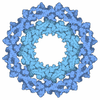
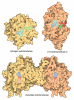

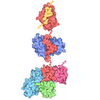
- Assembly
| Deposited unit | 
|
|---|---|
| 1 |
|
-Components
| #1: Protein | Mass: 127097.469 Da / Num. of mol.: 1 Source method: isolated from a genetically manipulated source Source: (gene. exp.) Homo sapiens (human) / Gene: DDB1, XAP1Production host: Insect cell expression vector pTIE1 (others) References: UniProt: Q16531 |
|---|---|
| #2: Protein | Mass: 43882.449 Da / Num. of mol.: 1 Source method: isolated from a genetically manipulated source Source: (gene. exp.) Homo sapiens (human) / Gene: CRBN, AD-006Production host: Insect cell expression vector pTIE1 (others) References: UniProt: Q96SW2 |
| #3: Protein | Mass: 9383.622 Da / Num. of mol.: 1 Source method: isolated from a genetically manipulated source Source: (gene. exp.) Homo sapiens (human) / Gene: ELAVL1, HURProduction host: Cloning vector pET-T7p(-3G)-lacO(SymR+1)-GFP-LVA (others) References: UniProt: Q15717 |
| #4: Chemical | ChemComp-ZN /   Mass: 65.409 Da / Num. of mol.: 1 / Source method: obtained synthetically / Formula: Zn / Feature type: SUBJECT OF INVESTIGATION Mass: 65.409 Da / Num. of mol.: 1 / Source method: obtained synthetically / Formula: Zn / Feature type: SUBJECT OF INVESTIGATION |
| #5: Chemical | ChemComp-A1EUN / ( Mass: 415.441 Da / Num. of mol.: 1 / Source method: obtained synthetically / Formula: C24H21N3O4 / Feature type: SUBJECT OF INVESTIGATION |
| Has ligand of interest | Y |
| Has protein modification | N |
-Experimental details
-Experiment
| Experiment | Method: ELECTRON MICROSCOPY |
|---|---|
| EM experiment | Aggregation state: PARTICLE / 3D reconstruction method: single particle reconstruction |
- Sample preparation
| Component | Name: Ternary complex of HuR-CRBN/DDB1 with dHuR-2 / Type: COMPLEX / Entity ID: #1-#3 / Source: RECOMBINANT |
|---|---|
| Source (natural) | Organism: Homo sapiens (human) |
| Source (recombinant) | Organism: Insect cell expression vector pTIE1 (others) |
| Buffer solution | pH: 7.4 |
| Specimen | Embedding applied: NO / Shadowing applied: NO / Staining applied: NO / Vitrification applied: YES |
| Vitrification | Cryogen name: ETHANE |
- Electron microscopy imaging
| Experimental equipment | 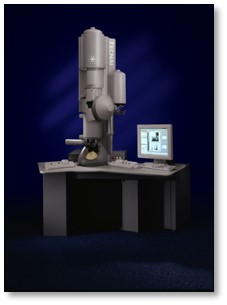 Model: Tecnai F30 / Image courtesy: FEI Company |
|---|---|
| Microscopy | Model: FEI TECNAI F30 |
| Electron gun | Electron source:  FIELD EMISSION GUN / Accelerating voltage: 300 kV / Illumination mode: FLOOD BEAM FIELD EMISSION GUN / Accelerating voltage: 300 kV / Illumination mode: FLOOD BEAM |
| Electron lens | Mode: 4D-STEM / Nominal defocus max: 2000 nm / Nominal defocus min: 800 nm |
| Image recording | Electron dose: 60 e/Å2 / Film or detector model: GATAN K3 (6k x 4k) |
- Processing
| EM software |
| |||||||||
|---|---|---|---|---|---|---|---|---|---|---|
| CTF correction | Type: NONE | |||||||||
| 3D reconstruction | Resolution: 3.4 Å / Resolution method: FSC 0.143 CUT-OFF / Num. of particles: 484157 / Symmetry type: POINT |
