 Movie
Movie Controller


+ Open data

- Basic information
| Entry | Database: PDB / ID: 9w01 | |||||||||||||||||||||||||||
|---|---|---|---|---|---|---|---|---|---|---|---|---|---|---|---|---|---|---|---|---|---|---|---|---|---|---|---|---|
| Title | Cryo-EM structure of LARS1:IARS1 complex | |||||||||||||||||||||||||||
 Components Components |
| |||||||||||||||||||||||||||
 Keywords Keywords | TRANSLATION / Aminoacyl-tRNA synthetase / complex | |||||||||||||||||||||||||||
| Function / homology |  Function and homology information Function and homology informationisoleucine-tRNA ligase / isoleucyl-tRNA aminoacylation / isoleucine-tRNA ligase activity / glutamine-tRNA ligase activity / glutaminyl-tRNA aminoacylation / Selenoamino acid metabolism / leucine-tRNA ligase / leucine-tRNA ligase activity / leucyl-tRNA aminoacylation / cellular response to leucine starvation ...isoleucine-tRNA ligase / isoleucyl-tRNA aminoacylation / isoleucine-tRNA ligase activity / glutamine-tRNA ligase activity / glutaminyl-tRNA aminoacylation / Selenoamino acid metabolism / leucine-tRNA ligase / leucine-tRNA ligase activity / leucyl-tRNA aminoacylation / cellular response to leucine starvation / Cytosolic tRNA aminoacylation / aminoacyl-tRNA synthetase multienzyme complex / tRNA aminoacylation for protein translation / cellular response to L-leucine / aminoacyl-tRNA deacylase activity / Transcriptional and post-translational regulation of MITF-M expression and activity / GTPase activator activity / positive regulation of TORC1 signaling / cellular response to amino acid starvation / cellular response to amino acid stimulus / endomembrane system / osteoblast differentiation / GTPase binding / tRNA binding / lysosome / endoplasmic reticulum / extracellular exosome / ATP binding / membrane / cytosol / cytoplasm Similarity search - Function | |||||||||||||||||||||||||||
| Biological species |  Homo sapiens (human) Homo sapiens (human) | |||||||||||||||||||||||||||
| Method | ELECTRON MICROSCOPY / single particle reconstruction / cryo EM / Resolution: 3.16 Å | |||||||||||||||||||||||||||
 Authors Authors | Kim, Y. / Kim, J.C. / Kim, D.W. / Kim, J. / Lee, J. / Kim, S. / Kang, J.Y. / Park, H.S. | |||||||||||||||||||||||||||
| Funding support |  Korea, Republic Of, 1items Korea, Republic Of, 1items
| |||||||||||||||||||||||||||
 Citation Citation | Journal: Nat Commun / Year: 2026 Title: Cryo-EM structure of the LARS1:IARS1 complex reveals a nutrient-responsive switch controlling mTORC1 signaling. Authors: Youjin Kim / Joo-Chan Kim / Do-Wook Kim / Jinwoo Kim / Jaehun Choi / Seo Young Park / Jimin Lee / Ina Yoon / Sunghoon Kim / Jin Young Kang / Hee-Sung Park / Abstract: Aminoacyl-tRNA synthetases (ARSs) assemble into the multi-tRNA synthetase complex (MSC) to mediate noncanonical functions in cell signaling and stress responses. Among them, human cytosolic leucyl- ...Aminoacyl-tRNA synthetases (ARSs) assemble into the multi-tRNA synthetase complex (MSC) to mediate noncanonical functions in cell signaling and stress responses. Among them, human cytosolic leucyl-tRNA synthetase 1 (LARS1) plays a central role in sensing leucine and activating mTORC1, thereby linking nutrient availability to metabolic regulation. Despite recent progress, fundamental questions remain unresolved about the regulatory mechanisms governing LARS1's non-canonical functions, particularly its structural organization within the MSC. Here, we employ an integrated approach combining structural, biochemical, and cellular analyses to investigate the noncanonical roles of LARS1. The cryo-EM structure of the LARS1:isoleucyl-tRNA synthetase 1 (IARS1) complex reveals that LARS1 binds to IARS1, its anchoring partner in the MSC, via its UNE-L domain. Amino acid stimulation induces LARS1 phosphorylation at Ser1070, Ser1077, and Ser1082, which are located at the interface with IARS1. These modifications disrupt the interaction, promote LARS1 dissociation from the MSC, and enable mTORC1 activation. This study highlights phosphorylation as a conserved and critical molecular switch that orchestrates the non-canonical functions of MSC by dynamically modulating the assembly and activity of its components in response to external stimuli. | |||||||||||||||||||||||||||
| History |
|
- Structure visualization
| Structure viewer | Molecule: MolmilJmol/JSmol |
|---|
- Downloads & links
-Download
| PDBx/mmCIF format | 9w01.cif.gz | 215.8 KB | Display | PDBx/mmCIF format |
|---|---|---|---|---|
| PDB format | pdb9w01.ent.gz | 145.3 KB | Display | PDB format |
| PDBx/mmJSON format | 9w01.json.gz | Tree view | PDBx/mmJSON format | |
| Others |  Other downloads Other downloads |
-Validation report
| Arichive directory | https://data.pdbj.org/pub/pdb/validation_reports/w0/9w01ftp://data.pdbj.org/pub/pdb/validation_reports/w0/9w01 | HTTPS FTP |
|---|
-Related structure data
| Related structure data |  65488MC M: map data used to model this data C: citing same article ( |
|---|---|
| Similar structure data |
-Links
 PDBj
PDBj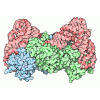
- Assembly
| Deposited unit | 
|
|---|---|
| 1 |
|
-Components
| #1: Protein | Mass: 134649.875 Da / Num. of mol.: 1 Source method: isolated from a genetically manipulated source Source: (gene. exp.) Homo sapiens (human) / Gene: LARS1, KIAA1352, LARS / Production host:   Escherichia coli (E. coli) / References: UniProt: Q9P2J5, leucine-tRNA ligase Escherichia coli (E. coli) / References: UniProt: Q9P2J5, leucine-tRNA ligase |
|---|---|
| #2: Protein | Mass: 144723.594 Da / Num. of mol.: 1 Source method: isolated from a genetically manipulated source Details: The N-terminal GST tag was cleaved by TEV protease, leaving a single Gly residue. Source: (gene. exp.) Homo sapiens (human) / Gene: IARS1, IARS / Production host: Escherichia coli (E. coli) / References: UniProt: P41252, isoleucine-tRNA ligase |
| Has protein modification | N |
-Experimental details
-Experiment
| Experiment | Method: ELECTRON MICROSCOPY |
|---|---|
| EM experiment | Aggregation state: PARTICLE / 3D reconstruction method: single particle reconstruction |
- Sample preparation
| Component | Name: Complex of Leucyl-tRNA synthetase 1 and Isoleucyl-tRNA synthetase Type: COMPLEX / Entity ID: all / Source: RECOMBINANT | ||||||||||||||||||||
|---|---|---|---|---|---|---|---|---|---|---|---|---|---|---|---|---|---|---|---|---|---|
| Molecular weight | Value: 98.97 kDa/nm / Experimental value: NO | ||||||||||||||||||||
| Source (natural) | Organism: Homo sapiens (human) | ||||||||||||||||||||
| Source (recombinant) | Organism: Escherichia coli (E. coli) | ||||||||||||||||||||
| Buffer solution | pH: 8 / Details: 20 mM Tris-HCl pH 8.0, 150 mM NaCl, 1 mM DTT | ||||||||||||||||||||
| Buffer component |
| ||||||||||||||||||||
| Specimen | Conc.: 1 mg/ml / Embedding applied: NO / Shadowing applied: NO / Staining applied: NO / Vitrification applied: YES | ||||||||||||||||||||
| Specimen support | Grid material: GOLD / Grid mesh size: 300 divisions/in. / Grid type: C-flat-1.2/1.3 | ||||||||||||||||||||
| Vitrification | Instrument: FEI VITROBOT MARK IV / Cryogen name: ETHANE / Humidity: 100 % / Chamber temperature: 277.15 K |
- Electron microscopy imaging
| Experimental equipment |  Model: Titan Krios / Image courtesy: FEI Company |
|---|---|
| Microscopy | Model: TFS KRIOS |
| Electron gun | Electron source:  FIELD EMISSION GUN / Accelerating voltage: 300 kV / Illumination mode: FLOOD BEAM FIELD EMISSION GUN / Accelerating voltage: 300 kV / Illumination mode: FLOOD BEAM |
| Electron lens | Mode: BRIGHT FIELD / Nominal magnification: 96000 X / Nominal defocus max: 2500 nm / Nominal defocus min: 800 nm / Cs: 2.7 mm / C2 aperture diameter: 50 µm / Alignment procedure: BASIC |
| Specimen holder | Cryogen: NITROGEN / Specimen holder model: FEI TITAN KRIOS AUTOGRID HOLDER |
| Image recording | Average exposure time: 3.8 sec. / Electron dose: 60 e/Å2 / Film or detector model: FEI FALCON IV (4k x 4k) / Num. of grids imaged: 1 / Num. of real images: 7504 |
- Processing
| EM software |
| ||||||||||||||||||||||||||||||||||||||||||||||||||||||||||||
|---|---|---|---|---|---|---|---|---|---|---|---|---|---|---|---|---|---|---|---|---|---|---|---|---|---|---|---|---|---|---|---|---|---|---|---|---|---|---|---|---|---|---|---|---|---|---|---|---|---|---|---|---|---|---|---|---|---|---|---|---|---|
| CTF correction | Details: Correction was performed following Homogeneous refinement Type: PHASE FLIPPING AND AMPLITUDE CORRECTION | ||||||||||||||||||||||||||||||||||||||||||||||||||||||||||||
| Particle selection | Num. of particles selected: 4690000 | ||||||||||||||||||||||||||||||||||||||||||||||||||||||||||||
| Symmetry | Point symmetry: C1 (asymmetric) | ||||||||||||||||||||||||||||||||||||||||||||||||||||||||||||
| 3D reconstruction | Resolution: 3.16 Å / Resolution method: FSC 0.143 CUT-OFF / Num. of particles: 135800 / Algorithm: FOURIER SPACE / Num. of class averages: 1 / Symmetry type: POINT | ||||||||||||||||||||||||||||||||||||||||||||||||||||||||||||
| Atomic model building | Protocol: RIGID BODY FIT Details: Initial fitting with Chimera followed by optimization using Phenix dock_in_map | ||||||||||||||||||||||||||||||||||||||||||||||||||||||||||||
| Atomic model building |
| ||||||||||||||||||||||||||||||||||||||||||||||||||||||||||||
| Refinement | Cross valid method: NONE Stereochemistry target values: GeoStd + Monomer Library + CDL v1.2 | ||||||||||||||||||||||||||||||||||||||||||||||||||||||||||||
| Displacement parameters | Biso mean: 65.29 Å2 | ||||||||||||||||||||||||||||||||||||||||||||||||||||||||||||
| Refine LS restraints |
|
