 Movie
Movie Controller


+ Open data

- Basic information
| Entry | Database: PDB / ID: 9vts | |||||||||||||||||||||||||||
|---|---|---|---|---|---|---|---|---|---|---|---|---|---|---|---|---|---|---|---|---|---|---|---|---|---|---|---|---|
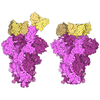
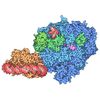
| Title | EBOV GP/1A10-VHH complex | |||||||||||||||||||||||||||
 Components Components |
| |||||||||||||||||||||||||||
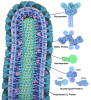
 Keywords Keywords | MEMBRANE PROTEIN / ebolavirus / glycoprotein / Nanobody / Complex | |||||||||||||||||||||||||||
| Function / homology |  Function and homology information Function and homology informationclathrin-dependent endocytosis of virus by host cell / symbiont-mediated-mediated suppression of host tetherin activity / entry receptor-mediated virion attachment to host cell / symbiont-mediated suppression of host innate immune response / fusion of virus membrane with host endosome membrane / viral envelope / lipid binding / host cell plasma membrane / virion membrane / extracellular region Similarity search - Function | |||||||||||||||||||||||||||
| Biological species |  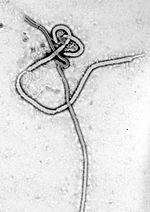 Zaire ebolavirus Zaire ebolavirusEbola virus - Gabon   Vicugna pacos (alpaca) Vicugna pacos (alpaca) | |||||||||||||||||||||||||||
| Method | ELECTRON MICROSCOPY / single particle reconstruction / cryo EM / Resolution: 2.56 Å | |||||||||||||||||||||||||||
 Authors Authors | Wang, M. / Gong, P. / Jin, T. | |||||||||||||||||||||||||||
| Funding support |  China, 3items China, 3items
| |||||||||||||||||||||||||||
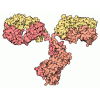
 Citation Citation | Journal: Nat Commun / Year: 2026 Title: A highly potent nanobody-based bispecific therapeutic provides broad-spectrum protection against ebolavirus. Authors: Meihua Wang / Xinghai Zhang / Wujian Li / Yanfeng Yao / Entao Li / Baoyue Zhang / Jinge Zhou / Shunli Liu / Yongxiang Gao / Zhongliang Zhu / Lixia Zhu / Mengyao Liu / Jing Hu / Cheng Peng / ...Authors: Meihua Wang / Xinghai Zhang / Wujian Li / Yanfeng Yao / Entao Li / Baoyue Zhang / Jinge Zhou / Shunli Liu / Yongxiang Gao / Zhongliang Zhu / Lixia Zhu / Mengyao Liu / Jing Hu / Cheng Peng / Fangxu Li / Miaoyu Chen / Hang Liu / Chengbing Yao / Yuhua Shang / Feihu Yan / Peng Gong / Tengchuan Jin / Sandra Chiu / Abstract: The highly lethal Ebola virus species-Zaire (EBOV), Sudan (SUDV), and Bundibugyo (BDBV)-pose persistent threats to global health. Current antibody therapies target EBOV but lack broad neutralization ...The highly lethal Ebola virus species-Zaire (EBOV), Sudan (SUDV), and Bundibugyo (BDBV)-pose persistent threats to global health. Current antibody therapies target EBOV but lack broad neutralization across ebolaviruses. Recent pan-ebolavirus strategies rely on antibody cocktails. Here, we identified two camelid-derived nanobodies (1A10 and BA2) that neutralize EBOV, SUDV, and BDBV in vitro and protect female rodents against these pathogens. High-resolution cryo-EM structures of their GP complexes showed that 1A10 and BA2 bind conserved but non-overlapping epitopes near the GP1 base and GP2's internal fusion loop (IFL), and biochemical analyses revealed their distinct neutralization mechanisms. To further improve efficacy, we engineered a bispecific antibody (BA2-1A10) via GS linker-mediated IgG-Fc fusion, which provided highly potent protection against all three viruses in female rodents model and positions it as a strong broad-spectrum anti-ebolavirus candidate. Our work demonstrates a structure-guided bispecific nanobody strategy for pan-ebolavirus therapy and highlights compact antibodies for next-generation antivirals. | |||||||||||||||||||||||||||
| History |
|
- Structure visualization
| Structure viewer | Molecule: MolmilJmol/JSmol |
|---|
- Downloads & links
-Download
| PDBx/mmCIF format | 9vts.cif.gz | 228.7 KB | Display | PDBx/mmCIF format |
|---|---|---|---|---|
| PDB format | pdb9vts.ent.gz | 175 KB | Display | PDB format |
| PDBx/mmJSON format | 9vts.json.gz | Tree view | PDBx/mmJSON format | |
| Others |  Other downloads Other downloads |
-Validation report
| Arichive directory | https://data.pdbj.org/pub/pdb/validation_reports/vt/9vtsftp://data.pdbj.org/pub/pdb/validation_reports/vt/9vts | HTTPS FTP |
|---|
-Related structure data
| Related structure data |  65343MC  9vt4C M: map data used to model this data C: citing same article ( |
|---|---|
| Similar structure data |

-Links
 PDBj
PDBj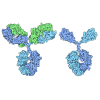
- Assembly
| Deposited unit | 
|
|---|---|
| 1 |
|
-Components
| #1: Protein | Mass: 34710.973 Da / Num. of mol.: 3 Source method: isolated from a genetically manipulated source Details: mucin-deleted EBOV GP1,mucin-deleted EBOV GP1 Source: (gene. exp.) Zaire ebolavirus, (gene. exp.) Ebola virus - Gabon (1994-1997)Gene: GP / Strain: Gabon-94 / Production host:  Homo sapiens (human) / References: UniProt: G8DB49, UniProt: O11457 Homo sapiens (human) / References: UniProt: G8DB49, UniProt: O11457#2: Protein | Mass: 17994.176 Da / Num. of mol.: 3 Source method: isolated from a genetically manipulated source Source: (gene. exp.) Zaire ebolavirus / Gene: GP / Production host: Homo sapiens (human) / References: UniProt: A0A5J6EDK7#3: Antibody | Mass: 14737.350 Da / Num. of mol.: 3 Source method: isolated from a genetically manipulated source Source: (gene. exp.) Vicugna pacos (alpaca) / Production host: Homo sapiens (human)#4: Polysaccharide | Source method: isolated from a genetically manipulated source Has ligand of interest | N | Has protein modification | Y | |
|---|
-Experimental details
-Experiment
| Experiment | Method: ELECTRON MICROSCOPY |
|---|---|
| EM experiment | Aggregation state: PARTICLE / 3D reconstruction method: single particle reconstruction |
- Sample preparation
| Component | Name: EBOV GP/1A10 complex / Type: COMPLEX / Entity ID: #2, #1, #3 / Source: RECOMBINANT | ||||||||||||
|---|---|---|---|---|---|---|---|---|---|---|---|---|---|
| Molecular weight | Experimental value: NO | ||||||||||||
| Source (natural) |
| ||||||||||||
| Source (recombinant) | Organism: Homo sapiens (human) | ||||||||||||
| Buffer solution | pH: 7.4 | ||||||||||||
| Specimen | Embedding applied: NO / Shadowing applied: NO / Staining applied: NO / Vitrification applied: YES | ||||||||||||
| Vitrification | Cryogen name: ETHANE |
- Electron microscopy imaging
| Microscopy | Model: JEOL CRYO ARM 300 |
|---|---|
| Electron gun | Electron source:  FIELD EMISSION GUN / Accelerating voltage: 300 kV / Illumination mode: FLOOD BEAM FIELD EMISSION GUN / Accelerating voltage: 300 kV / Illumination mode: FLOOD BEAM |
| Electron lens | Mode: BRIGHT FIELD / Nominal defocus max: 2500 nm / Nominal defocus min: 500 nm |
| Image recording | Electron dose: 40 e/Å2 / Film or detector model: GATAN K3 (6k x 4k) |
- Processing
| EM software |
| ||||||||||||||||||||||||
|---|---|---|---|---|---|---|---|---|---|---|---|---|---|---|---|---|---|---|---|---|---|---|---|---|---|
| CTF correction | Type: PHASE FLIPPING ONLY | ||||||||||||||||||||||||
| Symmetry | Point symmetry: C3 (3 fold cyclic) | ||||||||||||||||||||||||
| 3D reconstruction | Resolution: 2.56 Å / Resolution method: FSC 0.143 CUT-OFF / Num. of particles: 662790 / Symmetry type: POINT | ||||||||||||||||||||||||
| Atomic model building | Protocol: AB INITIO MODEL | ||||||||||||||||||||||||
| Refinement | Highest resolution: 2.56 Å / Cross valid method: NONE Stereochemistry target values: REAL-SPACE (WEIGHTED MAP SUM AT ATOM CENTERS) | ||||||||||||||||||||||||
| Refine LS restraints |
|
