 Movie
Movie Controller

[English] 日本語
 Yorodumi
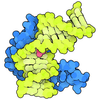
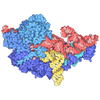
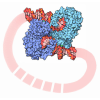
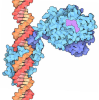
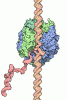
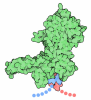
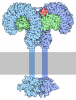
- PDB-9vtp: Target DNA-bound type I-F3 TniQ-Cascade of Vibrio parahaemolyticu... -
+ Open data

- Basic information
| Entry | Database: PDB / ID: 9vtp | |||||||||||||||||||||||||||||||||
|---|---|---|---|---|---|---|---|---|---|---|---|---|---|---|---|---|---|---|---|---|---|---|---|---|---|---|---|---|---|---|---|---|---|---|
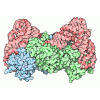
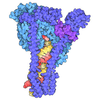
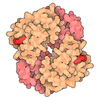
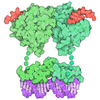
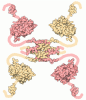
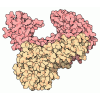
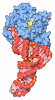
| Title | Target DNA-bound type I-F3 TniQ-Cascade of Vibrio parahaemolyticus in partial R-loop state | |||||||||||||||||||||||||||||||||
 Components Components |
| |||||||||||||||||||||||||||||||||
 Keywords Keywords | DNA BINDING PROTEIN / CRISPR-associated transposon | |||||||||||||||||||||||||||||||||
| Function / homology |  Function and homology information Function and homology information | |||||||||||||||||||||||||||||||||
| Biological species |  Vibrio parahaemolyticus RIMD 2210633 (bacteria)Vibrio alginolyticus (bacteria) Vibrio parahaemolyticus RIMD 2210633 (bacteria)Vibrio alginolyticus (bacteria) | |||||||||||||||||||||||||||||||||
| Method | ELECTRON MICROSCOPY / single particle reconstruction / Resolution: 2.68 Å | |||||||||||||||||||||||||||||||||
 Authors Authors | Ishihara, K. / Numata, T. | |||||||||||||||||||||||||||||||||
| Funding support |  Japan, 3items Japan, 3items
| |||||||||||||||||||||||||||||||||
 Citation Citation | Journal: Nucleic Acids Res / Year: 2026 Title: Sequential structural rearrangements at the PAM-distal site of a type I-F3 CRISPR-Cas effector enabling RNA-guided DNA transposition. Authors: Kazuki Ishihara / Shunsuke Matsumoto / Christoph Gerle / Chai C Gopalasingam / Hideki Shigematsu / Tsuyoshi Shirai / Tomoyuki Numata / Abstract: Some prokaryotes carry CRISPR-associated transposons (CASTs), Tn7-like elements that incorporate genes encoding CRISPR-Cas effectors. CAST insertion is directed by CRISPR-Cas effectors through RNA- ...Some prokaryotes carry CRISPR-associated transposons (CASTs), Tn7-like elements that incorporate genes encoding CRISPR-Cas effectors. CAST insertion is directed by CRISPR-Cas effectors through RNA-guided DNA binding and interactions with transposition-associated proteins. Although efficient sequence-specific DNA integration requires both precise target DNA recognition and coordinated interactions between effectors and transposition-associated proteins, the underlying mechanism remains elusive. Here, we determined three cryo-EM structures of target DNA-bound type I-F3 TniQ-Cascade from Vibrio parahaemolyticus, revealing how Cas8/5 recognizes the protospacer adjacent motif (PAM) and identifying a key residue responsible for the cytidine preference at position -2 of the PAM. We revealed mismatch tolerance at the PAM-proximal site. Structural analyses showed that correct base pairing at the PAM-distal site correlates with conformational changes in the Cas8/5 helical bundle and TniQ, bending the DNA to guide its downstream region toward the transposition machinery. Together, these dynamic rearrangements at the PAM-distal region provide insights into the licensing mechanism of type I-F3 CAST transposition and highlight its potential for genome engineering applications. | |||||||||||||||||||||||||||||||||
| History |
|
- Structure visualization
| Structure viewer | Molecule: MolmilJmol/JSmol |
|---|
- Downloads & links
-Download
| PDBx/mmCIF format | 9vtp.cif.gz | 749 KB | Display | PDBx/mmCIF format |
|---|---|---|---|---|
| PDB format | pdb9vtp.ent.gz | 602 KB | Display | PDB format |
| PDBx/mmJSON format | 9vtp.json.gz | Tree view | PDBx/mmJSON format | |
| Others |  Other downloads Other downloads |
-Validation report
| Arichive directory | https://data.pdbj.org/pub/pdb/validation_reports/vt/9vtpftp://data.pdbj.org/pub/pdb/validation_reports/vt/9vtp | HTTPS FTP |
|---|
-Related structure data
| Related structure data |  65338MC  9vtqC  9vtrC M: map data used to model this data C: citing same article ( |
|---|---|
| Similar structure data |


-Links
 PDBj
PDBj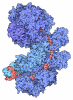

- Assembly
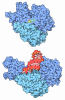
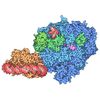
| Deposited unit | 
|
|---|---|
| 1 |
|
-Components
-DNA chain , 2 types, 2 molecules 23
| #2: DNA chain | Mass: 23027.676 Da / Num. of mol.: 1 / Source method: obtained synthetically / Source: (synth.) Vibrio alginolyticus (bacteria) / References: GenBank: 1190167432 |
|---|---|
| #3: DNA chain | Mass: 23224.912 Da / Num. of mol.: 1 / Source method: obtained synthetically / Source: (synth.) Vibrio alginolyticus (bacteria) / References: GenBank: 1190167432 |
-Protein , 2 types, 8 molecules ABCDEFIJ
| #4: Protein | Mass: 39455.414 Da / Num. of mol.: 6 Source method: isolated from a genetically manipulated source Source: (gene. exp.) Vibrio parahaemolyticus RIMD 2210633 (bacteria)Gene: VPA1389 / Plasmid: pMAL-c2 / Production host:  Escherichia coli BL21(DE3) (bacteria) / Variant (production host): Gold CodonPlus RIL / References: UniProt: Q87GC8 Escherichia coli BL21(DE3) (bacteria) / Variant (production host): Gold CodonPlus RIL / References: UniProt: Q87GC8#7: Protein | Mass: 47357.113 Da / Num. of mol.: 2 Source method: isolated from a genetically manipulated source Source: (gene. exp.) Vibrio parahaemolyticus RIMD 2210633 (bacteria)Gene: VPA1387 / Plasmid: pMAL-c2 / Production host: Escherichia coli BL21(DE3) (bacteria) / Variant (production host): Gold CodonPlus RIL / References: UniProt: Q87GD0 |
|---|
-CRISPR-associated ... , 2 types, 2 molecules GH
| #5: Protein | Mass: 71108.406 Da / Num. of mol.: 1 Source method: isolated from a genetically manipulated source Details: Chain g corresponds to an unassignable region of the Cas8/5 helical bundle in chain G (residues 326-389). Source: (gene. exp.) Vibrio parahaemolyticus RIMD 2210633 (bacteria)Gene: VPA1388 / Plasmid: pMAL-c2 / Production host: Escherichia coli BL21(DE3) (bacteria) / Variant (production host): Gold CodonPlus RIL / References: UniProt: Q87GC9 |
|---|---|
| #6: Protein | Mass: 22919.000 Da / Num. of mol.: 1 Source method: isolated from a genetically manipulated source Source: (gene. exp.) Vibrio parahaemolyticus RIMD 2210633 (bacteria)Gene: VPA1390 / Plasmid: pMAL-c2 / Production host: Escherichia coli BL21(DE3) (bacteria) / Variant (production host): Gold CodonPlus RIL / References: UniProt: Q87GC7 |
-RNA chain / Non-polymers , 2 types, 2 molecules 1
| #1: RNA chain | Mass: 19405.658 Da / Num. of mol.: 1 Source method: isolated from a genetically manipulated source Source: (gene. exp.) Vibrio parahaemolyticus RIMD 2210633 (bacteria)Plasmid: pACYCDuet-1 / Production host: Escherichia coli BL21(DE3) (bacteria) / Variant (production host): Gold CodonPlus RIL / References: GenBank: BA000032.2 |
|---|---|
| #8: Chemical | ChemComp-MG /  Mass: 24.305 Da / Num. of mol.: 1 / Source method: obtained synthetically / Formula: Mg Mass: 24.305 Da / Num. of mol.: 1 / Source method: obtained synthetically / Formula: Mg |
-Details
| Has ligand of interest | Y |
|---|---|
| Has protein modification | N |
-Experimental details
-Experiment
| Experiment | Method: ELECTRON MICROSCOPY |
|---|---|
| EM experiment | Aggregation state: PARTICLE / 3D reconstruction method: single particle reconstruction |
- Sample preparation
| Component | Name: Vibrio parahaemolyticus type I-F3 TniQ-Cascade / Type: COMPLEX / Entity ID: #1-#4, #6-#7 / Source: RECOMBINANT | ||||||||||||||||||||||||
|---|---|---|---|---|---|---|---|---|---|---|---|---|---|---|---|---|---|---|---|---|---|---|---|---|---|
| Molecular weight | Value: 0.494 MDa / Experimental value: NO | ||||||||||||||||||||||||
| Source (natural) | Organism: Vibrio parahaemolyticus RIMD 2210633 (bacteria) | ||||||||||||||||||||||||
| Source (recombinant) | Organism: Escherichia coli BL21(DE3) (bacteria) / Strain: Gold CodonPlus RIL / Plasmid: pACYCDuet-1, pMAL-c2 | ||||||||||||||||||||||||
| Buffer solution | pH: 7.4 | ||||||||||||||||||||||||
| Buffer component |
| ||||||||||||||||||||||||
| Specimen | Conc.: 2 mg/ml / Embedding applied: NO / Shadowing applied: NO / Staining applied: NO / Vitrification applied: NO | ||||||||||||||||||||||||
| Specimen support | Grid material: COPPER / Grid mesh size: 200 divisions/in. / Grid type: Quantifoil R1.2/1.3 | ||||||||||||||||||||||||
| Vitrification | Instrument: FEI VITROBOT MARK IV / Cryogen name: ETHANE / Humidity: 100 % / Chamber temperature: 281 K |
- Electron microscopy imaging
| Microscopy | Model: JEOL CRYO ARM 300 |
|---|---|
| Electron gun | Electron source:  FIELD EMISSION GUN / Accelerating voltage: 300 kV / Illumination mode: FLOOD BEAM FIELD EMISSION GUN / Accelerating voltage: 300 kV / Illumination mode: FLOOD BEAM |
| Electron lens | Mode: BRIGHT FIELD / Nominal magnification: 60000 X / Nominal defocus max: 1600 nm / Nominal defocus min: 1400 nm / Cs: 2.7 mm / C2 aperture diameter: 50 µm |
| Specimen holder | Cryogen: NITROGEN |
| Image recording | Electron dose: 50.31 e/Å2 / Film or detector model: GATAN K3 BIOCONTINUUM (6k x 4k) / Num. of real images: 4906 |
| EM imaging optics | Energyfilter name: In-column Omega Filter |
- Processing
| EM software |
| ||||||||||||||||||||||
|---|---|---|---|---|---|---|---|---|---|---|---|---|---|---|---|---|---|---|---|---|---|---|---|
| CTF correction | Type: PHASE FLIPPING AND AMPLITUDE CORRECTION | ||||||||||||||||||||||
| Symmetry | Point symmetry: C1 (asymmetric) | ||||||||||||||||||||||
| 3D reconstruction | Resolution: 2.68 Å / Num. of particles: 31509 / Symmetry type: POINT | ||||||||||||||||||||||
| Atomic model building |
| ||||||||||||||||||||||
| Refinement | Highest resolution: 2.68 Å |
