 Movie
Movie Controller

[English] 日本語
 Yorodumi
- PDB-9vq2: Cryo-EM structure of a human flippase mutant ATP11C Q79A-CDC50A i... -
+ Open data

- Basic information
| Entry | Database: PDB / ID: 9vq2 | |||||||||||||||||||||
|---|---|---|---|---|---|---|---|---|---|---|---|---|---|---|---|---|---|---|---|---|---|---|
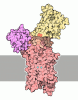
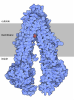
| Title | Cryo-EM structure of a human flippase mutant ATP11C Q79A-CDC50A in the PtdSer-occluded E2-AlF state | |||||||||||||||||||||
 Components Components |
| |||||||||||||||||||||
 Keywords Keywords | TRANSPORT PROTEIN / Lipid transporter flippase / PC bound E2P state | |||||||||||||||||||||
| Function / homology |  Function and homology information Function and homology informationpositive regulation of phospholipid translocation / aminophospholipid flippase activity / aminophospholipid transport / phosphatidylserine flippase activity / protein localization to endosome / phospholipid-translocating ATPase complex / phosphatidylserine floppase activity / ATPase-coupled intramembrane lipid carrier activity / positive regulation of protein exit from endoplasmic reticulum / phosphatidylethanolamine flippase activity ...positive regulation of phospholipid translocation / aminophospholipid flippase activity / aminophospholipid transport / phosphatidylserine flippase activity / protein localization to endosome / phospholipid-translocating ATPase complex / phosphatidylserine floppase activity / ATPase-coupled intramembrane lipid carrier activity / positive regulation of protein exit from endoplasmic reticulum / phosphatidylethanolamine flippase activity / xenobiotic transmembrane transport / P-type phospholipid transporter / phospholipid translocation / azurophil granule membrane / transport vesicle membrane / Ion transport by P-type ATPases / specific granule membrane / positive regulation of neuron projection development / recycling endosome / recycling endosome membrane / late endosome membrane / early endosome membrane / monoatomic ion transmembrane transport / apical plasma membrane / lysosomal membrane / Neutrophil degranulation / endoplasmic reticulum membrane / structural molecule activity / magnesium ion binding / Golgi apparatus / endoplasmic reticulum / ATP hydrolysis activity / ATP binding / membrane / plasma membrane Similarity search - Function | |||||||||||||||||||||
| Biological species |  Homo sapiens (human) Homo sapiens (human) | |||||||||||||||||||||
| Method | ELECTRON MICROSCOPY / single particle reconstruction / cryo EM / Resolution: 3.4 Å | |||||||||||||||||||||
 Authors Authors | Qian, Y. / Abe, K. | |||||||||||||||||||||
| Funding support |  Japan, 1items Japan, 1items
| |||||||||||||||||||||
 Citation Citation | Journal: J Biol Chem / Year: 2026 Title: Cryo-EM structure of the ATP11C Q79E mutant reveals the structural basis for altered Phospholipid recognition. Authors: Yuheng Qian / Chai C Gopalasingam / Christoph Gerle / Hideki Shigematsu / Kazuhiro Abe / Atsunori Oshima / Abstract: Closely related P4-ATPases, ATP11A and ATP11C, act as major phospholipid flippases in the plasma membrane of mammalian cells, with strict substrate specificity for phosphatidylserine (PS) and ...Closely related P4-ATPases, ATP11A and ATP11C, act as major phospholipid flippases in the plasma membrane of mammalian cells, with strict substrate specificity for phosphatidylserine (PS) and phosphatidylethanolamine (PE), but not for phosphatidylcholine (PC), thereby contributing to the asymmetric distribution of PS and PE across bilayers. A previously reported disease-associated Q84E mutation in ATP11A confers the ability to flip PC, implicating the involvement of this conserved residue in substrate specificity. We performed cryo-EM analysis for the equivalent mutant Q79E of ATP11C to address the structural basis for its unusual substrate specificity. Measurement of ATPase activity revealed that the ATP11C Q79E mutant retained PS-dependent activity, whilst gaining robust PC-dependent activity, indicative of expanded substrate specificity, consistent with reported properties in ATP11A Q84E. The cryo-EM structure of ATP11C Q79E mutant in the PC-occluded E2-P state revealed a PC molecule in a reshaped binding pocket. Due to the Q79E mutation and associated conformational changes in its surrounding residues, including Ser91and Asn352, the binding pocket has additional space to accommodate the bulky choline headgroup. Our results provide structural and functional insights into how a single point mutation can alter substrate specificity in a P4-ATPase. | |||||||||||||||||||||
| History |
|
- Structure visualization
| Structure viewer | Molecule: MolmilJmol/JSmol |
|---|
- Downloads & links
-Download
| PDBx/mmCIF format | 9vq2.cif.gz | 227.1 KB | Display | PDBx/mmCIF format |
|---|---|---|---|---|
| PDB format | pdb9vq2.ent.gz | 168.6 KB | Display | PDB format |
| PDBx/mmJSON format | 9vq2.json.gz | Tree view | PDBx/mmJSON format | |
| Others |  Other downloads Other downloads |
-Validation report
| Arichive directory | https://data.pdbj.org/pub/pdb/validation_reports/vq/9vq2ftp://data.pdbj.org/pub/pdb/validation_reports/vq/9vq2 | HTTPS FTP |
|---|
-Related structure data
| Related structure data |  65258MC  9vkgC  9vntC  9vslC M: map data used to model this data C: citing same article ( |
|---|---|
| Similar structure data |


-Links
 PDBj
PDBj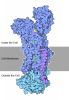
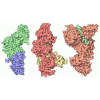
- Assembly
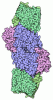
| Deposited unit | 
|
|---|---|
| 1 |
|
-Components
-Protein , 2 types, 2 molecules AC
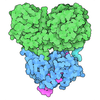
| #1: Protein | Mass: 124403.617 Da / Num. of mol.: 1 / Mutation: Q79A Source method: isolated from a genetically manipulated source Source: (gene. exp.) Homo sapiens (human) / Gene: ATP11C, ATPIG, ATPIQ / Cell line (production host): Expi293 / Production host: Homo sapiens (human)References: UniProt: Q8NB49, P-type phospholipid transporter |
|---|---|
| #2: Protein | Mass: 40900.801 Da / Num. of mol.: 1 Source method: isolated from a genetically manipulated source Source: (gene. exp.) Homo sapiens (human) / Gene: TMEM30A, C6orf67, CDC50A / Cell line (production host): Expi293 / Production host: Homo sapiens (human) / References: UniProt: Q9NV96 |
-Sugars , 2 types, 4 molecules 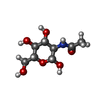
| #3: Polysaccharide | alpha-D-mannopyranose-(1-4)-2-acetamido-2-deoxy-beta-D-glucopyranose Source method: isolated from a genetically manipulated source |
|---|---|
| #7: Sugar | 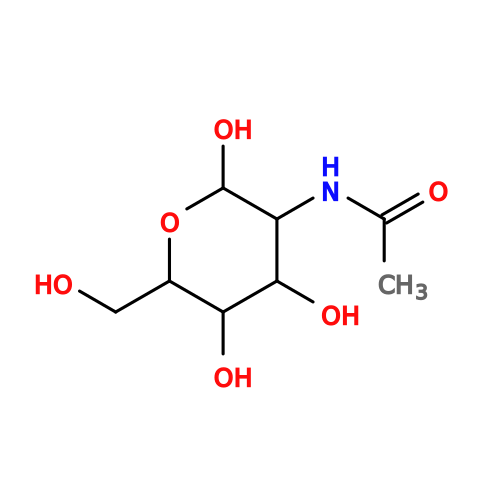 Type: D-saccharide, beta linking / Mass: 221.208 Da / Num. of mol.: 3 / Source method: obtained synthetically / Formula: C8H15NO6 / Feature type: SUBJECT OF INVESTIGATION Type: D-saccharide, beta linking / Mass: 221.208 Da / Num. of mol.: 3 / Source method: obtained synthetically / Formula: C8H15NO6 / Feature type: SUBJECT OF INVESTIGATION |
-Non-polymers , 4 types, 4 molecules 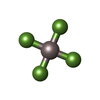


| #4: Chemical | ChemComp-ALF / 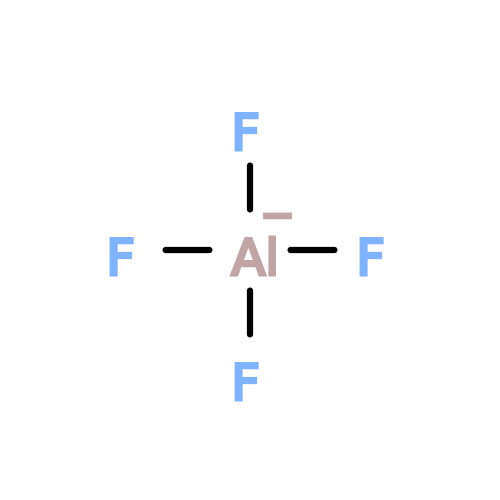 Mass: 102.975 Da / Num. of mol.: 1 / Source method: obtained synthetically / Formula: AlF4 / Feature type: SUBJECT OF INVESTIGATION Mass: 102.975 Da / Num. of mol.: 1 / Source method: obtained synthetically / Formula: AlF4 / Feature type: SUBJECT OF INVESTIGATION |
|---|---|
| #5: Chemical | ChemComp-MG /  Mass: 24.305 Da / Num. of mol.: 1 / Source method: obtained synthetically / Formula: Mg / Feature type: SUBJECT OF INVESTIGATION Mass: 24.305 Da / Num. of mol.: 1 / Source method: obtained synthetically / Formula: Mg / Feature type: SUBJECT OF INVESTIGATION |
| #6: Chemical | ChemComp-P5S / 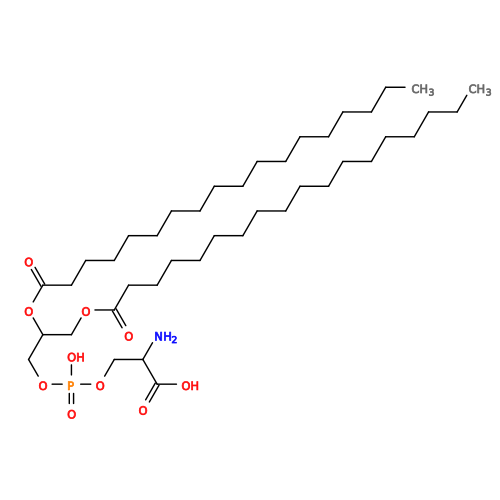 Mass: 792.075 Da / Num. of mol.: 1 / Source method: obtained synthetically / Formula: C42H82NO10P / Feature type: SUBJECT OF INVESTIGATION Mass: 792.075 Da / Num. of mol.: 1 / Source method: obtained synthetically / Formula: C42H82NO10P / Feature type: SUBJECT OF INVESTIGATION |
| #8: Water | ChemComp-HOH / Mass: 18.015 Da / Num. of mol.: 1 / Source method: isolated from a natural source / Formula: H2O |
-Details
| Has ligand of interest | Y |
|---|---|
| Has protein modification | Y |
-Experimental details
-Experiment
| Experiment | Method: ELECTRON MICROSCOPY |
|---|---|
| EM experiment | Aggregation state: PARTICLE / 3D reconstruction method: single particle reconstruction |
- Sample preparation
| Component | Name: ATP11C Q79A-CDC50A lipid flippase complex / Type: COMPLEX / Entity ID: #1-#2 / Source: RECOMBINANT |
|---|---|
| Molecular weight | Value: 170 kDa/nm / Experimental value: YES |
| Source (natural) | Organism: Homo sapiens (human) |
| Source (recombinant) | Organism: Homo sapiens (human) / Cell: Expi293 |
| Buffer solution | pH: 6.5 |
| Specimen | Conc.: 6 mg/ml / Embedding applied: NO / Shadowing applied: NO / Staining applied: NO / Vitrification applied: YES |
| Specimen support | Details: Glow discharge was performed on both sides of the grid Grid material: COPPER/RHODIUM / Grid mesh size: 200 divisions/in. / Grid type: Quantifoil R1.2/1.3 |
| Vitrification | Cryogen name: ETHANE / Humidity: 100 % / Chamber temperature: 277.15 K |
- Electron microscopy imaging
| Microscopy | Model: JEOL CRYO ARM 300 |
|---|---|
| Electron gun | Electron source:  FIELD EMISSION GUN / Accelerating voltage: 300 kV / Illumination mode: FLOOD BEAM FIELD EMISSION GUN / Accelerating voltage: 300 kV / Illumination mode: FLOOD BEAM |
| Electron lens | Mode: BRIGHT FIELD / Calibrated magnification: 60000 X / Nominal defocus max: 1600 nm / Nominal defocus min: 1200 nm / Cs: 2.7 mm |
| Specimen holder | Cryogen: NITROGEN / Specimen holder model: JEOL CRYOSPECPORTER |
| Image recording | Electron dose: 60 e/Å2 / Film or detector model: GATAN K3 (6k x 4k) / Num. of grids imaged: 1 / Num. of real images: 7350 |
| EM imaging optics | Energyfilter name: In-column Omega Filter / Energyfilter slit width: 20 eV |
- Processing
| EM software |
| ||||||||||||||||||||||||
|---|---|---|---|---|---|---|---|---|---|---|---|---|---|---|---|---|---|---|---|---|---|---|---|---|---|
| Image processing | Details: Images were collected using CDS mode | ||||||||||||||||||||||||
| CTF correction | Type: PHASE FLIPPING AND AMPLITUDE CORRECTION | ||||||||||||||||||||||||
| 3D reconstruction | Resolution: 3.4 Å / Resolution method: FSC 0.143 CUT-OFF / Num. of particles: 84218 / Symmetry type: POINT | ||||||||||||||||||||||||
| Refinement | Highest resolution: 3.4 Å Stereochemistry target values: REAL-SPACE (WEIGHTED MAP SUM AT ATOM CENTERS) | ||||||||||||||||||||||||
| Refine LS restraints |
|
