 Movie
Movie Controller

[English] 日本語
 Yorodumi
- PDB-9uwi: Cryo-EM structure of human V1aR bound with atosiban at a resoluti... -
+ Open data

- Basic information
| Entry | Database: PDB / ID: 9uwi | ||||||||||||||||||||||||
|---|---|---|---|---|---|---|---|---|---|---|---|---|---|---|---|---|---|---|---|---|---|---|---|---|---|
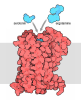
| Title | Cryo-EM structure of human V1aR bound with atosiban at a resolution of 2.8 angstrom | ||||||||||||||||||||||||
 Components Components |
| ||||||||||||||||||||||||
 Keywords Keywords | SIGNALING PROTEIN / GPCR / small molecule / antagonist / nanobody | ||||||||||||||||||||||||
| Function / homology |  Function and homology information Function and homology information: / Defective AVP does not bind AVPR1A,B and causes neurohypophyseal diabetes insipidus (NDI) / V1A vasopressin receptor binding / negative regulation of female receptivity / cellular response to water deprivation / maternal aggressive behavior / negative regulation of transmission of nerve impulse / myotube differentiation / sperm ejaculation / regulation of systemic arterial blood pressure by vasopressin ...: / Defective AVP does not bind AVPR1A,B and causes neurohypophyseal diabetes insipidus (NDI) / V1A vasopressin receptor binding / negative regulation of female receptivity / cellular response to water deprivation / maternal aggressive behavior / negative regulation of transmission of nerve impulse / myotube differentiation / sperm ejaculation / regulation of systemic arterial blood pressure by vasopressin / Vasopressin-like receptors / vasopressin receptor activity / grooming behavior / telencephalon development / positive regulation of prostaglandin biosynthetic process / maternal behavior / blood circulation / positive regulation of glutamate secretion / response to corticosterone / positive regulation of systemic arterial blood pressure / peptide hormone binding / social behavior / positive regulation of vasoconstriction / endocytic vesicle / positive regulation of heart rate / cellular response to hormone stimulus / transport across blood-brain barrier / protein kinase C binding / calcium-mediated signaling / generation of precursor metabolites and energy / positive regulation of cell growth / positive regulation of cytosolic calcium ion concentration / G alpha (q) signalling events / endosome / G protein-coupled receptor signaling pathway / positive regulation of cell population proliferation / plasma membrane Similarity search - Function | ||||||||||||||||||||||||
| Biological species |  Homo sapiens (human) Homo sapiens (human)synthetic construct (others) | ||||||||||||||||||||||||
| Method | ELECTRON MICROSCOPY / single particle reconstruction / cryo EM / Resolution: 2.8 Å | ||||||||||||||||||||||||
 Authors Authors | Wu, X.W. / Zhong, P.Y. / Chu, B.X. | ||||||||||||||||||||||||
| Funding support |  China, 1items China, 1items
| ||||||||||||||||||||||||
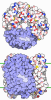
 Citation Citation | Journal: Nat Commun / Year: 2026 Title: Molecular basis of antagonism of the dimeric human arginine vasopressin receptor 1A. Authors: Peiyu Zhong / Bingxin Chu / Zijing Yu / Yu Qiao / Yu Ding / Yongdeng Zhang / Xudong Wu / Abstract: Arginine vasopressin (AVP) and oxytocin (OT) are peptide hormones critical for various physiological processes. Vasopressin receptor 1 A (V1aR), a primary AVP target, is promising for central ...Arginine vasopressin (AVP) and oxytocin (OT) are peptide hormones critical for various physiological processes. Vasopressin receptor 1 A (V1aR), a primary AVP target, is promising for central nervous system (CNS) disorders therapies, yet the mechanisms of antagonism and oligomerization remain poorly understood. Here, we present structures of human V1aR in its apo state and in complexes with antagonists: atosiban, balovaptan, and SRX246. Structural analyses reveal a dimeric V1aR assembly, validated by functional assays and imaging in cells. The apo structure shows a flat extracellular loop 2 (ECL2) with unpaired cysteines, undergoing significant conformational changes upon ligand binding. Antagonist-bound structures, combined with mutagenesis and radioligand binding assays, uncover distinct binding modes and key determinants for antagonism and selectivity. These findings provide a comprehensive understanding of V1aR assembly and dynamic regulation, offering valuable insights for structure-guided development of new antagonists targeting dimeric V1aR for CNS disorders. | ||||||||||||||||||||||||
| History |
|
- Structure visualization
| Structure viewer | Molecule: MolmilJmol/JSmol |
|---|
- Downloads & links
-Download
| PDBx/mmCIF format | 9uwi.cif.gz | 232.3 KB | Display | PDBx/mmCIF format |
|---|---|---|---|---|
| PDB format | pdb9uwi.ent.gz | Display | PDB format | |
| PDBx/mmJSON format | 9uwi.json.gz | Tree view | PDBx/mmJSON format | |
| Others |  Other downloads Other downloads |
-Validation report
| Arichive directory | https://data.pdbj.org/pub/pdb/validation_reports/uw/9uwiftp://data.pdbj.org/pub/pdb/validation_reports/uw/9uwi | HTTPS FTP |
|---|
-Related structure data
| Related structure data |  64555MC  9uwjC  9uwlC  9xb1C  64552 M: map data used to model this data C: citing same article ( |
|---|---|
| Similar structure data |


-Links
 PDBj
PDBj
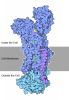
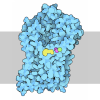
- Assembly
| Deposited unit | 
|
|---|---|
| 1 |
|
-Components
| #1: Protein | Mass: 43695.090 Da / Num. of mol.: 2 Source method: isolated from a genetically manipulated source Source: (gene. exp.) Homo sapiens (human) / Gene: AVPR1A, AVPR1 / Production host: Homo sapiens (human) / References: UniProt: P37288#2: Protein/peptide | Mass: 995.198 Da / Num. of mol.: 2 / Source method: obtained synthetically / Source: (synth.) synthetic construct (others) #3: Chemical | ChemComp-CLR / 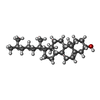 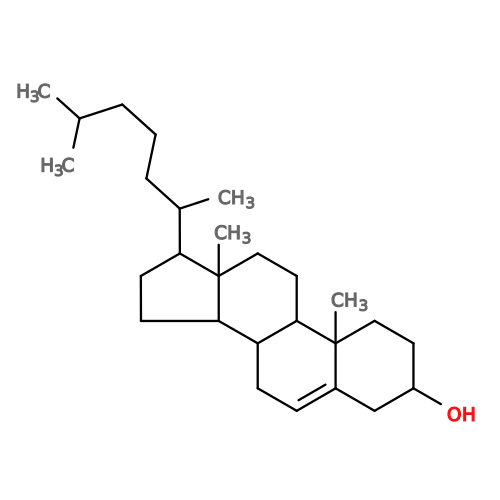 Mass: 386.654 Da / Num. of mol.: 4 / Source method: obtained synthetically / Formula: C27H46O Mass: 386.654 Da / Num. of mol.: 4 / Source method: obtained synthetically / Formula: C27H46OHas ligand of interest | Y | Has protein modification | Y | |
|---|
-Experimental details
-Experiment
| Experiment | Method: ELECTRON MICROSCOPY |
|---|---|
| EM experiment | Aggregation state: PARTICLE / 3D reconstruction method: single particle reconstruction |
- Sample preparation
| Component | Name: V1aR_dimer / Type: COMPLEX / Entity ID: #1-#2 / Source: MULTIPLE SOURCES |
|---|---|
| Molecular weight | Experimental value: NO |
| Source (natural) | Organism: Homo sapiens (human) |
| Source (recombinant) | Organism: Homo sapiens (human) |
| Buffer solution | pH: 7.4 |
| Specimen | Embedding applied: NO / Shadowing applied: NO / Staining applied: NO / Vitrification applied: YES |
| Vitrification | Cryogen name: ETHANE |
- Electron microscopy imaging
| Experimental equipment |  Model: Titan Krios / Image courtesy: FEI Company |
|---|---|
| Microscopy | Model: TFS KRIOS |
| Electron gun | Electron source:  FIELD EMISSION GUN / Accelerating voltage: 300 kV / Illumination mode: OTHER FIELD EMISSION GUN / Accelerating voltage: 300 kV / Illumination mode: OTHER |
| Electron lens | Mode: OTHER / Nominal defocus max: 2200 nm / Nominal defocus min: 1200 nm |
| Image recording | Electron dose: 50 e/Å2 / Film or detector model: FEI FALCON IV (4k x 4k) |
- Processing
| EM software | Name: PHENIX / Version: 1.20.1_4487 / Category: model refinement | ||||||||||||||||||||||||
|---|---|---|---|---|---|---|---|---|---|---|---|---|---|---|---|---|---|---|---|---|---|---|---|---|---|
| CTF correction | Type: NONE | ||||||||||||||||||||||||
| 3D reconstruction | Resolution: 2.8 Å / Resolution method: FSC 0.143 CUT-OFF / Num. of particles: 340153 / Symmetry type: POINT | ||||||||||||||||||||||||
| Refinement | Highest resolution: 2.8 Å Stereochemistry target values: REAL-SPACE (WEIGHTED MAP SUM AT ATOM CENTERS) | ||||||||||||||||||||||||
| Refine LS restraints |
|
