 Movie
Movie Controller


+ Open data

- Basic information
| Entry | Database: PDB / ID: 9utw | |||||||||||||||||||||||||||||||||
|---|---|---|---|---|---|---|---|---|---|---|---|---|---|---|---|---|---|---|---|---|---|---|---|---|---|---|---|---|---|---|---|---|---|---|
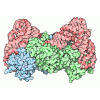
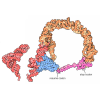
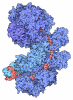
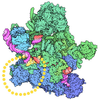
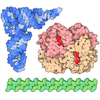
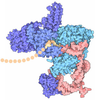
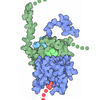
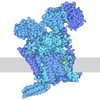
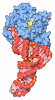
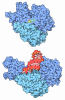
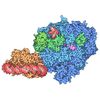
| Title | Structure of dimeric FKS1 in complex with tRNA | |||||||||||||||||||||||||||||||||
 Components Components |
| |||||||||||||||||||||||||||||||||
 Keywords Keywords | MEMBRANE PROTEIN / MEMBRANE PROTEIN-RNA COMPLEX | |||||||||||||||||||||||||||||||||
| Function / homology |  Function and homology information Function and homology informationregulation of cell wall (1->3)-beta-D-glucan biosynthetic process / fungal-type cell wall polysaccharide biosynthetic process / 1,3-beta-glucan synthase / 1,3-beta-D-glucan synthase activity / (1->3)-beta-D-glucan biosynthetic process / 1,3-beta-D-glucan synthase complex / fungal-type cell wall biogenesis / cellular bud / ascospore wall assembly / actin cortical patch ...regulation of cell wall (1->3)-beta-D-glucan biosynthetic process / fungal-type cell wall polysaccharide biosynthetic process / 1,3-beta-glucan synthase / 1,3-beta-D-glucan synthase activity / (1->3)-beta-D-glucan biosynthetic process / 1,3-beta-D-glucan synthase complex / fungal-type cell wall biogenesis / cellular bud / ascospore wall assembly / actin cortical patch / cellular bud tip / fungal-type cell wall / cellular bud neck / mating projection tip / regulation of cell size / positive regulation of endocytosis / cell periphery / mitochondrion / plasma membrane Similarity search - Function | |||||||||||||||||||||||||||||||||
| Biological species |   Saccharomyces cerevisiae (brewer's yeast) Saccharomyces cerevisiae (brewer's yeast) | |||||||||||||||||||||||||||||||||
| Method | ELECTRON MICROSCOPY / single particle reconstruction / cryo EM / Resolution: 2.96 Å | |||||||||||||||||||||||||||||||||
 Authors Authors | Li, J.L. / Zhu, A.Q. / Liu, J.X. / Dai, X.L. / Wang, X. / Yan, C.Y. / Deng, D. | |||||||||||||||||||||||||||||||||
| Funding support |  China, 1items China, 1items
| |||||||||||||||||||||||||||||||||
 Citation Citation | Journal: Nat Commun / Year: 2025 Title: Structural-guided identification of two modulators of β-1,3-glucan synthase FKS1. Authors: Jialu Li / Jian Li / Angqi Zhu / Xinli Dai / Juxiu Liu / Huayi Liu / Zhili Xia / Yuefan Dong / Wenyu Qian / Lunzhi Dai / Li Guo / Chuangye Yan / Dong Deng / Yunzi Luo / Xiang Wang / Abstract: FKS1 is a β-1,3-glucan synthase critical for fungal cell wall formation and a target for antifungal drugs such as echinocandin and ibrexafungerp. However, the mechanisms regulating FKS1 activity ...FKS1 is a β-1,3-glucan synthase critical for fungal cell wall formation and a target for antifungal drugs such as echinocandin and ibrexafungerp. However, the mechanisms regulating FKS1 activity remain largely unknown. Here, we reveal that transfer RNA (tRNA) acts as an endogenous inhibitor, whereas GSR1 functions as a stabilizer of FKS1. The cryo-EM structure of FKS1 adopts a tRNA-mediated homodimer configuration, representing a quiescent state of β-1,3-glucan synthase. Unexpectedly, the copurified endogenous tRNA is identified as a potent inhibitor that suppresses FKS1 activity. Moreover, high-resolution cryo-EM density analysis enable the identification of GSR1 as an additional binding partner of FKS1. Mutagenesis experiments confirm the interaction between FKS1 and GSR1. Evolutionarily conserved GSR1 is found to increase the stability of FKS1 in β-1,3-glucan biosynthesis. Collectively, our findings identify both tRNA and GSR1 as intrinsic modulators of β-1,3-glucan biosynthesis, thereby providing opportunities for the further development of FKS1-targeted antifungal drugs. | |||||||||||||||||||||||||||||||||
| History |
|
- Structure visualization
| Structure viewer | Molecule: MolmilJmol/JSmol |
|---|
- Downloads & links
-Download
| PDBx/mmCIF format | 9utw.cif.gz | 657.8 KB | Display | PDBx/mmCIF format |
|---|---|---|---|---|
| PDB format | pdb9utw.ent.gz | 517.4 KB | Display | PDB format |
| PDBx/mmJSON format | 9utw.json.gz | Tree view | PDBx/mmJSON format | |
| Others |  Other downloads Other downloads |
-Validation report
| Arichive directory | https://data.pdbj.org/pub/pdb/validation_reports/ut/9utwftp://data.pdbj.org/pub/pdb/validation_reports/ut/9utw | HTTPS FTP |
|---|
-Related structure data
| Related structure data |  37613  64502MC  9utuC M: map data used to model this data C: citing same article ( |
|---|---|
| Similar structure data |

-Links
 PDBj
PDBj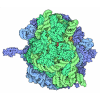
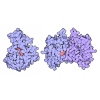
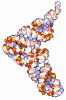
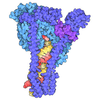
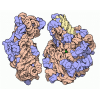
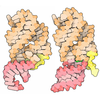
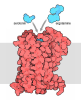
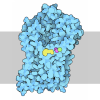
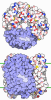
- Assembly
| Deposited unit | 
|
|---|---|
| 1 |
|
-Components
-Protein , 2 types, 4 molecules CGHB
| #1: Protein | Mass: 22209.684 Da / Num. of mol.: 2 / Source method: isolated from a natural source / Source: (natural) Saccharomyces cerevisiae (brewer's yeast) / References: UniProt: Q03559#2: Protein | Mass: 215076.156 Da / Num. of mol.: 2 / Source method: isolated from a natural source / Source: (natural) Saccharomyces cerevisiae (brewer's yeast) / References: UniProt: P38631, 1,3-beta-glucan synthase |
|---|
-RNA chain , 1 types, 1 molecules A
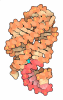
| #3: RNA chain | Mass: 24503.461 Da / Num. of mol.: 1 / Source method: isolated from a natural source / Source: (natural) Saccharomyces cerevisiae (brewer's yeast) |
|---|
-Sugars , 2 types, 2 molecules
| #4: Polysaccharide | beta-D-glucopyranose-(1-3)-beta-D-glucopyranose-(1-3)-beta-D-glucopyranose Source method: isolated from a genetically manipulated source |
|---|---|
| #5: Polysaccharide | beta-D-glucopyranose-(1-3)-beta-D-glucopyranose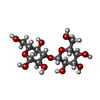  Source method: isolated from a genetically manipulated source Details: oligosaccharide / References: beta-laminaribiose |
-Non-polymers , 8 types, 40 molecules 
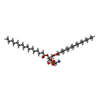
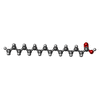
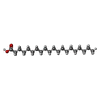
| #6: Chemical |  Mass: 24.305 Da / Num. of mol.: 2 / Source method: obtained synthetically / Formula: Mg / Feature type: SUBJECT OF INVESTIGATION Mass: 24.305 Da / Num. of mol.: 2 / Source method: obtained synthetically / Formula: Mg / Feature type: SUBJECT OF INVESTIGATION#7: Chemical | ChemComp-DD9 / 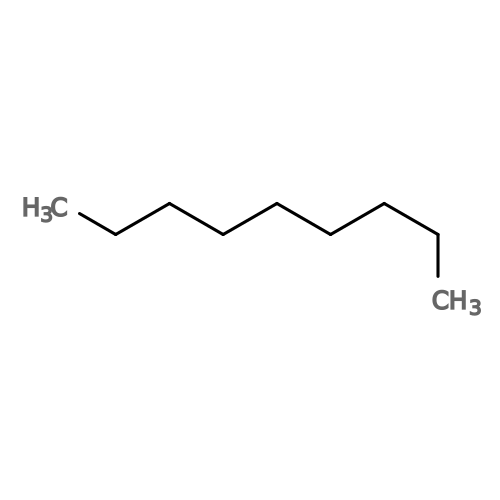 Mass: 128.255 Da / Num. of mol.: 8 / Source method: obtained synthetically / Formula: C9H20 / Feature type: SUBJECT OF INVESTIGATION Mass: 128.255 Da / Num. of mol.: 8 / Source method: obtained synthetically / Formula: C9H20 / Feature type: SUBJECT OF INVESTIGATION#8: Chemical | 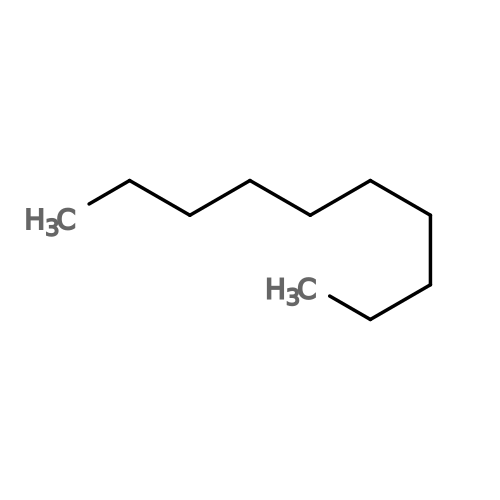 Mass: 142.282 Da / Num. of mol.: 2 / Source method: obtained synthetically / Formula: C10H22 / Feature type: SUBJECT OF INVESTIGATION Mass: 142.282 Da / Num. of mol.: 2 / Source method: obtained synthetically / Formula: C10H22 / Feature type: SUBJECT OF INVESTIGATION#9: Chemical | ChemComp-HP6 / 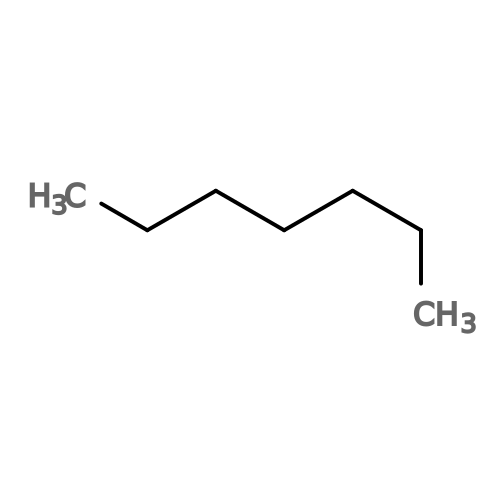 Mass: 100.202 Da / Num. of mol.: 6 / Source method: obtained synthetically / Formula: C7H16 / Feature type: SUBJECT OF INVESTIGATION Mass: 100.202 Da / Num. of mol.: 6 / Source method: obtained synthetically / Formula: C7H16 / Feature type: SUBJECT OF INVESTIGATION#10: Chemical | 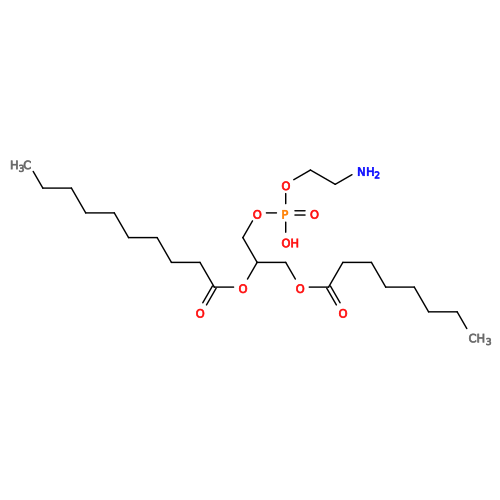 Mass: 495.587 Da / Num. of mol.: 2 / Source method: obtained synthetically / Formula: C23H46NO8P / Feature type: SUBJECT OF INVESTIGATION Mass: 495.587 Da / Num. of mol.: 2 / Source method: obtained synthetically / Formula: C23H46NO8P / Feature type: SUBJECT OF INVESTIGATION#11: Chemical | 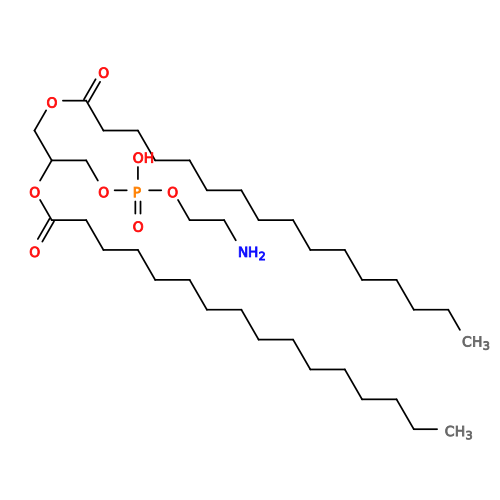 Mass: 691.959 Da / Num. of mol.: 2 / Source method: obtained synthetically / Formula: C37H74NO8P / Feature type: SUBJECT OF INVESTIGATION / Comment: phospholipid*YM Mass: 691.959 Da / Num. of mol.: 2 / Source method: obtained synthetically / Formula: C37H74NO8P / Feature type: SUBJECT OF INVESTIGATION / Comment: phospholipid*YM#12: Chemical | ChemComp-PLM / 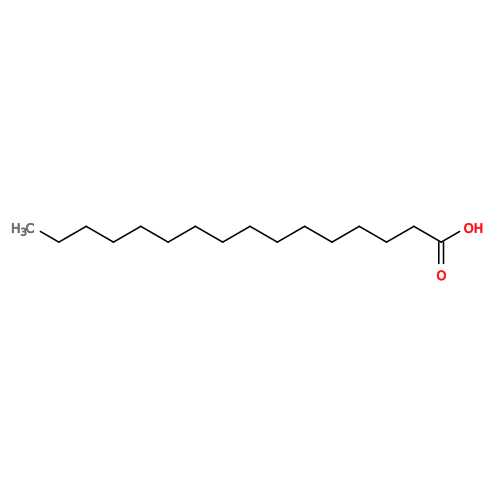 Mass: 256.424 Da / Num. of mol.: 16 / Source method: obtained synthetically / Formula: C16H32O2 / Feature type: SUBJECT OF INVESTIGATION Mass: 256.424 Da / Num. of mol.: 16 / Source method: obtained synthetically / Formula: C16H32O2 / Feature type: SUBJECT OF INVESTIGATION#13: Chemical | 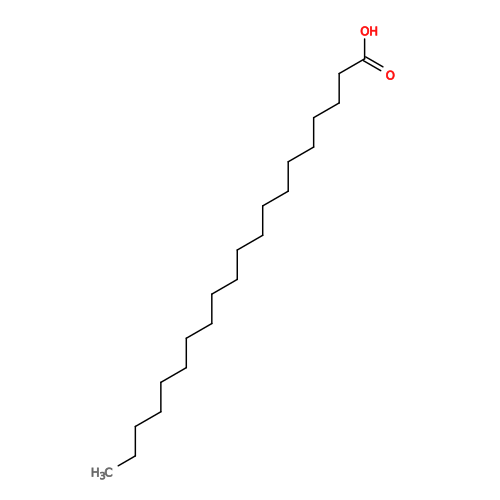 Mass: 312.530 Da / Num. of mol.: 2 / Source method: obtained synthetically / Formula: C20H40O2 / Feature type: SUBJECT OF INVESTIGATION Mass: 312.530 Da / Num. of mol.: 2 / Source method: obtained synthetically / Formula: C20H40O2 / Feature type: SUBJECT OF INVESTIGATION |
|---|
-Details
| Has ligand of interest | Y |
|---|---|
| Has protein modification | Y |
-Experimental details
-Experiment
| Experiment | Method: ELECTRON MICROSCOPY |
|---|---|
| EM experiment | Aggregation state: PARTICLE / 3D reconstruction method: single particle reconstruction |
- Sample preparation
| Component | Name: Dimeric Fks1 in complex with tRNA / Type: COMPLEX / Entity ID: #1-#3 / Source: NATURAL |
|---|---|
| Source (natural) | Organism: Saccharomyces cerevisiae (brewer's yeast) |
| Buffer solution | pH: 8 |
| Specimen | Embedding applied: NO / Shadowing applied: NO / Staining applied: NO / Vitrification applied: YES |
| Vitrification | Cryogen name: ETHANE |
- Electron microscopy imaging
| Experimental equipment |  Model: Titan Krios / Image courtesy: FEI Company |
|---|---|
| Microscopy | Model: TFS KRIOS |
| Electron gun | Electron source:  FIELD EMISSION GUN / Accelerating voltage: 300 kV / Illumination mode: FLOOD BEAM FIELD EMISSION GUN / Accelerating voltage: 300 kV / Illumination mode: FLOOD BEAM |
| Electron lens | Mode: BRIGHT FIELD / Nominal defocus max: 1800 nm / Nominal defocus min: 1100 nm |
| Image recording | Electron dose: 60 e/Å2 / Film or detector model: GATAN K2 SUMMIT (4k x 4k) |
- Processing
| CTF correction | Type: NONE |
|---|---|
| 3D reconstruction | Resolution: 2.96 Å / Resolution method: FSC 0.143 CUT-OFF / Num. of particles: 243849 / Symmetry type: POINT |
