 Movie
Movie Controller


+ Open data

- Basic information
| Entry | Database: PDB / ID: 9tqd | ||||||||||||||||||
|---|---|---|---|---|---|---|---|---|---|---|---|---|---|---|---|---|---|---|---|
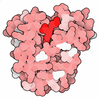
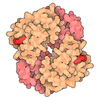
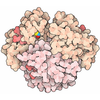
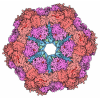
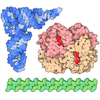
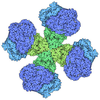
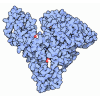
| Title | CD163 bound to haemoglobin | ||||||||||||||||||
 Components Components |
| ||||||||||||||||||
 Keywords Keywords | CELL ADHESION / CD163 / haemoglobin / haptoglobin-haemoglobin receptor | ||||||||||||||||||
| Function / homology |  Function and homology information Function and homology informationscavenger receptor activity / CD163 mediating an anti-inflammatory response / cellular oxidant detoxification / Heme assimilation / nitric oxide transport / hemoglobin alpha binding / hemoglobin binding / renal absorption / haptoglobin-hemoglobin complex / hemoglobin complex ...scavenger receptor activity / CD163 mediating an anti-inflammatory response / cellular oxidant detoxification / Heme assimilation / nitric oxide transport / hemoglobin alpha binding / hemoglobin binding / renal absorption / haptoglobin-hemoglobin complex / hemoglobin complex / oxygen transport / Scavenging of heme from plasma / erythrocyte development / endocytic vesicle lumen / blood vessel diameter maintenance / acute-phase response / hydrogen peroxide catabolic process / oxygen carrier activity / response to hydrogen peroxide / carbon dioxide transport / Heme signaling / Erythrocytes take up oxygen and release carbon dioxide / Erythrocytes take up carbon dioxide and release oxygen / Cytoprotection by HMOX1 / oxygen binding / Late endosomal microautophagy / platelet aggregation / regulation of blood pressure / positive regulation of nitric oxide biosynthetic process / Chaperone Mediated Autophagy / endocytic vesicle membrane / tertiary granule lumen / Factors involved in megakaryocyte development and platelet production / scaffold protein binding / blood microparticle / ficolin-1-rich granule lumen / iron ion binding / inflammatory response / external side of plasma membrane / heme binding / Neutrophil degranulation / : / extracellular exosome / extracellular region / membrane / metal ion binding / plasma membrane / cytosol Similarity search - Function | ||||||||||||||||||
| Biological species |  Homo sapiens (human) Homo sapiens (human) | ||||||||||||||||||
| Method | ELECTRON MICROSCOPY / single particle reconstruction / cryo EM / Resolution: 2.8 Å | ||||||||||||||||||
 Authors Authors | Zhou, R.X. / Higgins, M.K. | ||||||||||||||||||
| Funding support |  United Kingdom, 1items United Kingdom, 1items
| ||||||||||||||||||
 Citation Citation | Journal: PLoS Biol / Year: 2026 Title: Structural basis for hemoglobin scavenging by CD163 reveals mechanism of ligand promiscuity. Authors: Richard X Zhou / Matthew K Higgins / Abstract: The scavenger receptor CD163 detoxifies free hemoglobin released on erythrocyte lysis to prevent oxidative damage. The best understood route for hemoglobin detoxification involves the formation of ...The scavenger receptor CD163 detoxifies free hemoglobin released on erythrocyte lysis to prevent oxidative damage. The best understood route for hemoglobin detoxification involves the formation of haptoglobin-hemoglobin complexes that bind CD163 and are internalized into macrophages, resulting in hemoglobin degradation. However, during conditions such as sickle cell anemia or malaria, haptoglobin is depleted. CD163 can then act as a lower-affinity receptor for free hemoglobin. Previous studies revealed that CD163 forms a multimeric "base," which presents "arms" that form a binding site for haptoglobin-hemoglobin. In this study, we use cryogenic electron microscopy to reveal how human CD163 binds hemoglobin tetramers in a process that, unlike haptoglobin-hemoglobin uptake, requires a full trimeric CD163 assembly to achieve sufficient binding. We reveal how flexibility at the calcium-mediated base, combined with a hinge between receptor domains 2 and 3, allows the arms to wrap around diverse ligands. This brings together multiple small binding surfaces from different domains to form cradles for different ligands. These adaptations allow the scavenger receptor to be promiscuous, protecting us from oxidative damage caused by hemoglobin release in various pathological conditions. | ||||||||||||||||||
| History |
|
- Structure visualization
| Structure viewer | Molecule: MolmilJmol/JSmol |
|---|
- Downloads & links
-Download
| PDBx/mmCIF format | 9tqd.cif.gz | 614.9 KB | Display | PDBx/mmCIF format |
|---|---|---|---|---|
| PDB format | pdb9tqd.ent.gz | Display | PDB format | |
| PDBx/mmJSON format | 9tqd.json.gz | Tree view | PDBx/mmJSON format | |
| Others |  Other downloads Other downloads |
-Validation report
| Arichive directory | https://data.pdbj.org/pub/pdb/validation_reports/tq/9tqdftp://data.pdbj.org/pub/pdb/validation_reports/tq/9tqd | HTTPS FTP |
|---|
-Related structure data
| Related structure data |  56135MC M: map data used to model this data C: citing same article ( |
|---|---|
| Similar structure data |


-Links
 PDBj
PDBj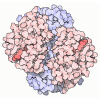

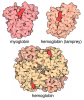
- Assembly
| Deposited unit | 
|
|---|---|
| 1 |
|
-Components
-Protein , 3 types, 7 molecules ABCDFEG
| #1: Protein | Mass: 125594.805 Da / Num. of mol.: 3 Source method: isolated from a genetically manipulated source Source: (gene. exp.) Homo sapiens (human) / Gene: CD163, M130 / Production host: Homo sapiens (human) / References: UniProt: Q86VB7#2: Protein | Mass: 15281.550 Da / Num. of mol.: 2 Source method: isolated from a genetically manipulated source Source: (gene. exp.) Homo sapiens (human) / Gene: HBA1, HBA2 / Production host: Homo sapiens (human) / References: UniProt: P69905#3: Protein | Mass: 16021.396 Da / Num. of mol.: 2 Source method: isolated from a genetically manipulated source Source: (gene. exp.) Homo sapiens (human) / Gene: HBB / Production host: Homo sapiens (human) / References: UniProt: P68871 |
|---|
-Sugars , 2 types, 13 molecules 
| #4: Polysaccharide | 2-acetamido-2-deoxy-beta-D-glucopyranose-(1-4)-2-acetamido-2-deoxy-beta-D-glucopyranose Source method: isolated from a genetically manipulated source #5: Sugar | ChemComp-NAG / 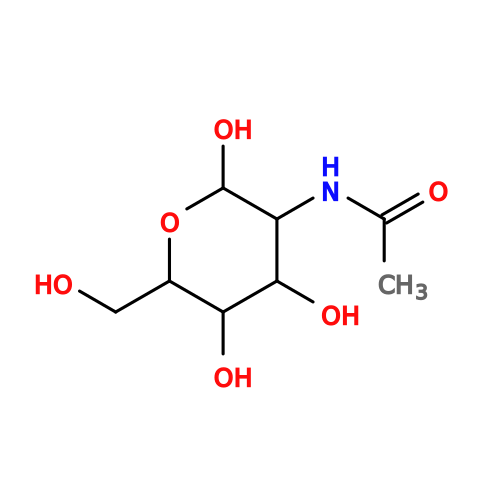 Type: D-saccharide, beta linking / Mass: 221.208 Da / Num. of mol.: 8 / Source method: obtained synthetically / Formula: C8H15NO6 Type: D-saccharide, beta linking / Mass: 221.208 Da / Num. of mol.: 8 / Source method: obtained synthetically / Formula: C8H15NO6 |
|---|
-Non-polymers , 3 types, 24 molecules 

| #6: Chemical | ChemComp-CA /  Mass: 40.078 Da / Num. of mol.: 16 / Source method: obtained synthetically / Formula: Ca Mass: 40.078 Da / Num. of mol.: 16 / Source method: obtained synthetically / Formula: Ca#7: Chemical | ChemComp-HEM / 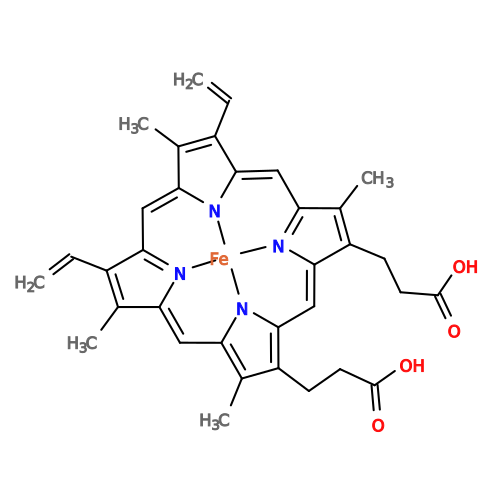 Mass: 616.487 Da / Num. of mol.: 4 / Source method: obtained synthetically / Formula: C34H32FeN4O4 Mass: 616.487 Da / Num. of mol.: 4 / Source method: obtained synthetically / Formula: C34H32FeN4O4#8: Chemical | ChemComp-OXY / 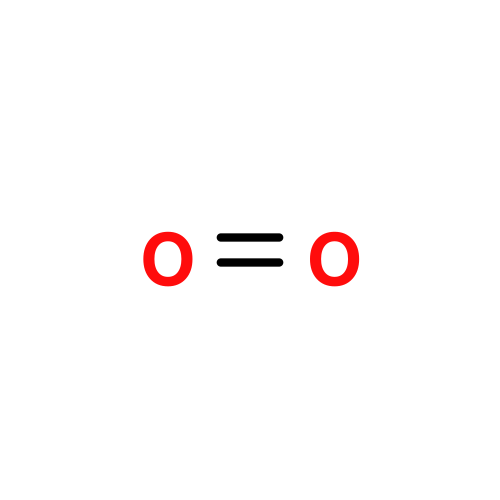 Mass: 31.999 Da / Num. of mol.: 4 / Source method: obtained synthetically / Formula: O2 Mass: 31.999 Da / Num. of mol.: 4 / Source method: obtained synthetically / Formula: O2 |
|---|
-Details
| Has ligand of interest | N |
|---|---|
| Has protein modification | Y |
-Experimental details
-Experiment
| Experiment | Method: ELECTRON MICROSCOPY |
|---|---|
| EM experiment | Aggregation state: PARTICLE / 3D reconstruction method: single particle reconstruction |
- Sample preparation
| Component | Name: CD163 trimer bound to haemoglobin / Type: COMPLEX / Entity ID: #1-#3 / Source: RECOMBINANT |
|---|---|
| Source (natural) | Organism: Homo sapiens (human) |
| Source (recombinant) | Organism: Homo sapiens (human) |
| Buffer solution | pH: 7.4 |
| Specimen | Embedding applied: NO / Shadowing applied: NO / Staining applied: NO / Vitrification applied: YES |
| Vitrification | Cryogen name: ETHANE |
- Electron microscopy imaging
| Experimental equipment |  Model: Titan Krios / Image courtesy: FEI Company |
|---|---|
| Microscopy | Model: TFS KRIOS |
| Electron gun | Electron source:  FIELD EMISSION GUN / Accelerating voltage: 300 kV / Illumination mode: FLOOD BEAM FIELD EMISSION GUN / Accelerating voltage: 300 kV / Illumination mode: FLOOD BEAM |
| Electron lens | Mode: BRIGHT FIELD / Nominal defocus max: 1800 nm / Nominal defocus min: 600 nm |
| Image recording | Electron dose: 38.3 e/Å2 / Film or detector model: GATAN K3 BIOQUANTUM (6k x 4k) |
- Processing
| EM software |
| ||||||||||||||||||||||||
|---|---|---|---|---|---|---|---|---|---|---|---|---|---|---|---|---|---|---|---|---|---|---|---|---|---|
| CTF correction | Type: PHASE FLIPPING AND AMPLITUDE CORRECTION | ||||||||||||||||||||||||
| 3D reconstruction | Resolution: 2.8 Å / Resolution method: FSC 0.143 CUT-OFF / Num. of particles: 1033649 / Symmetry type: POINT | ||||||||||||||||||||||||
| Refinement | Highest resolution: 2.8 Å Stereochemistry target values: REAL-SPACE (WEIGHTED MAP SUM AT ATOM CENTERS) | ||||||||||||||||||||||||
| Refine LS restraints |
|
