 Movie
Movie Controller

[English] 日本語
 Yorodumi
- PDB-9rsx: Structure of RACK1 bound to the C-terminus of SERBP1 and the RIH ... -
+ Open data

- Basic information
| Entry | Database: PDB / ID: 9rsx | ||||||||||||||||||||||||
|---|---|---|---|---|---|---|---|---|---|---|---|---|---|---|---|---|---|---|---|---|---|---|---|---|---|
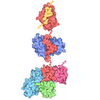
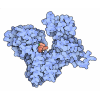
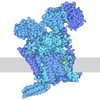
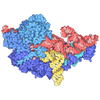
| Title | Structure of RACK1 bound to the C-terminus of SERBP1 and the RIH region of ZAK | ||||||||||||||||||||||||
 Components Components |
| ||||||||||||||||||||||||
 Keywords Keywords | RIBOSOME / ZAK / collision / RSR / quality control | ||||||||||||||||||||||||
| Function / homology |  Function and homology information Function and homology informationpositive regulation of mitotic DNA damage checkpoint / negative regulation of stress-activated protein kinase signaling cascade / negative regulation of translation in response to endoplasmic reticulum stress / stalled ribosome sensor activity / GCN2-mediated signaling / cell death / PML body organization / mitogen-activated protein kinase kinase kinase / translation elongation factor binding / ribosome hibernation ...positive regulation of mitotic DNA damage checkpoint / negative regulation of stress-activated protein kinase signaling cascade / negative regulation of translation in response to endoplasmic reticulum stress / stalled ribosome sensor activity / GCN2-mediated signaling / cell death / PML body organization / mitogen-activated protein kinase kinase kinase / translation elongation factor binding / ribosome hibernation / SUMO binding / JUN kinase kinase kinase activity / embryonic digit morphogenesis / negative regulation of endoplasmic reticulum unfolded protein response / stress-activated protein kinase signaling cascade / oxidized pyrimidine DNA binding / response to TNF agonist / positive regulation of base-excision repair / regulation of adenylate cyclase-activating G protein-coupled receptor signaling pathway / positive regulation of intrinsic apoptotic signaling pathway in response to DNA damage / positive regulation of gastrulation / protein tyrosine kinase inhibitor activity / positive regulation of programmed cell death / cellular response to UV-B / IRE1-RACK1-PP2A complex / TNFR1-mediated ceramide production / positive regulation of Golgi to plasma membrane protein transport / regulation of mitotic metaphase/anaphase transition / positive regulation of DNA-templated transcription initiation / negative regulation of DNA repair / supercoiled DNA binding / regulation of establishment of cell polarity / oxidized purine DNA binding / NF-kappaB complex / negative regulation of intrinsic apoptotic signaling pathway in response to hydrogen peroxide / negative regulation of phagocytosis / p38MAPK cascade / ubiquitin-like protein conjugating enzyme binding / cytoplasmic translational initiation / Formation of the ternary complex, and subsequently, the 43S complex / ion channel inhibitor activity / Ribosomal scanning and start codon recognition / protein kinase A binding / Translation initiation complex formation / negative regulation of Wnt signaling pathway / BH3 domain binding / limb development / negative regulation of translational frameshifting / PELO:HBS1L and ABCE1 dissociate a ribosome on a non-stop mRNA / SARS-CoV-1 modulates host translation machinery / pyroptotic inflammatory response / regulation of cell division / positive regulation of GTPase activity / stress-activated MAPK cascade / MAP kinase kinase kinase activity / Peptide chain elongation / JNK cascade / Selenocysteine synthesis / negative regulation of protein binding / Formation of a pool of free 40S subunits / protein kinase activator activity / protein serine/threonine kinase inhibitor activity / Eukaryotic Translation Termination / SRP-dependent cotranslational protein targeting to membrane / Response of EIF2AK4 (GCN2) to amino acid deficiency / Viral mRNA Translation / Nonsense Mediated Decay (NMD) independent of the Exon Junction Complex (EJC) / GTP hydrolysis and joining of the 60S ribosomal subunit / L13a-mediated translational silencing of Ceruloplasmin expression / DNA damage checkpoint signaling / Major pathway of rRNA processing in the nucleolus and cytosol / spindle assembly / positive regulation of microtubule polymerization / phagocytic cup / Nonsense Mediated Decay (NMD) enhanced by the Exon Junction Complex (EJC) / regulation of mRNA stability / translation regulator activity / DNA-(apurinic or apyrimidinic site) endonuclease activity / negative regulation of protein ubiquitination / translation repressor activity / SH2 domain binding / positive regulation of apoptotic signaling pathway / signaling adaptor activity / Hsp70 protein binding / positive regulation of DNA repair / cyclin binding / negative regulation of phosphatidylinositol 3-kinase/protein kinase B signal transduction / protein kinase C binding / chromosome segregation / DNA-(apurinic or apyrimidinic site) lyase / class I DNA-(apurinic or apyrimidinic site) endonuclease activity / iron-sulfur cluster binding / rescue of stalled cytosolic ribosome / ZNF598 and the Ribosome-associated Quality Trigger (RQT) complex dissociate a ribosome stalled on a no-go mRNA / negative regulation of smoothened signaling pathway / cellular response to glucose stimulus / TNFR1-induced NF-kappa-B signaling pathway / mRNA 3'-UTR binding / cellular response to reactive oxygen species / DNA endonuclease activity Similarity search - Function | ||||||||||||||||||||||||
| Biological species |  Homo sapiens (human) Homo sapiens (human) | ||||||||||||||||||||||||
| Method | ELECTRON MICROSCOPY / single particle reconstruction / cryo EM / Resolution: 2.91 Å | ||||||||||||||||||||||||
 Authors Authors | Niu, S. / Beckmann, R. | ||||||||||||||||||||||||
| Funding support | European Union, 1items
| ||||||||||||||||||||||||
 Citation Citation | Journal: Nature / Year: 2026 Title: ZAK activation at the collided ribosome. Authors: Vienna L Huso / Shuangshuang Niu / Marco A Catipovic / James A Saba / Timo Denk / Eugene Park / Jingdong Cheng / Otto Berninghausen / Thomas Becker / Rachel Green / Roland Beckmann /    Abstract: Ribosome collisions activate the ribotoxic stress response mediated by the MAP3K ZAK, which in turn regulates cell-fate consequences through downstream phosphorylation of the MAPKs p38 and JNK. ...Ribosome collisions activate the ribotoxic stress response mediated by the MAP3K ZAK, which in turn regulates cell-fate consequences through downstream phosphorylation of the MAPKs p38 and JNK. Despite the critical role of ZAK during cellular stress, a mechanistic and structural understanding of ZAK-ribosome interactions and how these lead to activation remain elusive. Here we combine biochemistry and cryo-electron microscopy to discover distinct ZAK-ribosome interactions required for constitutive recruitment and for activation. We find that upon induction of ribosome collisions, interactions between ZAK and the ribosomal protein RACK1 enable its activation by dimerization of its SAM domains at the collision interface. Furthermore, we discover how this process is negatively regulated by the ribosome-binding protein SERBP1 to prevent constitutive ZAK activation. Characterization of novel SAM variants as well as a known pathogenic variant of the SAM domain of ZAK supports a key role of the SAM domain in regulating kinase activity on and off the ribosome, with some mutants bypassing the ribosome requirement for ZAK activation. Collectively, our data provide a mechanistic blueprint of the kinase activity of ZAK at the collided ribosome interface. | ||||||||||||||||||||||||
| History |
|
- Structure visualization
| Structure viewer | Molecule: MolmilJmol/JSmol |
|---|
- Downloads & links
-Download
| PDBx/mmCIF format | 9rsx.cif.gz | 102.7 KB | Display | PDBx/mmCIF format |
|---|---|---|---|---|
| PDB format | pdb9rsx.ent.gz | Display | PDB format | |
| PDBx/mmJSON format | 9rsx.json.gz | Tree view | PDBx/mmJSON format | |
| Others |  Other downloads Other downloads |
-Validation report
| Arichive directory | https://data.pdbj.org/pub/pdb/validation_reports/rs/9rsxftp://data.pdbj.org/pub/pdb/validation_reports/rs/9rsx | HTTPS FTP |
|---|
-Related structure data
| Related structure data |  54236MC  9rpvC M: map data used to model this data C: citing same article ( |
|---|---|
| Similar structure data |


-Links
 PDBj
PDBj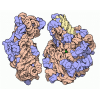
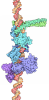
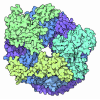
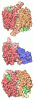
- Assembly
| Deposited unit | 
|
|---|---|
| 1 |
|
-Components
| #1: Protein | Mass: 91284.078 Da / Num. of mol.: 1 / Source method: isolated from a natural source / Source: (natural) Homo sapiens (human)References: UniProt: Q9NYL2, mitogen-activated protein kinase kinase kinase |
|---|---|
| #2: Protein | Mass: 45051.504 Da / Num. of mol.: 1 / Source method: isolated from a natural source / Source: (natural) Homo sapiens (human) / References: UniProt: Q8NC51 |
| #3: Protein | Mass: 26729.369 Da / Num. of mol.: 1 / Source method: isolated from a natural source / Source: (natural) Homo sapiens (human)References: UniProt: P23396, DNA-(apurinic or apyrimidinic site) lyase |
| #4: Protein | Mass: 35115.652 Da / Num. of mol.: 1 / Source method: isolated from a natural source / Source: (natural) Homo sapiens (human) / References: UniProt: P63244 |
| Has protein modification | N |
-Experimental details
-Experiment
| Experiment | Method: ELECTRON MICROSCOPY |
|---|---|
| EM experiment | Aggregation state: PARTICLE / 3D reconstruction method: single particle reconstruction |
- Sample preparation
| Component | Name: RACK1 bound to ZAK(RIH) and SERBP1(C-term) / Type: RIBOSOME / Entity ID: all / Source: NATURAL |
|---|---|
| Molecular weight | Experimental value: NO |
| Source (natural) | Organism: Homo sapiens (human) |
| Buffer solution | pH: 7.5 |
| Specimen | Embedding applied: NO / Shadowing applied: NO / Staining applied: NO / Vitrification applied: YES |
| Vitrification | Cryogen name: ETHANE |
- Electron microscopy imaging
| Experimental equipment |  Model: Titan Krios / Image courtesy: FEI Company |
|---|---|
| Microscopy | Model: TFS KRIOS |
| Electron gun | Electron source:  FIELD EMISSION GUN / Accelerating voltage: 300 kV / Illumination mode: FLOOD BEAM FIELD EMISSION GUN / Accelerating voltage: 300 kV / Illumination mode: FLOOD BEAM |
| Electron lens | Mode: BRIGHT FIELD / Nominal defocus max: 3500 nm / Nominal defocus min: 500 nm |
| Image recording | Electron dose: 40 e/Å2 / Film or detector model: FEI FALCON IV (4k x 4k) |
- Processing
| EM software |
| ||||||||||||
|---|---|---|---|---|---|---|---|---|---|---|---|---|---|
| CTF correction | Type: PHASE FLIPPING AND AMPLITUDE CORRECTION | ||||||||||||
| 3D reconstruction | Resolution: 2.91 Å / Resolution method: FSC 0.143 CUT-OFF / Num. of particles: 108673 / Symmetry type: POINT |
