National Institutes of Health/Eunice Kennedy Shriver National Institute of Child Health & Human Development (NIH/NICHD)
Z1A HD008998
United States
National Science Foundation (NSF, United States)
DGE 1840340
United States
National Science Foundation (NSF, United States)
CHE-1944892/2326678
United States
Citation
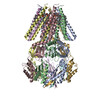
Journal: bioRxiv / Year: 2025 Title: The lipid-mediated mechanism of mechanosensitive channel MscS inactivation. Authors: Elissa Moller / Madolyn Britt / Fei Zhou / Hyojik Yang / Andriy Anishkin / Robert Ernst / Juan M Vanegas / Sergei Sukharev / Doreen Matthies Abstract: Interpretations of experimental conformations of mechanosensitive channels gated by 'force from lipids' become more reliable when native lipids are preserved in the structures. MscS is an adaptive ...Interpretations of experimental conformations of mechanosensitive channels gated by 'force from lipids' become more reliable when native lipids are preserved in the structures. MscS is an adaptive osmolyte release valve that regulates turgor in osmotically stressed cells. MscS promptly opens under abrupt super-threshold tensions in the membrane, but at lower and more gradually applied tensions, it silently inactivates from the closed state. A central question has been whether to assign the commonly observed non-conductive conformation with splayed peripheral helices to a closed or inactivated state. We present a 3-Å MscS cryo-EM structure obtained in Glyco-DIBMA polymers, which avoid complete lipid removal. Within the complex, we observe densities for endogenous phospholipids intercalating between the peripheral and pore-lining helices. The lipidomic analysis shows a 2-3 fold enrichment of phosphatidylglycerol in Glyco-DIBMA-extracted MscS samples. The computed pressure of these lipids on the protein surface enforces the characteristic kinks in the pore-lining helices, sterically stabilizing the separation of the peripheral helices. Mutations of residues coordinating lipids in the crevices eliminate inactivation, allowing us to classify this group of structures as the inactivated state. Our study reveals a novel inactivation mechanism in which intercalated lipids physically decouple the tension-sensing helices from the gate.
History
Deposition
Jun 7, 2025
Deposition site: RCSB / Processing site: RCSB
Revision 1.0
Jan 28, 2026
Provider: repository / Type: Initial release
Revision 1.0
Jan 28, 2026
Data content type: EM metadata / Data content type: EM metadata / Provider: repository / Type: Initial release
Revision 1.0
Jan 28, 2026
Data content type: Additional map / Part number: 1 / Data content type: Additional map / Provider: repository / Type: Initial release
Revision 1.0
Jan 28, 2026
Data content type: Additional map / Part number: 2 / Data content type: Additional map / Provider: repository / Type: Initial release
Revision 1.0
Jan 28, 2026
Data content type: FSC / Data content type: FSC / Provider: repository / Type: Initial release
Revision 1.0
Jan 28, 2026
Data content type: Half map / Part number: 1 / Data content type: Half map / Provider: repository / Type: Initial release
Revision 1.0
Jan 28, 2026
Data content type: Half map / Part number: 2 / Data content type: Half map / Provider: repository / Type: Initial release
Revision 1.0
Jan 28, 2026
Data content type: Image / Data content type: Image / Provider: repository / Type: Initial release
Revision 1.0
Jan 28, 2026
Data content type: Mask / Part number: 1 / Data content type: Mask / Provider: repository / Type: Initial release
Revision 1.0
Jan 28, 2026
Data content type: Primary map / Data content type: Primary map / Provider: repository / Type: Initial release
Cryogen: NITROGEN / Specimen holder model: FEI TITAN KRIOS AUTOGRID HOLDER / Temperature (max): 79 K / Temperature (min): 79 K
Image recording
Average exposure time: 2.4 sec. / Electron dose: 50 e/Å2 / Film or detector model: GATAN K3 BIOQUANTUM (6k x 4k) / Num. of grids imaged: 1 / Num. of real images: 20649
EM imaging optics
Energyfilter name: GIF Bioquantum / Energyfilter slit width: 20 eV
Image scans
Width: 5760 / Height: 4092
-
Processing
EM software
ID
Name
Version
Category
Details (eV)
1
cryoSPARC
v3.3.250
particleselection
BlobPicker
2
SerialEM
4.1
imageacquisition
4
cryoSPARC
v3.3.250
CTFcorrection
PatchCTFestimation (multi)
7
Coot
v.0.9.8.92
modelfitting
9
PHENIX
v.1.21.2-5419
modelrefinement
10
cryoSPARC
v3.3.250
initialEulerassignment
Ab-Initio Reconstruction
11
cryoSPARC
v3.3.250
finalEulerassignment
Non-uniform Refinement (Legacy)
12
cryoSPARC
v3.3.250
classification
2DClassification
13
cryoSPARC
v3.3.250
3Dreconstruction
CTF correction
Type: PHASE FLIPPING AND AMPLITUDE CORRECTION
Particle selection
Num. of particles selected: 3380588
Symmetry
Point symmetry: C7 (7 fold cyclic)
3D reconstruction
Resolution: 2.99 Å / Resolution method: FSC 0.143 CUT-OFF / Num. of particles: 368753 / Symmetry type: POINT
Atomic model building
B value: 127.8 / Protocol: FLEXIBLE FIT / Space: REAL
In the structure databanks used in Yorodumi, some data are registered as the other names, "COVID-19 virus" and "2019-nCoV". Here are the details of the virus and the list of structure data.
Jan 31, 2019. EMDB accession codes are about to change! (news from PDBe EMDB page)
EMDB accession codes are about to change! (news from PDBe EMDB page)
The allocation of 4 digits for EMDB accession codes will soon come to an end. Whilst these codes will remain in use, new EMDB accession codes will include an additional digit and will expand incrementally as the available range of codes is exhausted. The current 4-digit format prefixed with “EMD-” (i.e. EMD-XXXX) will advance to a 5-digit format (i.e. EMD-XXXXX), and so on. It is currently estimated that the 4-digit codes will be depleted around Spring 2019, at which point the 5-digit format will come into force.
The EM Navigator/Yorodumi systems omit the EMD- prefix.
Related info.:Q: What is EMD? / ID/Accession-code notation in Yorodumi/EM Navigator
Yorodumi is a browser for structure data from EMDB, PDB, SASBDB, etc.
This page is also the successor to EM Navigator detail page, and also detail information page/front-end page for Omokage search.
The word "yorodu" (or yorozu) is an old Japanese word meaning "ten thousand". "mi" (miru) is to see.
Related info.:EMDB / PDB / SASBDB / Comparison of 3 databanks / Yorodumi Search / Aug 31, 2016. New EM Navigator & Yorodumi / Yorodumi Papers / Jmol/JSmol / Function and homology information / Changes in new EM Navigator and Yorodumi
 Movie
Movie Controller


 Open data
 Basic information
 Components
 Keywords
 Function and homology information
 Escherichia coli (E. coli)
 Authors
 United States, 3items
  Citation
 Structure visualization
 Downloads & links
 Other downloads


 PDBj
PDBj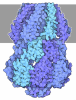
 Assembly

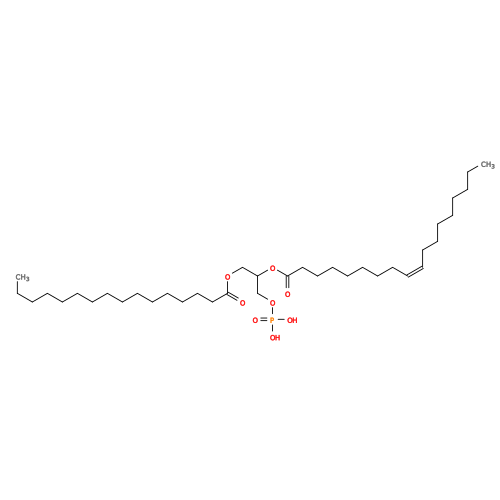 Mass: 674.929 Da / Num. of mol.: 28 / Source method: obtained synthetically / Formula: C37H71O8P / Feature type: SUBJECT OF INVESTIGATION
 Mass: 18.015 Da / Num. of mol.: 91 / Source method: isolated from a natural source / Formula: H2O
 Sample preparation
 Electron microscopy imaging
 FIELD EMISSION GUN / Accelerating voltage: 300 kV / Illumination mode: FLOOD BEAM
 Processing