 Movie
Movie Controller

[English] 日本語
 Yorodumi
- PDB-9oxl: SthK closed state at low temperature, cAMP-bound in the presence ... -
+ Open data

- Basic information
| Entry | Database: PDB / ID: 9oxl | |||||||||||||||||||||||||||
|---|---|---|---|---|---|---|---|---|---|---|---|---|---|---|---|---|---|---|---|---|---|---|---|---|---|---|---|---|
| Title | SthK closed state at low temperature, cAMP-bound in the presence of DOPE | |||||||||||||||||||||||||||
 Components Components | Transcriptional regulator, Crp/Fnr family | |||||||||||||||||||||||||||
 Keywords Keywords | TRANSPORT PROTEIN / cyclic nucleotide-gated channel / lipid modulation / pacemaker channel / potassium channel / thermoreceptor | |||||||||||||||||||||||||||
| Function / homology |  Function and homology information Function and homology informationintracellularly cyclic nucleotide-activated monoatomic cation channel activity / nucleotide binding / protein-containing complex binding / membrane Similarity search - Function | |||||||||||||||||||||||||||
| Biological species |  Spirochaeta thermophila (bacteria) Spirochaeta thermophila (bacteria) | |||||||||||||||||||||||||||
| Method | ELECTRON MICROSCOPY / single particle reconstruction / cryo EM / Resolution: 2.62 Å | |||||||||||||||||||||||||||
 Authors Authors | Li, C.-C. / Nimigean, C.M. | |||||||||||||||||||||||||||
| Funding support |  United States, United States,  Taiwan, 2items Taiwan, 2items
| |||||||||||||||||||||||||||
 Citation Citation | Journal: Nat Commun / Year: 2026 Title: Mechanism of lipid-dependent cold sensitivity in a model ion channel. Authors: Chieh-Chin Li / Crina M Nimigean / Abstract: Temperature sensing enables organisms to detect and respond to environmental changes. While temperature-responsive ion channels are key to this process, the physico-chemical mechanisms by which they ...Temperature sensing enables organisms to detect and respond to environmental changes. While temperature-responsive ion channels are key to this process, the physico-chemical mechanisms by which they sense temperature remain poorly understood. Here, we investigate the molecular details of temperature sensing in the model bacterial channel, SthK from Spirochaeta thermophila. We show that SthK is cold sensitive, displaying higher activity below 30 °C. Remarkably, SthK cold sensitivity depends strongly on membrane lipids, being sensitive in amine-containing lipids but insensitive in anionic lipids. Combining cryo-EM structural analysis, mutagenesis, and functional assays, we identify an intersubunit salt bridge that acts as temperature sensor. This salt bridge forms only in closed states, and determines channel opening by controlling closed-state stability. Lower temperatures weaken salt-bridge interactions, favoring channel opening, and lipid headgroups tune temperature sensitivity by modulating salt-bridge strength. These findings highlight how thermosensitivity can emerge from cooperative interactions between protein and the surrounding membrane. | |||||||||||||||||||||||||||
| History |
|
- Structure visualization
| Structure viewer | Molecule: MolmilJmol/JSmol |
|---|
- Downloads & links
-Download
| PDBx/mmCIF format | 9oxl.cif.gz | 337.9 KB | Display | PDBx/mmCIF format |
|---|---|---|---|---|
| PDB format | pdb9oxl.ent.gz | 270.8 KB | Display | PDB format |
| PDBx/mmJSON format | 9oxl.json.gz | Tree view | PDBx/mmJSON format | |
| Others |  Other downloads Other downloads |
-Validation report
| Arichive directory | https://data.pdbj.org/pub/pdb/validation_reports/ox/9oxlftp://data.pdbj.org/pub/pdb/validation_reports/ox/9oxl | HTTPS FTP |
|---|
-Related structure data
| Related structure data |  70988MC  10rxC  9oxmC M: map data used to model this data C: citing same article ( |
|---|---|
| Similar structure data |


-Links
 PDBj
PDBj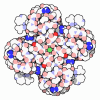
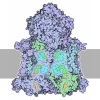
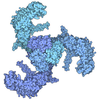
- Assembly
| Deposited unit | 
|
|---|---|
| 1 |
|
-Components
| #1: Protein | Mass: 51118.574 Da / Num. of mol.: 4 Source method: isolated from a genetically manipulated source Source: (gene. exp.) Spirochaeta thermophila (bacteria) / Gene: Spith_0644 / Production host:  Escherichia coli BL21(DE3) (bacteria) / Variant (production host): C41 / References: UniProt: G0GA88 Escherichia coli BL21(DE3) (bacteria) / Variant (production host): C41 / References: UniProt: G0GA88#2: Chemical | ChemComp-CMP / 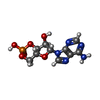 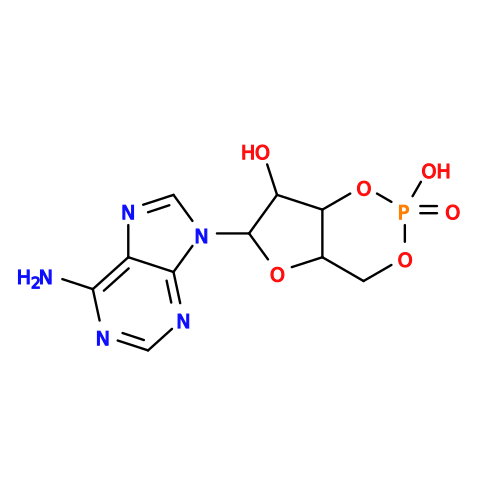 Mass: 329.206 Da / Num. of mol.: 4 / Source method: obtained synthetically / Formula: C10H12N5O6P / Feature type: SUBJECT OF INVESTIGATION Mass: 329.206 Da / Num. of mol.: 4 / Source method: obtained synthetically / Formula: C10H12N5O6P / Feature type: SUBJECT OF INVESTIGATION#3: Chemical | ChemComp-PEE /  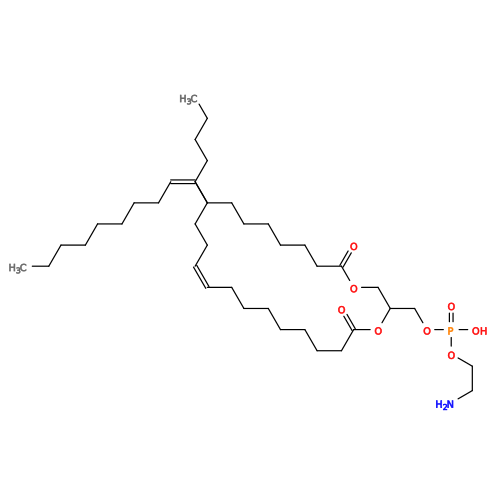 Mass: 744.034 Da / Num. of mol.: 28 / Source method: obtained synthetically / Formula: C41H78NO8P / Feature type: SUBJECT OF INVESTIGATION / Comment: DOPE, phospholipid*YM Mass: 744.034 Da / Num. of mol.: 28 / Source method: obtained synthetically / Formula: C41H78NO8P / Feature type: SUBJECT OF INVESTIGATION / Comment: DOPE, phospholipid*YMHas ligand of interest | Y | Has protein modification | N | |
|---|
-Experimental details
-Experiment
| Experiment | Method: ELECTRON MICROSCOPY |
|---|---|
| EM experiment | Aggregation state: PARTICLE / 3D reconstruction method: single particle reconstruction |
- Sample preparation
| Component | Name: tetrameric SthK protein / Type: COMPLEX Details: SthK in complex with cAMP reconstituted into MSP1E3 nanodiscs containing DOPE Entity ID: #1 / Source: RECOMBINANT |
|---|---|
| Source (natural) | Organism: Spirochaeta thermophila (bacteria) |
| Source (recombinant) | Organism: Escherichia coli (E. coli) / Strain: C41 (DE3) |
| Buffer solution | pH: 7.4 |
| Specimen | Conc.: 8 mg/ml / Embedding applied: NO / Shadowing applied: NO / Staining applied: NO / Vitrification applied: YES |
| Specimen support | Grid material: GOLD / Grid mesh size: 300 divisions/in. / Grid type: UltrAuFoil R1.2/1.3 |
| Vitrification | Instrument: FEI VITROBOT MARK IV / Cryogen name: ETHANE / Humidity: 100 % / Chamber temperature: 279 K |
- Electron microscopy imaging
| Experimental equipment |  Model: Titan Krios / Image courtesy: FEI Company |
|---|---|
| Microscopy | Model: TFS KRIOS |
| Electron gun | Electron source:  FIELD EMISSION GUN / Accelerating voltage: 300 kV / Illumination mode: FLOOD BEAM FIELD EMISSION GUN / Accelerating voltage: 300 kV / Illumination mode: FLOOD BEAM |
| Electron lens | Mode: BRIGHT FIELD / Nominal magnification: 105000 X / Nominal defocus max: 2500 nm / Nominal defocus min: 400 nm |
| Specimen holder | Cryogen: NITROGEN |
| Image recording | Electron dose: 48.4 e/Å2 / Film or detector model: GATAN K3 BIOQUANTUM (6k x 4k) |
- Processing
| EM software |
| ||||||||||||||||||||||||||||||||||||||||
|---|---|---|---|---|---|---|---|---|---|---|---|---|---|---|---|---|---|---|---|---|---|---|---|---|---|---|---|---|---|---|---|---|---|---|---|---|---|---|---|---|---|
| CTF correction | Type: PHASE FLIPPING AND AMPLITUDE CORRECTION | ||||||||||||||||||||||||||||||||||||||||
| Particle selection | Num. of particles selected: 1383889 | ||||||||||||||||||||||||||||||||||||||||
| 3D reconstruction | Resolution: 2.62 Å / Resolution method: FSC 0.143 CUT-OFF / Num. of particles: 79604 / Symmetry type: POINT | ||||||||||||||||||||||||||||||||||||||||
| Refine LS restraints |
|
