- PDB-9or5: Cryo-EM structure of rat TRPM1 in the apo state -
+
Open data
ID or keywords:
Loading...
-
Basic information
Entry
Database: PDB / ID: 9or5
Title
Cryo-EM structure of rat TRPM1 in the apo state
Components
Isoform 2 of Transient receptor potential cation channel subfamily M member 1
Keywords
MEMBRANE PROTEIN / TRPM1 / ion channel
Function / homology
Function and homology information
new growing cell tip / retinal rod cell development / cellular response to light stimulus / cell tip / TRP channels / G protein-coupled glutamate receptor signaling pathway / monoatomic cation transmembrane transporter activity / calcium ion import across plasma membrane / monoatomic cation transmembrane transport / monoatomic ion channel activity ...new growing cell tip / retinal rod cell development / cellular response to light stimulus / cell tip / TRP channels / G protein-coupled glutamate receptor signaling pathway / monoatomic cation transmembrane transporter activity / calcium ion import across plasma membrane / monoatomic cation transmembrane transport / monoatomic ion channel activity / monoatomic cation channel activity / visual perception / protein tetramerization / calcium channel activity / calcium ion transport / intracellular protein localization / axon / dendrite / endoplasmic reticulum membrane / signal transduction / endoplasmic reticulum / plasma membrane Similarity search - Function
TRPM, tetramerisation domain / TRPM, tetramerisation domain superfamily / Tetramerisation domain of TRPM / TRPM, SLOG domain / : / : / SLOG in TRPM / TRPM2-like domain / Ion transport domain / Ion transport protein Similarity search - Domain/homology
National Institutes of Health/National Institute of General Medical Sciences (NIH/NIGMS)
1R24GM154186
United States
National Institutes of Health/National Institute of General Medical Sciences (NIH/NIGMS)
R24GM145964
United States
National Institutes of Health/National Institute of General Medical Sciences (NIH/NIGMS)
R24GM154185
United States
Citation
Journal: Nat Commun / Year: 2026 Title: Cryo-EM structure of TRPM1 reveals a non-canonical architecture with an inverted transmembrane domain. Authors: Michael Fabrizio / Mackenzie Brewer / Nebojša Bogdanović / Chen Zhao / Abstract: Transient receptor potential melastatin 1 (TRPM1) is a membrane protein essential for vision in dim light, and mutations in TRPM1 cause complete congenital stationary night blindness. Although TRPM1 ...Transient receptor potential melastatin 1 (TRPM1) is a membrane protein essential for vision in dim light, and mutations in TRPM1 cause complete congenital stationary night blindness. Although TRPM1 shares sequence similarity to other TRPM ion channels such as TRPM3, whether it independently functions as an ion channel remains controversial. This controversy is largely caused by TRPM1's challenging biochemical behaviors that prevent detailed molecular characterization. In this work, we isolate TRPM1 and determine its structures using cryogenic electron microscopy (cryo-EM). The structures reveal a canonical tetrameric fold in the intracellular domain, consistent with other TRPM family members that are ion channels. Surprisingly, in the transmembrane domain, despite the presence of the conserved voltage sensor-like domain (VSLD) and pore domain (PD) in a domain-swapped fashion, the VSLD and PD are arranged with an opposite handedness compared to other related channels. This inverted transmembrane domain allows the formation of a large pore-like structure that supports the role of TRPM1 as an ion channel. This non-canonical architecture of TRPM1 may also confer unique permeation and pharmacological properties.
History
Deposition
May 21, 2025
Deposition site: RCSB / Processing site: RCSB
Revision 1.0
Apr 1, 2026
Provider: repository / Type: Initial release
Revision 1.0
Apr 1, 2026
Data content type: EM metadata / Data content type: EM metadata / Provider: repository / Type: Initial release
Revision 1.0
Apr 1, 2026
Data content type: Additional map / Part number: 1 / Data content type: Additional map / Provider: repository / Type: Initial release
Revision 1.0
Apr 1, 2026
Data content type: Additional map / Part number: 2 / Data content type: Additional map / Provider: repository / Type: Initial release
Revision 1.0
Apr 1, 2026
Data content type: Additional map / Part number: 3 / Data content type: Additional map / Provider: repository / Type: Initial release
Revision 1.0
Apr 1, 2026
Data content type: Additional map / Part number: 4 / Data content type: Additional map / Provider: repository / Type: Initial release
Revision 1.0
Apr 1, 2026
Data content type: Additional map / Part number: 5 / Data content type: Additional map / Provider: repository / Type: Initial release
Revision 1.0
Apr 1, 2026
Data content type: FSC / Data content type: FSC / Provider: repository / Type: Initial release
Revision 1.0
Apr 1, 2026
Data content type: Half map / Part number: 1 / Data content type: Half map / Provider: repository / Type: Initial release
Revision 1.0
Apr 1, 2026
Data content type: Half map / Part number: 2 / Data content type: Half map / Provider: repository / Type: Initial release
Revision 1.0
Apr 1, 2026
Data content type: Image / Data content type: Image / Provider: repository / Type: Initial release
Revision 1.0
Apr 1, 2026
Data content type: Primary map / Data content type: Primary map / Provider: repository / Type: Initial release
Data content type: EM metadata / Data content type: EM metadata / EM metadata / Group: Database references / Experimental summary / Data content type: EM metadata / EM metadata / EM metadata / Category: citation / citation_author / em_admin / Data content type: EM metadata / EM metadata / EM metadata Item: _citation.journal_volume / _citation_author.identifier_ORCID / _em_admin.last_update
A: Isoform 2 of Transient receptor potential cation channel subfamily M member 1 B: Isoform 2 of Transient receptor potential cation channel subfamily M member 1 C: Isoform 2 of Transient receptor potential cation channel subfamily M member 1 D: Isoform 2 of Transient receptor potential cation channel subfamily M member 1
In the structure databanks used in Yorodumi, some data are registered as the other names, "COVID-19 virus" and "2019-nCoV". Here are the details of the virus and the list of structure data.
Jan 31, 2019. EMDB accession codes are about to change! (news from PDBe EMDB page)
EMDB accession codes are about to change! (news from PDBe EMDB page)
The allocation of 4 digits for EMDB accession codes will soon come to an end. Whilst these codes will remain in use, new EMDB accession codes will include an additional digit and will expand incrementally as the available range of codes is exhausted. The current 4-digit format prefixed with “EMD-” (i.e. EMD-XXXX) will advance to a 5-digit format (i.e. EMD-XXXXX), and so on. It is currently estimated that the 4-digit codes will be depleted around Spring 2019, at which point the 5-digit format will come into force.
The EM Navigator/Yorodumi systems omit the EMD- prefix.
Related info.:Q: What is EMD? / ID/Accession-code notation in Yorodumi/EM Navigator
Yorodumi is a browser for structure data from EMDB, PDB, SASBDB, etc.
This page is also the successor to EM Navigator detail page, and also detail information page/front-end page for Omokage search.
The word "yorodu" (or yorozu) is an old Japanese word meaning "ten thousand". "mi" (miru) is to see.
Related info.:EMDB / PDB / SASBDB / Comparison of 3 databanks / Yorodumi Search / Aug 31, 2016. New EM Navigator & Yorodumi / Yorodumi Papers / Jmol/JSmol / Function and homology information / Changes in new EM Navigator and Yorodumi
 Movie
Movie Controller


 Open data
 Basic information
 Components
 Keywords
 Function and homology information
 Rattus norvegicus (Norway rat)
 Authors
 United States, 3items
  Citation
 Structure visualization
 Downloads & links
 Other downloads
 PDBj
PDBj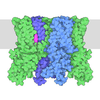
 Assembly
 Homo sapiens (human) / References: UniProt: Q2WEA5
 Sample preparation
 Electron microscopy imaging
 FIELD EMISSION GUN / Accelerating voltage: 300 kV / Illumination mode: FLOOD BEAM
 Processing