 Movie
Movie Controller

[English] 日本語
 Yorodumi
- PDB-9oac: C5 reconstruction of the thermophilic bacteriophage P74-26 Portal... -
+ Open data

- Basic information
| Entry | Database: PDB / ID: 9oac | |||||||||||||||||||||||||||
|---|---|---|---|---|---|---|---|---|---|---|---|---|---|---|---|---|---|---|---|---|---|---|---|---|---|---|---|---|
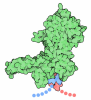
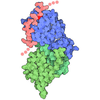
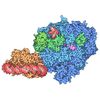
| Title | C5 reconstruction of the thermophilic bacteriophage P74-26 Portal Vertex | |||||||||||||||||||||||||||
 Components Components |
| |||||||||||||||||||||||||||
 Keywords Keywords | VIRUS / bacteriophage / thermophilic / Neck / Capsid | |||||||||||||||||||||||||||
| Function / homology |  Function and homology information Function and homology information | |||||||||||||||||||||||||||
| Biological species |  Oshimavirus P7426 Oshimavirus P7426 | |||||||||||||||||||||||||||
| Method | ELECTRON MICROSCOPY / single particle reconstruction / cryo EM / Resolution: 2.6 Å | |||||||||||||||||||||||||||
 Authors Authors | Sedivy, E.L. / Agnello, E. / Song, K. / Xu, C. / Kelch, B.A. | |||||||||||||||||||||||||||
| Funding support |  United States, 1items United States, 1items
| |||||||||||||||||||||||||||
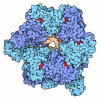
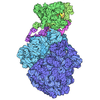
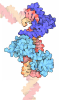
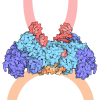
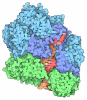
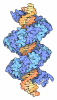
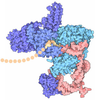
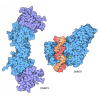
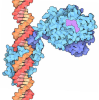
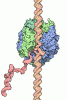
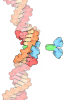
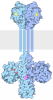
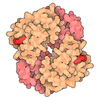
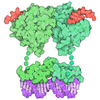
 Citation Citation | Journal: J Mol Biol / Year: 2026 Title: The Structure of a Thermostable Phage's Portal Vertex and Neck Complex Illuminates the Headful Maturation Mechanism. Authors: Emma L Sedivy / Emily Agnello / Julia E Hobaugh / Rakeyah Ahsan / Kangkang Song / Chen Xu / Brian A Kelch / Abstract: Viruses assemble from component parts inside their host cells, but the mechanisms coordinating this complex process are not completely understood. In tailed bacteriophages, the genome is packaged ...Viruses assemble from component parts inside their host cells, but the mechanisms coordinating this complex process are not completely understood. In tailed bacteriophages, the genome is packaged into its capsid shell through the portal complex. The portal complex then closes to retain DNA and connects to the tail, which is required for host recognition and infection. The trigger to stop pumping DNA and assemble the mature virus has been a longstanding conundrum in the field. We determined the structure of the portal, the proteins that connect it to the tail, and portal vertex in the hyperthermophilic phage Oshimavirus using cryo-Electron Microscopy (cryo-EM). We find highly intertwined loop structures, like in a wicker basket, potentially stabilizing the portal vertex against high temperatures. Moreover, we observe that the portal protrudes from the capsid in mature virions. We propose that portal is repositioned by packaged DNA, forming a pressure-sensitive switch that terminates genome packaging and triggers tail attachment in headful phages. | |||||||||||||||||||||||||||
| History |
|
- Structure visualization
| Structure viewer | Molecule: MolmilJmol/JSmol |
|---|
- Downloads & links
-Download
| PDBx/mmCIF format | 9oac.cif.gz | 2.1 MB | Display | PDBx/mmCIF format |
|---|---|---|---|---|
| PDB format | pdb9oac.ent.gz | Display | PDB format | |
| PDBx/mmJSON format | 9oac.json.gz | Tree view | PDBx/mmJSON format | |
| Others |  Other downloads Other downloads |
-Validation report
| Arichive directory | https://data.pdbj.org/pub/pdb/validation_reports/oa/9oacftp://data.pdbj.org/pub/pdb/validation_reports/oa/9oac | HTTPS FTP |
|---|
-Related structure data
| Related structure data |  70279MC  9oabC 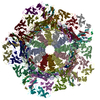 9oadC  9oaeC  9q7aC M: map data used to model this data C: citing same article ( |
|---|---|
| Similar structure data |


-Links
 PDBj
PDBj

- Assembly
| Deposited unit | 
|
|---|---|
| 1 |
|
-Components
| #1: Protein | Mass: 46680.754 Da / Num. of mol.: 20 / Source method: isolated from a natural source / Source: (natural) Oshimavirus P7426 / References: UniProt: A7XXR6#2: Protein | Mass: 16376.630 Da / Num. of mol.: 20 / Source method: isolated from a natural source / Source: (natural) Oshimavirus P7426 / References: UniProt: A7XXR5#3: Protein | Mass: 8431.445 Da / Num. of mol.: 5 / Source method: isolated from a natural source / Source: (natural) Oshimavirus P7426 / References: UniProt: A7XXK1#4: DNA chain | Mass: 9385.020 Da / Num. of mol.: 5 / Source method: isolated from a natural source / Source: (natural) Oshimavirus P7426#5: DNA chain | Mass: 9664.453 Da / Num. of mol.: 5 / Source method: isolated from a natural source / Source: (natural) Oshimavirus P7426Has protein modification | N | |
|---|
-Experimental details
-Experiment
| Experiment | Method: ELECTRON MICROSCOPY |
|---|---|
| EM experiment | Aggregation state: PARTICLE / 3D reconstruction method: single particle reconstruction |
- Sample preparation
| Component |
| |||||||||||||||||||||
|---|---|---|---|---|---|---|---|---|---|---|---|---|---|---|---|---|---|---|---|---|---|---|
| Molecular weight |
| |||||||||||||||||||||
| Source (natural) |
| |||||||||||||||||||||
| Details of virus |
| |||||||||||||||||||||
| Natural host |
| |||||||||||||||||||||
| Virus shell |
| |||||||||||||||||||||
| Buffer solution | pH: 8 | |||||||||||||||||||||
| Specimen | Embedding applied: NO / Shadowing applied: NO / Staining applied: NO / Vitrification applied: YES Details: Virions were purified from infected Thermus thermophilus using cesium chloride and sucrose gradient ultracentrifugation. | |||||||||||||||||||||
| Specimen support | Grid material: COPPER / Grid mesh size: 400 divisions/in. / Grid type: EMS Lacey Carbon | |||||||||||||||||||||
| Vitrification | Instrument: FEI VITROBOT MARK IV / Cryogen name: ETHANE / Humidity: 90 % / Chamber temperature: 283 K |
- Electron microscopy imaging
| Experimental equipment |  Model: Titan Krios / Image courtesy: FEI Company |
|---|---|
| Microscopy | Model: TFS KRIOS |
| Electron gun | Electron source:  FIELD EMISSION GUN / Accelerating voltage: 300 kV / Illumination mode: FLOOD BEAM FIELD EMISSION GUN / Accelerating voltage: 300 kV / Illumination mode: FLOOD BEAM |
| Electron lens | Mode: BRIGHT FIELD / Nominal defocus max: 1500 nm / Nominal defocus min: 500 nm / Cs: 2.7 mm / Alignment procedure: COMA FREE |
| Specimen holder | Cryogen: NITROGEN |
| Image recording | Electron dose: 49.0571 e/Å2 / Film or detector model: GATAN K3 (6k x 4k) / Num. of grids imaged: 16184 |
- Processing
| EM software | Name: PHENIX / Version: dev_5430 / Category: model refinement | ||||||||||||||||||||||||
|---|---|---|---|---|---|---|---|---|---|---|---|---|---|---|---|---|---|---|---|---|---|---|---|---|---|
| CTF correction | Type: PHASE FLIPPING AND AMPLITUDE CORRECTION | ||||||||||||||||||||||||
| Symmetry | Point symmetry: C5 (5 fold cyclic) | ||||||||||||||||||||||||
| 3D reconstruction | Resolution: 2.6 Å / Resolution method: FSC 0.143 CUT-OFF / Num. of particles: 40773 / Algorithm: FOURIER SPACE Details: FSC was calculated inside the provided mask, which excludes the Neck (C12 and C3 components) Num. of class averages: 1 / Symmetry type: POINT | ||||||||||||||||||||||||
| Refinement | Cross valid method: NONE Stereochemistry target values: GeoStd + Monomer Library + CDL v1.2 | ||||||||||||||||||||||||
| Displacement parameters | Biso mean: 111.32 Å2 | ||||||||||||||||||||||||
| Refine LS restraints |
|
