 Movie
Movie Controller


+ Open data

- Basic information
| Entry | Database: PDB / ID: 9njl | |||||||||||||||||||||
|---|---|---|---|---|---|---|---|---|---|---|---|---|---|---|---|---|---|---|---|---|---|---|
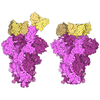
| Title | MARV GP in complex with MARV16 Fab | |||||||||||||||||||||
 Components Components |
| |||||||||||||||||||||
 Keywords Keywords | VIRAL PROTEIN / Glycoprotein / Antibody / Structural Genomics / Seattle Structural Genomics Center for Infectious Disease / SSGCID | |||||||||||||||||||||
| Function / homology |  Function and homology information Function and homology informationfusion of virus membrane with host endosome membrane / viral envelope / symbiont entry into host cell / virion attachment to host cell / host cell plasma membrane / virion membrane Similarity search - Function | |||||||||||||||||||||
| Biological species |   Mus musculus (house mouse) Mus musculus (house mouse) Orthomarburgvirus marburgense Orthomarburgvirus marburgense | |||||||||||||||||||||
| Method | ELECTRON MICROSCOPY / single particle reconstruction / cryo EM / Resolution: 2.6 Å | |||||||||||||||||||||
 Authors Authors | Addetia, A. / Seattle Structural Genomics Center for Infectious Disease (SSGCID) / Veesler, D. | |||||||||||||||||||||
| Funding support |  United States, 1items United States, 1items
| |||||||||||||||||||||
 Citation Citation | Journal: Nature / Year: 2026 Title: Potent neutralization of Marburg virus by a vaccine-elicited antibody. Authors: Amin Addetia / Lisa Perruzza / Kaitlin Sprouse / Young-Jun Park / Matthew McCallum / Cameron Stewart / Bianca Partini / Jack T Brown / Alessia Donati / Katja Culap / Alessio Balmelli / ...Authors: Amin Addetia / Lisa Perruzza / Kaitlin Sprouse / Young-Jun Park / Matthew McCallum / Cameron Stewart / Bianca Partini / Jack T Brown / Alessia Donati / Katja Culap / Alessio Balmelli / Bhavna Chawla / Swagata Kar / Michal Gazi / Kendra Alfson / Yenny Goez-Gazi / Ricardo Carrion / Davide Corti / Fabio Benigni / David Veesler /  Abstract: Marburg virus (MARV) is a filovirus that causes severe and often lethal haemorrhagic fever. Despite the increasing frequency of MARV outbreaks, no vaccines or therapeutics are licensed for use in ...Marburg virus (MARV) is a filovirus that causes severe and often lethal haemorrhagic fever. Despite the increasing frequency of MARV outbreaks, no vaccines or therapeutics are licensed for use in humans. Here we designed mutations that improve the expression, thermostability and immunogenicity of the prefusion MARV glycoprotein (GP) ectodomain trimer, which is the sole target of neutralizing antibodies and vaccines in development. We discovered a fully human, pan-marburgvirus monoclonal antibody, MARV16, that broadly neutralizes all MARV isolates, Ravn virus and Dehong virus with 40-100-fold increased potency relative to previously described antibodies. Moreover, MARV16 provided therapeutic protection in guinea pigs challenged with MARV. We determined a cryogenic electron microscopy structure of MARV16-bound MARV GP. The structure shows that MARV16 recognizes a prefusion-specific epitope spanning GP1 and GP2, which blocks receptor binding and prevents conformational changes required for viral entry. We further determined the architecture of the MARV GP glycan cap, which shields the receptor-binding site, and identified architectural similarities with distantly related filovirus GPs. MARV16 and previously identified antibodies directed against the receptor-binding site simultaneously bound MARV GP. These antibody cocktails required multiple mutations to escape neutralization by both antibodies, a result that paves the way for the development of MARV therapeutics resistant to viral evolution. MARV GP stabilization along with the discovery of MARV16 advance prevention and treatment options for MARV disease. | |||||||||||||||||||||
| History |
|
- Structure visualization
| Structure viewer | Molecule: MolmilJmol/JSmol |
|---|
- Downloads & links
-Download
| PDBx/mmCIF format | 9njl.cif.gz | 317 KB | Display | PDBx/mmCIF format |
|---|---|---|---|---|
| PDB format | pdb9njl.ent.gz | 238.5 KB | Display | PDB format |
| PDBx/mmJSON format | 9njl.json.gz | Tree view | PDBx/mmJSON format | |
| Others |  Other downloads Other downloads |
-Validation report
| Arichive directory | https://data.pdbj.org/pub/pdb/validation_reports/nj/9njlftp://data.pdbj.org/pub/pdb/validation_reports/nj/9njl | HTTPS FTP |
|---|
-Related structure data
| Related structure data |  49486MC M: map data used to model this data C: citing same article ( |
|---|---|
| Similar structure data |
-Links
 PDBj
PDBj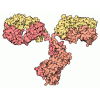
- Assembly
| Deposited unit | 
|
|---|---|
| 1 |
|
-Components
-Envelope glycoprotein ... , 2 types, 6 molecules ACEBDF
| #3: Protein | Mass: 29689.832 Da / Num. of mol.: 3 Source method: isolated from a genetically manipulated source Source: (gene. exp.) Orthomarburgvirus marburgense / Strain: Musoke / Gene: GP / Production host:  Homo sapiens (human) / References: UniProt: P35253 Homo sapiens (human) / References: UniProt: P35253#4: Protein | Mass: 23432.998 Da / Num. of mol.: 3 / Mutation: W439A, F445G, F447N, H589I Source method: isolated from a genetically manipulated source Source: (gene. exp.) Orthomarburgvirus marburgense / Strain: Musoke / Gene: GP / Production host: Homo sapiens (human) / References: UniProt: P35253 |
|---|
-Antibody , 2 types, 6 molecules HIJLNP
| #1: Antibody | Mass: 23921.689 Da / Num. of mol.: 3 Source method: isolated from a genetically manipulated source Source: (gene. exp.) Mus musculus (house mouse) / Production host: Homo sapiens (human)#2: Antibody | Mass: 23236.838 Da / Num. of mol.: 3 Source method: isolated from a genetically manipulated source Source: (gene. exp.) Mus musculus (house mouse) / Production host: Homo sapiens (human) |
|---|
-Sugars , 3 types, 15 molecules 
| #5: Polysaccharide | Source method: isolated from a genetically manipulated source #6: Polysaccharide | Source method: isolated from a genetically manipulated source #7: Sugar | ChemComp-NAG / 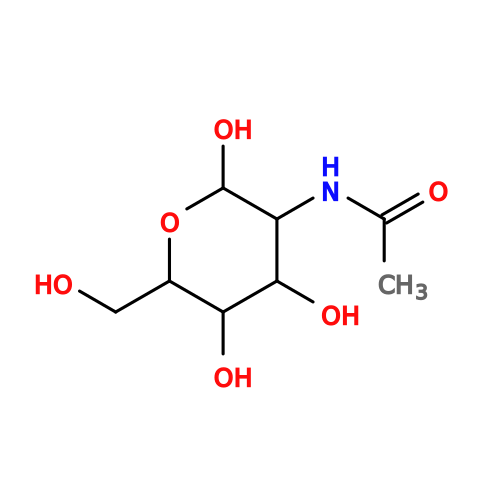 Type: D-saccharide, beta linking / Mass: 221.208 Da / Num. of mol.: 9 Type: D-saccharide, beta linking / Mass: 221.208 Da / Num. of mol.: 9Source method: isolated from a genetically manipulated source Formula: C8H15NO6 |
|---|
-Non-polymers , 1 types, 54 molecules 
| #8: Water | ChemComp-HOH / Mass: 18.015 Da / Num. of mol.: 54 / Source method: isolated from a natural source / Formula: H2O |
|---|
-Details
| Has ligand of interest | N |
|---|---|
| Has protein modification | Y |
-Experimental details
-Experiment
| Experiment | Method: ELECTRON MICROSCOPY |
|---|---|
| EM experiment | Aggregation state: PARTICLE / 3D reconstruction method: single particle reconstruction |
- Sample preparation
| Component | Name: MARV GP in complex with MARV16 Fab / Type: COMPLEX / Entity ID: #3-#4, #1-#2 / Source: MULTIPLE SOURCES |
|---|---|
| Source (natural) | Organism: Orthomarburgvirus marburgense / Strain: Musoke |
| Source (recombinant) | Organism: Homo sapiens (human) |
| Buffer solution | pH: 7.4 |
| Specimen | Embedding applied: NO / Shadowing applied: NO / Staining applied: NO / Vitrification applied: YES |
| Vitrification | Cryogen name: ETHANE |
- Electron microscopy imaging
| Experimental equipment |  Model: Titan Krios / Image courtesy: FEI Company |
|---|---|
| Microscopy | Model: TFS KRIOS |
| Electron gun | Electron source:  FIELD EMISSION GUN / Accelerating voltage: 300 kV / Illumination mode: FLOOD BEAM FIELD EMISSION GUN / Accelerating voltage: 300 kV / Illumination mode: FLOOD BEAM |
| Electron lens | Mode: BRIGHT FIELD / Nominal defocus max: 3000 nm / Nominal defocus min: 400 nm |
| Image recording | Electron dose: 63 e/Å2 / Film or detector model: GATAN K3 (6k x 4k) |
- Processing
| EM software |
| |||||||||
|---|---|---|---|---|---|---|---|---|---|---|
| CTF correction | Type: PHASE FLIPPING AND AMPLITUDE CORRECTION | |||||||||
| Symmetry | Point symmetry: C3 (3 fold cyclic) | |||||||||
| 3D reconstruction | Resolution: 2.6 Å / Resolution method: FSC 0.143 CUT-OFF / Num. of particles: 368509 / Symmetry type: POINT | |||||||||
| Refinement | Highest resolution: 2.6 Å Stereochemistry target values: REAL-SPACE (WEIGHTED MAP SUM AT ATOM CENTERS) |
