National Institutes of Health/National Institute of General Medical Sciences (NIH/NIGMS)
GM122510
United States
Citation
Journal: Cell Rep / Year: 2025 Title: A type IV pili-mediated mutualism between two co-resident temperate archaeal viruses and their host. Authors: Jialin Xiang / Ravi R Sonani / Yangyang Wang / Zhao Chen / Weiyan Xiong / Jiangling Chen / Shuyu Li / Kang An / Yixuan Wang / Ying Liu / Mark A B Kreutzberger / Mart Krupovic / Edward H ...Authors: Jialin Xiang / Ravi R Sonani / Yangyang Wang / Zhao Chen / Weiyan Xiong / Jiangling Chen / Shuyu Li / Kang An / Yixuan Wang / Ying Liu / Mark A B Kreutzberger / Mart Krupovic / Edward H Egelman / Shishen Du / Xiangdong Chen / Abstract: Co-resident temperate viruses are ubiquitous in prokaryotes, which interact with each other and affect their shared host. However, how such virus-virus and virus-host interactions play out in Archaea ...Co-resident temperate viruses are ubiquitous in prokaryotes, which interact with each other and affect their shared host. However, how such virus-virus and virus-host interactions play out in Archaea remains largely unexplored. Here, we discover a tripartite mutualistic interaction among the co-existing temperate viruses SNJ1 and SNJ2 and their host, haloarchaeon Natrinema sp. J7. We find that the SNJ2 provirus encodes two type IV pilins (T4Ps), which hijack the host secretion machinery to assemble into distinct filaments on the host cell surface. The SNJ2-encoded pili are dispensable for the SNJ2 infection but serve as receptors for SNJ1. As a quid pro quo, SNJ1 enhances the replication of SNJ2. Furthermore, the viral pili are the dominant filaments on the cell surface and promote biofilm formation and motility of the host. A number of SNJ2-like proviruses harbor T4P genes, suggesting that T4P-mediated virus-virus and virus-host interactions are widespread in Haloarchaea.
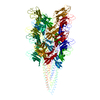
Helical symmetry: (Circular symmetry: 1 / Dyad axis: no / N subunits divisor: 1 / Num. of operations: 24 / Rise per n subunits: 4.95 Å / Rotation per n subunits: 108.81 °)
In the structure databanks used in Yorodumi, some data are registered as the other names, "COVID-19 virus" and "2019-nCoV". Here are the details of the virus and the list of structure data.
Jan 31, 2019. EMDB accession codes are about to change! (news from PDBe EMDB page)
EMDB accession codes are about to change! (news from PDBe EMDB page)
The allocation of 4 digits for EMDB accession codes will soon come to an end. Whilst these codes will remain in use, new EMDB accession codes will include an additional digit and will expand incrementally as the available range of codes is exhausted. The current 4-digit format prefixed with “EMD-” (i.e. EMD-XXXX) will advance to a 5-digit format (i.e. EMD-XXXXX), and so on. It is currently estimated that the 4-digit codes will be depleted around Spring 2019, at which point the 5-digit format will come into force.
The EM Navigator/Yorodumi systems omit the EMD- prefix.
Related info.:Q: What is EMD? / ID/Accession-code notation in Yorodumi/EM Navigator
Yorodumi is a browser for structure data from EMDB, PDB, SASBDB, etc.
This page is also the successor to EM Navigator detail page, and also detail information page/front-end page for Omokage search.
The word "yorodu" (or yorozu) is an old Japanese word meaning "ten thousand". "mi" (miru) is to see.
Related info.:EMDB / PDB / SASBDB / Comparison of 3 databanks / Yorodumi Search / Aug 31, 2016. New EM Navigator & Yorodumi / Yorodumi Papers / Jmol/JSmol / Function and homology information / Changes in new EM Navigator and Yorodumi
 Movie
Movie Controller


 Open data
 Basic information
 Components
 Keywords
 Function and homology information
 Natrinema sp. J7-2 (archaea)
 Authors
 United States, 1items
  Citation

 Structure visualization
 Downloads & links
 Other downloads

 PDBj
PDBj
 Assembly

 Sample preparation
 Electron microscopy imaging
 FIELD EMISSION GUN / Accelerating voltage: 300 kV / Illumination mode: FLOOD BEAM
 Processing