 Movie
Movie Controller


+ Open data

- Basic information
| Entry | Database: PDB / ID: 9kv7 | |||||||||
|---|---|---|---|---|---|---|---|---|---|---|
| Title | Cryo-EM structure of mouse RIPK1-DD filament | |||||||||
 Components Components | Receptor-interacting serine/threonine-protein kinase 1 | |||||||||
 Keywords Keywords | IMMUNE SYSTEM / RIPK1 / death domain / 568-656 / dimerization | |||||||||
| Function / homology |  Function and homology information Function and homology informationTNF signaling / Regulation by c-FLIP / CASP8 activity is inhibited / Dimerization of procaspase-8 / TNFR1-induced proapoptotic signaling / Caspase activation via Death Receptors in the presence of ligand / RIPK1-mediated regulated necrosis / TRIF-mediated programmed cell death / ripoptosome assembly / positive regulation of miRNA processing ...TNF signaling / Regulation by c-FLIP / CASP8 activity is inhibited / Dimerization of procaspase-8 / TNFR1-induced proapoptotic signaling / Caspase activation via Death Receptors in the presence of ligand / RIPK1-mediated regulated necrosis / TRIF-mediated programmed cell death / ripoptosome assembly / positive regulation of miRNA processing / positive regulation of interleukin-6-mediated signaling pathway / death domain binding / peptidyl-serine autophosphorylation / TNFR1-induced NF-kappa-B signaling pathway / ripoptosome assembly involved in necroptotic process / Regulation of necroptotic cell death / Ovarian tumor domain proteases / Regulation of TNFR1 signaling / T cell apoptotic process / IKK complex recruitment mediated by RIP1 / programmed necrotic cell death / ripoptosome / activation of protein kinase activity / positive regulation of macrophage differentiation / necroptotic process / negative regulation of necroptotic process / JUN kinase kinase kinase activity / necroptotic signaling pathway / TRP channels / death-inducing signaling complex / Ub-specific processing proteases / positive regulation of necroptotic process / positive regulation of tumor necrosis factor-mediated signaling pathway / death receptor binding / positive regulation of programmed necrotic cell death / positive regulation of extrinsic apoptotic signaling pathway / regulation of reactive oxygen species metabolic process / positive regulation of programmed cell death / extrinsic apoptotic signaling pathway via death domain receptors / protein serine/threonine phosphatase activity / response to tumor necrosis factor / positive regulation of phosphorylation / negative regulation of extrinsic apoptotic signaling pathway in absence of ligand / positive regulation of execution phase of apoptosis / extrinsic apoptotic signaling pathway / canonical NF-kappaB signal transduction / protein catabolic process / signaling adaptor activity / negative regulation of extrinsic apoptotic signaling pathway / negative regulation of canonical NF-kappaB signal transduction / tumor necrosis factor-mediated signaling pathway / positive regulation of interleukin-8 production / protein serine/threonine kinase binding / cellular response to tumor necrosis factor / positive regulation of non-canonical NF-kappaB signal transduction / cellular response to growth factor stimulus / positive regulation of protein phosphorylation / positive regulation of JNK cascade / cellular response to hydrogen peroxide / positive regulation of inflammatory response / positive regulation of neuron apoptotic process / positive regulation of tumor necrosis factor production / protein autophosphorylation / response to oxidative stress / amyloid fibril formation / positive regulation of MAPK cascade / positive regulation of canonical NF-kappaB signal transduction / protein kinase activity / non-specific serine/threonine protein kinase / signaling receptor complex / intracellular signal transduction / positive regulation of apoptotic process / inflammatory response / protein serine kinase activity / ubiquitin protein ligase binding / protein serine/threonine kinase activity / apoptotic process / positive regulation of gene expression / negative regulation of apoptotic process / protein-containing complex binding / positive regulation of transcription by RNA polymerase II / protein homodimerization activity / protein-containing complex / mitochondrion / ATP binding / identical protein binding / cytoplasm Similarity search - Function | |||||||||
| Biological species |   Mus musculus (house mouse) Mus musculus (house mouse) | |||||||||
| Method | ELECTRON MICROSCOPY / helical reconstruction / cryo EM / Resolution: 3.02 Å | |||||||||
 Authors Authors | Zhang, H. | |||||||||
| Funding support |  China, 2items China, 2items
| |||||||||
 Citation Citation | Journal: Cell Metab / Year: 2025 Title: RIPK1 senses S-adenosylmethionine scarcity to drive cell death and inflammation. Authors: Zezhao Chen / Xiaosong Gu / Hongbo Chen / Huijing Zhang / Jianping Liu / Xiaohua Yang / Yuping Cai / Mengmeng Zhang / Lingjie Yan / Yuanxin Yang / Bing Shan / Zheng-Jiang Zhu / Yixiao Zhang ...Authors: Zezhao Chen / Xiaosong Gu / Hongbo Chen / Huijing Zhang / Jianping Liu / Xiaohua Yang / Yuping Cai / Mengmeng Zhang / Lingjie Yan / Yuanxin Yang / Bing Shan / Zheng-Jiang Zhu / Yixiao Zhang / Jinyang Gu / Daichao Xu / Abstract: The capacity of cells to sense and respond to nutrient availability is essential for metabolic homeostasis. Failure in this process may cause cell death and associated diseases. While nutrient ...The capacity of cells to sense and respond to nutrient availability is essential for metabolic homeostasis. Failure in this process may cause cell death and associated diseases. While nutrient sensing in metabolic pathways is well understood, the mechanisms linking nutrient signals to cell death remain unclear. Here, we show that RIPK1, a key mediator of cell death and inflammation, senses methionine and its metabolite, S-adenosylmethionine (SAM), to dictate cell survival and death. SAM-mediated symmetrical dimethylation at RIPK1 Arg606 by PRMT5 functions as a physiological protective brake against RIPK1 activation. Metabolic perturbations, such as methionine restriction or disrupted one-carbon flux, reduce SAM levels and unmask Arg606, promoting RIPK1 self-association and trans-activation, thereby triggering apoptosis and inflammation. Thus, RIPK1 is a physiological SAM sensor linking methionine and one-carbon metabolism to the control of life-or-death decisions. Our findings suggest that RIPK1 could be a potential target for diseases associated with disrupted SAM availability. | |||||||||
| History |
|
- Structure visualization
| Structure viewer | Molecule: MolmilJmol/JSmol |
|---|
- Downloads & links
-Download
| PDBx/mmCIF format | 9kv7.cif.gz | 361.7 KB | Display | PDBx/mmCIF format |
|---|---|---|---|---|
| PDB format | pdb9kv7.ent.gz | 296.6 KB | Display | PDB format |
| PDBx/mmJSON format | 9kv7.json.gz | Tree view | PDBx/mmJSON format | |
| Others |  Other downloads Other downloads |
-Validation report
| Arichive directory | https://data.pdbj.org/pub/pdb/validation_reports/kv/9kv7ftp://data.pdbj.org/pub/pdb/validation_reports/kv/9kv7 | HTTPS FTP |
|---|
-Related structure data
| Related structure data |  62587MC M: map data used to model this data C: citing same article ( |
|---|---|
| Similar structure data |
-Links
 PDBj
PDBj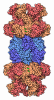

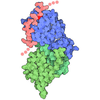
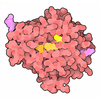
- Assembly
| Deposited unit | 
|
|---|---|
| 1 |
|
-Components
| #1: Protein | Mass: 13810.670 Da / Num. of mol.: 23 Source method: isolated from a genetically manipulated source Source: (gene. exp.) Mus musculus (house mouse) / Gene: Ripk1, Rinp, Rip / Production host:   Escherichia coli (E. coli) Escherichia coli (E. coli)References: UniProt: Q60855, non-specific serine/threonine protein kinase Has protein modification | N | |
|---|
-Experimental details
-Experiment
| Experiment | Method: ELECTRON MICROSCOPY |
|---|---|
| EM experiment | Aggregation state: FILAMENT / 3D reconstruction method: helical reconstruction |
- Sample preparation
| Component | Name: Receptor-interacting serine/threonine-protein kinase 1 Type: COMPLEX / Entity ID: all / Source: RECOMBINANT |
|---|---|
| Molecular weight | Value: 0.001017 MDa / Experimental value: NO |
| Source (natural) | Organism: Mus musculus (house mouse) |
| Source (recombinant) | Organism: Escherichia coli (E. coli) |
| Buffer solution | pH: 7.5 |
| Specimen | Embedding applied: NO / Shadowing applied: NO / Staining applied: NO / Vitrification applied: YES |
| Vitrification | Cryogen name: ETHANE-PROPANE |
- Electron microscopy imaging
| Experimental equipment |  Model: Titan Krios / Image courtesy: FEI Company |
|---|---|
| Microscopy | Model: TFS KRIOS |
| Electron gun | Electron source:  FIELD EMISSION GUN / Accelerating voltage: 300 kV / Illumination mode: FLOOD BEAM FIELD EMISSION GUN / Accelerating voltage: 300 kV / Illumination mode: FLOOD BEAM |
| Electron lens | Mode: BRIGHT FIELD / Nominal defocus max: 2400 nm / Nominal defocus min: 1400 nm |
| Image recording | Electron dose: 49.41 e/Å2 / Film or detector model: GATAN K3 (6k x 4k) |
- Processing
| EM software | Name: PHENIX / Version: 1.18.2_3874 / Category: model refinement | ||||||||||||||||||||||||
|---|---|---|---|---|---|---|---|---|---|---|---|---|---|---|---|---|---|---|---|---|---|---|---|---|---|
| CTF correction | Type: PHASE FLIPPING AND AMPLITUDE CORRECTION | ||||||||||||||||||||||||
| Helical symmerty | Angular rotation/subunit: 139.82 ° / Axial rise/subunit: 4.96 Å / Axial symmetry: C1 | ||||||||||||||||||||||||
| 3D reconstruction | Resolution: 3.02 Å / Resolution method: FSC 0.143 CUT-OFF / Num. of particles: 988646 / Symmetry type: HELICAL | ||||||||||||||||||||||||
| Refinement | Stereochemistry target values: REAL-SPACE (WEIGHTED MAP SUM AT ATOM CENTERS) | ||||||||||||||||||||||||
| Refine LS restraints |
|
