 Movie
Movie Controller


+ Open data

- Basic information
| Entry | Database: PDB / ID: 9isg | ||||||||||||||||||||||||
|---|---|---|---|---|---|---|---|---|---|---|---|---|---|---|---|---|---|---|---|---|---|---|---|---|---|
| Title | Structure of rat TRPV1 in complex with PSFL426-S5 | ||||||||||||||||||||||||
 Components Components | Transient receptor potential cation channel subfamily V member 1 | ||||||||||||||||||||||||
 Keywords Keywords | MEMBRANE PROTEIN / TRPV1 / protein complex | ||||||||||||||||||||||||
| Function / homology |  Function and homology information Function and homology informationpeptide secretion / negative regulation of iodide transmembrane transport / detection of temperature stimulus involved in thermoception / sensory perception of mechanical stimulus / negative regulation of establishment of blood-brain barrier / positive regulation of membrane depolarization / positive regulation of renal sodium excretion / response to capsazepine / cellular response to temperature stimulus / detection of chemical stimulus involved in sensory perception of pain ...peptide secretion / negative regulation of iodide transmembrane transport / detection of temperature stimulus involved in thermoception / sensory perception of mechanical stimulus / negative regulation of establishment of blood-brain barrier / positive regulation of membrane depolarization / positive regulation of renal sodium excretion / response to capsazepine / cellular response to temperature stimulus / detection of chemical stimulus involved in sensory perception of pain / positive regulation of sensory perception of pain / temperature-gated ion channel activity / smooth muscle contraction involved in micturition / fever generation / negative regulation of axon regeneration / diet induced thermogenesis / TRP channels / positive regulation of cardiac muscle cell differentiation / urinary bladder smooth muscle contraction / thermoception / glutamate secretion / response to pH / monoatomic cation transmembrane transporter activity / response to pain / response to acidic pH / negative regulation of systemic arterial blood pressure / excitatory extracellular ligand-gated monoatomic ion channel activity / dendritic spine membrane / positive regulation of urine volume / negative regulation of heart rate / cellular response to alkaloid / sensory perception of taste / cellular response to cytokine stimulus / temperature homeostasis / intracellularly gated calcium channel activity / cellular response to ATP / behavioral response to pain / detection of temperature stimulus involved in sensory perception of pain / negative regulation of mitochondrial membrane potential / calcium ion import across plasma membrane / positive regulation of vasoconstriction / monoatomic ion channel activity / ligand-gated monoatomic ion channel activity / monoatomic cation channel activity / cellular response to acidic pH / extracellular ligand-gated monoatomic ion channel activity / sensory perception of pain / phosphatidylinositol binding / axon terminus / positive regulation of excitatory postsynaptic potential / lipid metabolic process / sarcoplasmic reticulum / cellular response to tumor necrosis factor / phosphoprotein binding / microglial cell activation / cellular response to nerve growth factor stimulus / cellular response to growth factor stimulus / response to peptide hormone / GABA-ergic synapse / positive regulation of nitric oxide biosynthetic process / calcium ion transmembrane transport / calcium channel activity / calcium ion transport / transmembrane signaling receptor activity / cellular response to heat / response to heat / positive regulation of cytosolic calcium ion concentration / monoatomic ion transmembrane transport / protein homotetramerization / calmodulin binding / postsynaptic membrane / neuron projection / positive regulation of apoptotic process / external side of plasma membrane / neuronal cell body / dendrite / negative regulation of transcription by RNA polymerase II / ATP binding / membrane / metal ion binding / identical protein binding / nucleus / plasma membrane Similarity search - Function | ||||||||||||||||||||||||
| Biological species |   Rattus norvegicus (Norway rat) Rattus norvegicus (Norway rat) | ||||||||||||||||||||||||
| Method | ELECTRON MICROSCOPY / single particle reconstruction / cryo EM / Resolution: 3.5 Å | ||||||||||||||||||||||||
 Authors Authors | Chen, X. / Yu, Y. | ||||||||||||||||||||||||
| Funding support |  China, 1items China, 1items
| ||||||||||||||||||||||||
 Citation Citation | Journal: Nat Chem Biol / Year: 2025 Title: Mechanism of capsaicin entry into buried vanilloid sites in TRPV1. Authors: Meng-Yang Sun / Yu-Jing Bian / Xiao-Ying Chen / Xue Zhang / Ming Li / Bo-Ying Zhou / Yang Yang / Yi-Zhe Huang / Rui Yang / Yu-Hao Gao / Wen-Wen Cui / Ya-Qi Wang / Si-Jia Zhu / Peng Cao / ...Authors: Meng-Yang Sun / Yu-Jing Bian / Xiao-Ying Chen / Xue Zhang / Ming Li / Bo-Ying Zhou / Yang Yang / Yi-Zhe Huang / Rui Yang / Yu-Hao Gao / Wen-Wen Cui / Ya-Qi Wang / Si-Jia Zhu / Peng Cao / Chang-Zhu Li / Michael X Zhu / Yun-Tao Lei / Fan Yang / Ye Yu /  Abstract: The transient receptor potential vanilloid 1 (TRPV1) receptor is a promising target for nonopioid analgesics, yet hyperthermic side effects have hindered drug development. The prevailing perspective ...The transient receptor potential vanilloid 1 (TRPV1) receptor is a promising target for nonopioid analgesics, yet hyperthermic side effects have hindered drug development. The prevailing perspective maintains that extracellular hydrophobic vanilloid ligands, such as capsaicin, traverse the cell membrane to reach the buried vanilloid site during TRPV1 activation. Here, we present an alternative mechanism based on computational and experimental approaches, which suggests a distinct hydrophobic pathway at the TRPV1-cell membrane interface as the principal route for ligand entry to the vanilloid site, rather than direct membrane penetration. Modifications to residues within this pathway greatly delayed capsaicin entry without directly modulating TRPV1 channel gating. A compound designed to occupy this pathway's entrance exhibited analgesic effects without inducing hyperthermia. Cryo-electron microscopy confirmed binding to TRPV1 and its role in perturbing capsaicin entry. Thus, our findings unveil a unique and targetable route for capsaicin access to the TRPV1 vanilloid site. | ||||||||||||||||||||||||
| History |
|
- Structure visualization
| Structure viewer | Molecule: MolmilJmol/JSmol |
|---|
- Downloads & links
-Download
| PDBx/mmCIF format | 9isg.cif.gz | 730.3 KB | Display | PDBx/mmCIF format |
|---|---|---|---|---|
| PDB format | pdb9isg.ent.gz | Display | PDB format | |
| PDBx/mmJSON format | 9isg.json.gz | Tree view | PDBx/mmJSON format | |
| Others |  Other downloads Other downloads |
-Validation report
| Arichive directory | https://data.pdbj.org/pub/pdb/validation_reports/is/9isgftp://data.pdbj.org/pub/pdb/validation_reports/is/9isg | HTTPS FTP |
|---|
-Related structure data
| Related structure data |  60835MC M: map data used to model this data C: citing same article ( |
|---|---|
| Similar structure data |
-Links
 PDBj
PDBj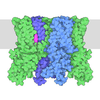
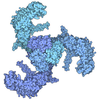
- Assembly
| Deposited unit | 
|
|---|---|
| 1 |
|
-Components
| #1: Protein | Mass: 99645.812 Da / Num. of mol.: 4 Source method: isolated from a genetically manipulated source Source: (gene. exp.) Rattus norvegicus (Norway rat) / Gene: Trpv1, Vr1, Vr1l / Cell line (production host): HEK293 / Production host:  Homo sapiens (human) / References: UniProt: O35433 Homo sapiens (human) / References: UniProt: O35433#2: Chemical | ChemComp-A1D92 / Mass: 158.139 Da / Num. of mol.: 4 / Source method: obtained synthetically / Formula: C3H2N4O2S Has ligand of interest | Y | Has protein modification | Y | |
|---|
-Experimental details
-Experiment
| Experiment | Method: ELECTRON MICROSCOPY |
|---|---|
| EM experiment | Aggregation state: PARTICLE / 3D reconstruction method: single particle reconstruction |
- Sample preparation
| Component | Name: Structure of rat TRPV1 in complex with PSFL426-S5 / Type: COMPLEX / Entity ID: #1 / Source: RECOMBINANT |
|---|---|
| Source (natural) | Organism: Rattus norvegicus (Norway rat) |
| Source (recombinant) | Organism: Homo sapiens (human) / Cell: HEK293 |
| Buffer solution | pH: 8 |
| Specimen | Embedding applied: NO / Shadowing applied: NO / Staining applied: NO / Vitrification applied: YES |
| Vitrification | Cryogen name: ETHANE |
- Electron microscopy imaging
| Experimental equipment |  Model: Titan Krios / Image courtesy: FEI Company |
|---|---|
| Microscopy | Model: TFS KRIOS |
| Electron gun | Electron source:  FIELD EMISSION GUN / Accelerating voltage: 300 kV / Illumination mode: FLOOD BEAM FIELD EMISSION GUN / Accelerating voltage: 300 kV / Illumination mode: FLOOD BEAM |
| Electron lens | Mode: BRIGHT FIELD / Nominal defocus max: 1600 nm / Nominal defocus min: 800 nm / Cs: 2.7 mm |
| Image recording | Average exposure time: 4.5 sec. / Electron dose: 50 e/Å2 / Film or detector model: GATAN K2 SUMMIT (4k x 4k) |
- Processing
| CTF correction | Type: PHASE FLIPPING AND AMPLITUDE CORRECTION |
|---|---|
| 3D reconstruction | Resolution: 3.5 Å / Resolution method: FSC 0.143 CUT-OFF / Num. of particles: 15808 / Symmetry type: POINT |
