 Movie
Movie Controller


+ Open data

- Basic information
| Entry | Database: PDB / ID: 9i91 | |||||||||
|---|---|---|---|---|---|---|---|---|---|---|
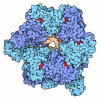
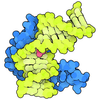
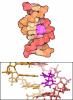
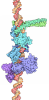
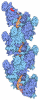
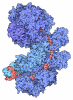
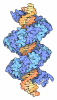
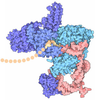
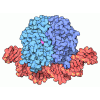
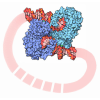
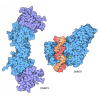
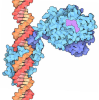
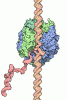
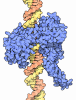
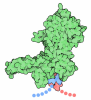
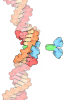
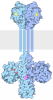
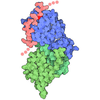
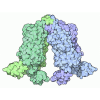
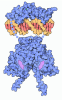
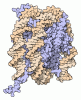
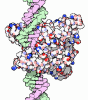
| Title | Ku from Mycobacterium tuberculosis bound to DNA | |||||||||
 Components Components |
| |||||||||
 Keywords Keywords | DNA BINDING PROTEIN / DNA repair / tuberculosis / NHEJ | |||||||||
| Function / homology |  Function and homology information Function and homology informationDNA helicase complex / positive regulation of ligase activity / double-strand break repair via nonhomologous end joining / double-stranded DNA binding / DNA recombination / protein homodimerization activity Similarity search - Function | |||||||||
| Biological species |   Mycobacterium tuberculosis (bacteria) Mycobacterium tuberculosis (bacteria)DNA molecule (others) | |||||||||
| Method | ELECTRON MICROSCOPY / single particle reconstruction / cryo EM / Resolution: 2.96 Å | |||||||||
 Authors Authors | Chaplin, A.K. / Zahid, S. | |||||||||
| Funding support |  United Kingdom, 2items United Kingdom, 2items
| |||||||||
 Citation Citation | Journal: Nat Commun / Year: 2025 Title: Oligomerisation of Ku from Mycobacterium tuberculosis promotes DNA synapsis. Authors: Sayma Zahid / Sonia Baconnais / Henrietta Smith / Saseela Atwal / Lucy Bates / Harriet Read / Ankita Chadda / Florian Morati / Tom Bedwell / Emil G P Stender / Joanne Walter / Steven W ...Authors: Sayma Zahid / Sonia Baconnais / Henrietta Smith / Saseela Atwal / Lucy Bates / Harriet Read / Ankita Chadda / Florian Morati / Tom Bedwell / Emil G P Stender / Joanne Walter / Steven W Hardwick / Fredrik Westerlund / Eric Galburt / Eric Le Cam / Alice Pyne / Galina V Mukamolova / Amanda K Chaplin /     Abstract: Mycobacterium tuberculosis (Mtb), the causative agent of tuberculosis (TB), is estimated to infect nearly one-quarter of the global population. A key factor in its resilience and persistence is its ...Mycobacterium tuberculosis (Mtb), the causative agent of tuberculosis (TB), is estimated to infect nearly one-quarter of the global population. A key factor in its resilience and persistence is its robust DNA repair capacity. Non-homologous end joining (NHEJ) is the primary pathway for repairing DNA double-strand breaks (DSBs) in many organisms, including Mtb, where it is mediated by the Ku protein and the multifunctional LigD enzyme. In this study, we demonstrate that Ku is essential for mycobacterial survival under DNA-damaging conditions. Using cryogenic electron microscopy (cryo-EM), we solved high-resolution structures of both the apo and DNA-bound forms of the Ku-Mtb homodimer. Our structural and biophysical analyses reveal that Ku forms an extended proteo-filament upon binding DNA. We identify critical residues involved in filament formation and DNA synapsis and show that their mutation severely impairs bacterial viability. Furthermore, we propose a model in which the C-terminus of Ku regulates DNA binding and loading and facilitates subsequent recruitment of LigD. These findings provide unique insights into bacterial DNA repair and guide future therapeutics. | |||||||||
| History |
|
- Structure visualization
| Structure viewer | Molecule: MolmilJmol/JSmol |
|---|
- Downloads & links
-Download
| PDBx/mmCIF format | 9i91.cif.gz | 322.5 KB | Display | PDBx/mmCIF format |
|---|---|---|---|---|
| PDB format | pdb9i91.ent.gz | 247.6 KB | Display | PDB format |
| PDBx/mmJSON format | 9i91.json.gz | Tree view | PDBx/mmJSON format | |
| Others |  Other downloads Other downloads |
-Validation report
| Arichive directory | https://data.pdbj.org/pub/pdb/validation_reports/i9/9i91ftp://data.pdbj.org/pub/pdb/validation_reports/i9/9i91 | HTTPS FTP |
|---|
-Related structure data
| Related structure data |  52748MC M: map data used to model this data C: citing same article ( |
|---|---|
| Similar structure data |
-Links
 PDBj
PDBj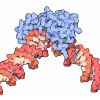
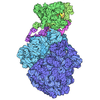
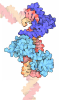
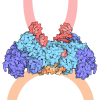
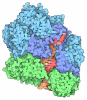


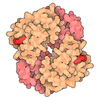
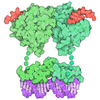
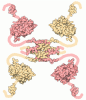
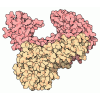
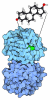
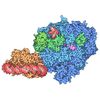
- Assembly
| Deposited unit | 
|
|---|---|
| 1 |
|
-Components
| #1: Protein | Mass: 33477.570 Da / Num. of mol.: 6 Source method: isolated from a genetically manipulated source Source: (gene. exp.) Mycobacterium tuberculosis (bacteria) / Gene: mku, Rv0937c / Production host:  Escherichia coli (E. coli) / References: UniProt: P9WKD9 Escherichia coli (E. coli) / References: UniProt: P9WKD9#2: DNA chain | Mass: 9947.389 Da / Num. of mol.: 2 / Source method: obtained synthetically / Source: (synth.) DNA molecule (others) #3: DNA chain | Mass: 9738.257 Da / Num. of mol.: 2 / Source method: obtained synthetically / Source: (synth.) DNA molecule (others) #4: Water | ChemComp-HOH / |  Mass: 18.015 Da / Num. of mol.: 4 / Source method: isolated from a natural source / Formula: H2O Mass: 18.015 Da / Num. of mol.: 4 / Source method: isolated from a natural source / Formula: H2OHas protein modification | N | |
|---|
-Experimental details
-Experiment
| Experiment | Method: ELECTRON MICROSCOPY |
|---|---|
| EM experiment | Aggregation state: FILAMENT / 3D reconstruction method: single particle reconstruction |
- Sample preparation
| Component | Name: KuTB-DNA complex / Type: COMPLEX / Entity ID: #1-#3 / Source: RECOMBINANT | |||||||||||||||||||||||||
|---|---|---|---|---|---|---|---|---|---|---|---|---|---|---|---|---|---|---|---|---|---|---|---|---|---|---|
| Source (natural) | Organism: Mycobacterium tuberculosis (bacteria) | |||||||||||||||||||||||||
| Source (recombinant) | Organism: Escherichia coli (E. coli) | |||||||||||||||||||||||||
| Buffer solution | pH: 8 | |||||||||||||||||||||||||
| Buffer component |
| |||||||||||||||||||||||||
| Specimen | Embedding applied: NO / Shadowing applied: NO / Staining applied: NO / Vitrification applied: YES | |||||||||||||||||||||||||
| Specimen support | Grid material: COPPER / Grid mesh size: 300 divisions/in. / Grid type: Quantifoil R1.2/1.3 | |||||||||||||||||||||||||
| Vitrification | Instrument: FEI VITROBOT MARK IV / Cryogen name: ETHANE / Humidity: 100 % / Chamber temperature: 277 K |
- Electron microscopy imaging
| Experimental equipment |  Model: Titan Krios / Image courtesy: FEI Company |
|---|---|
| Microscopy | Model: TFS KRIOS |
| Electron gun | Electron source:  FIELD EMISSION GUN / Accelerating voltage: 300 kV / Illumination mode: FLOOD BEAM FIELD EMISSION GUN / Accelerating voltage: 300 kV / Illumination mode: FLOOD BEAM |
| Electron lens | Mode: BRIGHT FIELD / Nominal defocus max: 2200 nm / Nominal defocus min: 700 nm / Cs: 2.7 mm / C2 aperture diameter: 50 µm |
| Image recording | Electron dose: 50 e/Å2 / Film or detector model: GATAN K3 BIOQUANTUM (6k x 4k) |
- Processing
| EM software | Name: PHENIX / Category: model refinement | ||||||||||||||||||||||||
|---|---|---|---|---|---|---|---|---|---|---|---|---|---|---|---|---|---|---|---|---|---|---|---|---|---|
| CTF correction | Type: PHASE FLIPPING AND AMPLITUDE CORRECTION | ||||||||||||||||||||||||
| 3D reconstruction | Resolution: 2.96 Å / Resolution method: FSC 0.143 CUT-OFF / Num. of particles: 147904 / Symmetry type: POINT | ||||||||||||||||||||||||
| Refinement | Cross valid method: NONE Stereochemistry target values: GeoStd + Monomer Library + CDL v1.2 | ||||||||||||||||||||||||
| Displacement parameters | Biso mean: 161.18 Å2 | ||||||||||||||||||||||||
| Refine LS restraints |
|
